reshoring
(12)
Bret Boyd Is Building the Missing Switchboard for American Manufacturing
After four Iraq deployments and a career spent watching organizations wrestle with change, the Sustainment co-founder has chosen an unglamorous but consequential target: the friction keeping 250,000 American manufacturers apart.
The Firm Buying Back America's Factory Floor - Then Handing It to the Workers
Two brothers watched private equity buy their father's factory and shut it down. Their answer was to build a manufacturing group that ends with the employees owning the whole thing.
The 750-Acre Bet: How a Chinese Owner Talked Americans Into Building Washers in Kentucky Again
General Electric sold its appliance business to a Chinese buyer and expected quiet decline. Instead, Haier handed the keys to the people running the machines - and GE Appliances started pouring billions back into Kentucky.

Duranium
Duranium is a Y Combinator (S25) advanced-materials company reshoring U.S. production of critical metals - titanium, magnesium, aluminum, zirconium and hafnium. It modernizes carbochlorination metallurgy with a novel reactor that recirculates CO and chlorine streams back into feedstock and spins off a saleable co-product (bleaching agents/hypochlorite), aiming to match Chinese-level pricing without subsidies while eliminating direct emissions. Founded in 2025 by CEO Brenden Prins-McKinney and CTO Berkley Noble, the company targets a pilot facility by June 2026 and roughly 12% of the U.S. magnesium market by 2029.
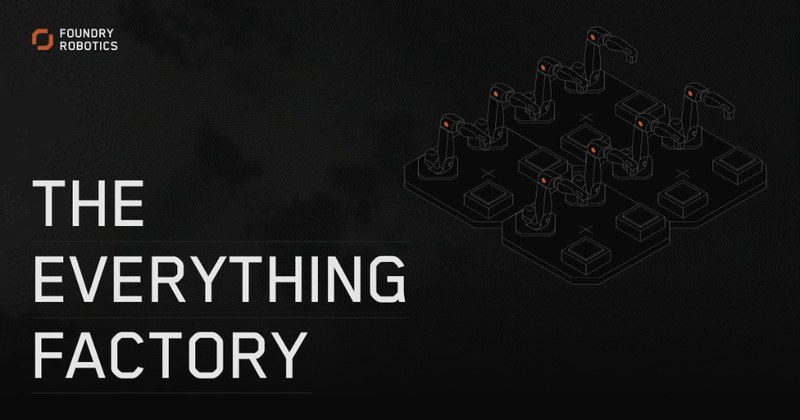
Foundry Robotics
Foundry Robotics is a San Francisco startup building 'The Everything Factory' - an AI-first, assembly-focused contract manufacturer that uses Vision-Language-Action (VLA) foundation models to run flexible robotic assembly cells. Instead of retooling a line for every new product, Foundry aims to let general-purpose robots switch between building drones, robot dogs, battery packs and satellite components on demand. Founded in 2025 by ex-Ghost Robotics and Scale AI robotics lead Adarsh Kulkarni, the company positions itself as a dual-use manufacturer serving both commercial customers and the U.S. Department of Defense, backed by a seed round led by Khosla Ventures and Garuda Ventures.

Laborup
Laborup is a Knoxville, Tennessee startup building an AI-powered recruiting platform for America's skilled industrial workforce - the machinists, welders, and maintenance techs that keep factories running. Founded in 2024 by former Stanford AI researcher Tasimba 'Simba' Jonga, it uses voice-first AI agents to interview and profile blue-collar workers in minutes, then matches employers to a vetted network of thousands of tradespeople. The company pitches itself as the 'LinkedIn of manufacturing,' promising faster time-to-fill, lower cost-per-hire, and better retention, and has raised roughly $7.7M in total funding.

Brenden Prins-McKinney
Brenden Prins-McKinney is the co-founder and CEO of Duranium (YC S25), an Alameda, California company working to bring critical light metal production - titanium, magnesium, aluminum, zirconium and hafnium - back to American soil. A Stanford Law graduate and Knight-Hennessy Scholar with a research background at McKinsey and a stint as a Goldman Sachs banker, he advised the Department of Defense on reshoring critical chemical production before deciding to build the supply chain himself. He pairs a policy-and-finance brain with chemistry borrowed from the 1950s, modernized so the U.S. can make metals it currently buys almost entirely from China and Russia.

James Crean
James Crean is the co-founder and Chief Visionary Officer (also serving as President/CTO) of CREAN Inc, an Austin, Texas aerospace engineering and smart factory firm he started in 2002 with his wife Jennifer. A former satellite systems engineer and program manager at Hughes Space & Communications and Boeing - where he worked on DirecTV, NASA's TDRSS and other communications and weather satellites, and built the Lean Six Sigma group for Boeing Satellites - Crean now leads a team of 600-plus aerospace and defense engineers and champions CREAN's AI-enabled Smart Factory Operating System (SFOS), which aims to make American high-mix manufacturing fast, flexible and competitive enough to bring production home from overseas.
Build Block
Build Block is a Korea-founded real estate company that gives Korean investors and companies a single, end-to-end path into the U.S. property market. What began as a cross-border investment platform lowering the barrier for individual Asian investors has grown into a full-stack operator: brokerage, architectural design and permitting, construction management as a general contractor, and post-investment asset and facility management. Today it also builds the physical backbone of the AI economy - data centers and EPC plants for semiconductor, battery, and advanced manufacturing - for Korean firms reshoring to the United States.

Seurat Technologies
Seurat Technologies is a Massachusetts-based contract metal manufacturer built around Area Printing, a laser powder bed fusion process invented at Lawrence Livermore National Laboratory. Instead of melting metal powder one point at a time, Seurat uses millions of tiny laser points to print entire areas at once, decoupling resolution from speed. The company doesn't sell printers; it runs its own clean-energy print factories and sells finished parts at costs meant to rival casting, forging, and machining, with the goal of reshoring high-volume metal manufacturing and cutting its carbon footprint.

James DeMuth
James DeMuth is the co-founder and CEO of Seurat Technologies, a Wilmington, Massachusetts metal additive manufacturing company chasing a single audacious goal: printing metal parts fast and cheap enough to compete with mass production, then planting factories next to the customers who need them. He co-invented Seurat's Area Printing technology while working on laser fusion research at Lawrence Livermore National Laboratory, holds a hand in roughly 145 patents, and has raised more than $181 million to reshore manufacturing and cut carbon out of how metal gets made.

Excelsior Sciences
Excelsior Sciences is a New York City biotech building 'machine-native chemistry' - a way to make small molecules that machines can execute and AI can learn from. Its proprietary smart bloccs platform turns drug synthesis into a modular, automation-friendly, iterative process, closing the loop between AI-driven discovery and real-world manufacturing. Founded in 2024 and spun out of Deerfield Management, the company raised $95M in late 2025 to scale the platform and reshore U.S. drug discovery and production.