Tagged: onboarding
26 results
MyPass Global
MyPass Global is an Australian B2B SaaS company that runs a worker-owned digital Skills Passport and compliance platform for highly regulated, high-risk industries such as mining, oil and gas, energy and construction. Workers store verified qualifications, licences, medicals and background checks in one place and grant employers permission to view them, while site owners and contractors get real-time visibility of workforce compliance. Founded by Matt Smith and headquartered in Perth and Sydney, the platform serves more than 1,500 organisations and over 160,000 verified workers, and raised a A$7.5M Series A led by OneVentures in February 2025 to expand across the Americas.

palm.hr
palm.hr is a Riyadh-born, cloud-based HR and payroll platform built for small and mid-sized businesses across Saudi Arabia and the wider GCC. It brings employee data, time and attendance, WPS-compliant payroll, and employee engagement into one system that plugs directly into local government rails like GOSI and Mudad, so companies can run people operations that comply with regional labor law out of the box. Founded in 2019, it raised a $5M pre-Series A in 2023 to expand across MENA and pairs its software with an outsourced HR concierge service.

ZenHR
ZenHR is a cloud-based Human Resources Management System (HRMS) built specifically for the Middle East, North Africa and Gulf region. It automates payroll, attendance, onboarding, performance and recruitment while staying compliant with local labor laws, social insurance (GOSI), and wage protection (WPS) rules. Founded in 2016 and headquartered in Riyadh, ZenHR serves companies from small businesses to large enterprises across markets including Saudi Arabia, the UAE, Egypt, Jordan, Kuwait and Iraq.

Footprint
Footprint is a New York-based identity and risk-operations company that unifies KYC, KYB, fraud detection, authentication, and secure data vaulting into a single platform for banks, fintechs, and marketplaces. Founded in 2022 by Eli Wachs and Alex Grinman, it aims to make verified identity portable across the internet - so a person proves who they are once and reuses that verification everywhere - while using AI agents (its Percy product) to automate manual fraud and compliance review.

Greenhouse Software
Greenhouse Software is a New York-based hiring platform that helps companies run structured, data-driven recruiting. Founded in 2012 by Daniel Chait and Jon Stross, it centralizes applicant tracking, interview scorecards, candidate sourcing, onboarding and reporting into one system used by more than 7,500 organizations. Rather than pushing automation for its own sake, Greenhouse pitches 'structured hiring' - a consistent, comparable process for evaluating candidates - and has layered in AI tools and fraud detection to keep that process reliable as application volumes surge.

Multiplier
Multiplier is a global employment platform that lets companies hire, onboard, pay and manage full-time employees and contractors in 150+ countries without setting up local entities. Founded in 2020 in Singapore, it bundles Employer of Record (EOR), Contractor of Record, global payroll, PEO and HRIS tooling into one dashboard, handling local labor contracts, tax, benefits and compliance so distributed teams can operate legally across borders.

Vitally
Vitally is a New York-based customer success platform for B2B SaaS companies. It unifies product usage, billing, CRM and support data into a single workspace so customer success managers can score account health, automate playbooks, collaborate with customers and cut churn. Its AI Copilot layers summaries, meeting notes and natural-language insights on top of that data. Founded in 2017 by Jamie Davidson and Patrick Vatterott out of Techstars NYC, Vitally has raised roughly $40 million and counts Zapier, Productboard, Mixpanel and Gorgias among its customers.

Eli Wachs
Eli Wachs is the co-founder and CEO of Footprint, a New York identity verification company building what he calls the identity layer for the internet. Footprint helps banks, real estate firms, auto dealers, and other businesses onboard customers by automating KYC and fraud checks while storing personal data inside secure enclaves. A Stanford economics and history graduate and former General Atlantic investor, Wachs started the company in 2022 with CTO Alex Grinman and has raised roughly $20 million to pursue a blunt goal: reduce digital identity theft toward zero while giving people more control over their own data.

Fountain
Fountain is a San Francisco-based software company that builds an AI-native hiring and workforce-management platform for the frontline - the hourly, deskless, high-turnover workers who staff restaurants, warehouses, retail floors, delivery fleets, hospitals and factories. Founded in 2014, its platform sources, screens, hires, onboards and schedules workers at high volume, and it has moved aggressively toward autonomous 'agentic' AI with products like Frontline OS and its orchestrator agent Cue. Fountain says it helps more than 500 employers hire well over a million frontline workers a year, and counts brands such as Chipotle, Stitch Fix, GoPuff and Just Eat Takeaway among its customers.

StandardC
StandardC is a San Francisco fintech that builds compliance and risk-management software for banks, credit unions and other financial institutions serving high-risk, cash-intensive industries - most notably cannabis-related businesses. Its AI-assisted platform bundles onboarding (ApplyC), KYC/KYB screening and continuous monitoring (MonitorC), GPS-verified virtual site inspections (VerifyC) and examiner-ready audit logging so smaller institutions can bank regulated sectors without drowning in manual BSA/AML work.

Parcha
Parcha is a San Francisco AI company building enterprise-grade AI agents that automate compliance and operations work for banks and fintechs. Founded in 2023 by former Brex leaders AJ Asver and Miguel Rios-Berrios, its Agent Hub platform lets compliance teams create, test, and deploy agents in minutes to run KYC/KYB reviews, enhanced due diligence, AML screening, and document verification - work that traditionally requires large operations teams. Backed by $5M in seed funding led by Kindred Ventures and Initialized Capital, Parcha counts fintechs like Bridge, Airwallex, Flutterwave, and Pipe among its users.

Pastel
Pastel builds agentic AI for banking operations, aimed at the regional, mid-tier, and community banks that most fintech innovation skips over. Its flagship platform, Sigma, deploys AI agents across customer onboarding, due diligence, fraud detection, anti-money laundering, screening, and executive reporting - trained on local data and regulations rather than retrofitted Western systems. Founded by Stanford graduate students and rooted in African markets, Pastel started as a small-business bookkeeping tool called Sabi before pivoting into compliance infrastructure for financial institutions.

Prelim
Prelim is a San Francisco-based fintech building white-labeled, no-code software that helps banks and credit unions open deposit accounts, originate loans, and service customers online. Founded in 2017 by Heang Chan and Chris Blaser out of Y Combinator, Prelim powers consumer and business onboarding for institutions like First Republic, Pacific Western, and City National Bank of Florida, with 50+ integrations into core banking systems.

Trulioo
Trulioo is a Vancouver-based global identity platform that helps banks, fintechs, marketplaces and crypto firms verify both people and businesses in seconds. Through a single API it combines KYC, KYB, AML watchlist screening, document and biometric verification, and credit decisioning, drawing on data sources that reach billions of people and hundreds of millions of businesses worldwide. The pitch is simple: prove who - and what - you are dealing with, anywhere on earth, without stitching together a dozen regional vendors.

Guidde
Guidde is an AI-powered video documentation platform that turns a screen recording into a polished, narrated how-to video in minutes. Used by 4,500+ companies including Nasdaq, Yahoo, Bayer and SentinelOne, Guidde positions itself as the connective tissue between employees and the enterprise software they have to learn fast.

Homebase
Homebase is a San Francisco-based workforce management platform built for small businesses running hourly teams. Founded in 2014, it combines employee scheduling, time tracking, payroll, HR compliance, and team communication in one mobile-first app. As of 2024, the platform serves over 150,000 businesses and 3.8 million hourly workers, having logged 8 billion hours and processed $3 billion in gross payroll. Backed by $198 million in total funding, Homebase competes by bundling tools that small business owners previously paid for separately - and more recently by embedding AI assistants across hiring, scheduling, and payroll.

Humand
Humand is a mobile-first, all-in-one HR platform built for the 2.7 billion deskless and frontline workers who have never had a proper digital work home. Founded in 2020 by Nicolas Benenzon and Geronimo Maspero, the platform combines 30+ HR modules - from internal communications and payroll to performance reviews and AI-powered automation - into a single app. With 1.6 million workers across 1,500+ organizations in 51 countries, and a $66M Series A raised in February 2026 co-led by Kaszek and Goodwater Capital, Humand is positioning itself as the operating system for the world's largest workforce segment.

Incode
Incode is an AI-powered identity verification platform that lets businesses confirm who is really on the other side of a screen — in under two seconds. Founded in San Francisco in 2015, the company has built a modular biometric platform used by banks, hotels, hospitals, and gaming companies across more than 190 countries. Its flagship product, Incode Omni, handles everything from document verification and facial recognition to AML screening and liveness detection, processing more than 100 million user verifications per year. Backed by General Atlantic, SoftBank, J.P. Morgan, and Capital One Ventures at a $1.25 billion valuation, Incode has been named a Gartner Magic Quadrant Leader for Identity Verification two consecutive years running.

Middesk
Middesk is a San Francisco-based business identity platform that helps banks, fintechs, lenders, and marketplaces verify the businesses they transact with. Its KYB APIs turn the slow, paper-heavy process of vetting a company into a real-time decision, powering onboarding at firms like Brex, Plaid, Mercury, Gusto, Affirm, and Shopify.

Kyle Mack
Kyle Mack is the CEO and Co-founder of Middesk, the business identity platform that's modernizing how financial institutions and fintechs verify and trust the companies they work with. Founded in 2018 after Mack witnessed firsthand the painful manual process of customer credentialing at Checkr, Middesk has grown into a category-defining KYB infrastructure company backed by Sequoia Capital, Accel, Insight Partners, and Canapi Ventures with $77M+ in total funding. The company serves hundreds of enterprise clients - including two of the top three U.S. banks and fintechs like Plaid, Affirm, Brex, and Shopify - by connecting to roughly 400 U.S. government agencies to surface real-time business identity intelligence. Mack is also a Sequoia Scout, investing in early-stage founders.

Max Wang
Max Wang is the Co-Founder and CTO of Workstream, a San Francisco-based HR and payroll platform built specifically for America's hourly workforce. He co-founded China's AngelList equivalent (VC.CN) in 2011, built it to a 50-person team, then crossed the Pacific to co-build Workstream with Desmond Lim and Lei Xu after a 100-interview discovery sprint revealed that hiring hourly workers was a massive unsolved problem. Today, Workstream serves 4,000+ businesses across 24,000 locations, has raised $118 million, and is deploying AI tools - including VoiceAI - to compress hiring cycles from weeks to hours for restaurants, franchises, and deskless-workforce employers.

Persona
Persona is a San Francisco-based identity infrastructure company that helps businesses verify people - and increasingly, AI agents - online. Its configurable platform powers KYC, KYB, AML, age verification, and ongoing trust-and-safety workflows for fintechs, marketplaces, crypto exchanges, and AI platforms across 200+ countries.
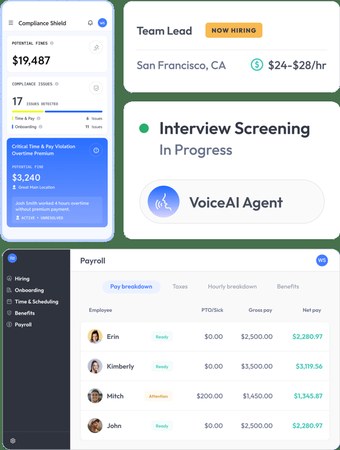
Workstream
Workstream is an HR, hiring and payroll platform built for the deskless economy - the 80 million Americans who clock in by the hour at restaurants, gyms, car washes and franchises. Founded in 2017 by three immigrants in San Francisco, it uses texting, voice AI and automation to cut time-to-hire by roughly 70% for chains like Burger King, Jimmy John's and Chick-fil-A franchisees.

Heang Chan
Heang Chan is the CEO and Co-Founder of Prelim, a San Francisco-based fintech that builds the digital onboarding operating system for banks and credit unions. A Stanford MBA and former Goldman Sachs banker who also helped build the mortgage platform at Blend used by 3 of the top 10 U.S. banks, Chan founded Prelim in 2017 after Y Combinator to solve the friction-filled account-opening workflows he watched slow down banks from the inside. Prelim now orchestrates 50+ banking integrations for institutions managing more than $5 trillion in assets, turning weeks-long onboarding into minutes.

Val Geisler
Val Geisler is a lifecycle marketing strategist and VP of Partner Programs at Digioh, best known for founding Fix My Churn and creating the 'Dinner Party Strategy' — a behavior-driven email onboarding framework that has powered 209% conversion lifts for SaaS and ecommerce brands. With 12+ years at the intersection of customer empathy and marketing systems, she has built advocacy programs at Klaviyo, grown retention email to 25% of company revenue at ByHeart, and hosted the Ecommerce Marketing School podcast. Her philosophy: emails are relationships, not broadcasts.

Zeroframe
Zeroframe is the company behind Andoria, an AI-powered customer onboarding agent that learns how web applications work and generates personalized walkthroughs for users who get stuck. Founded in San Francisco in 2024 by Daryl Budiman and Anirudh Ramprasad - two former MultiOn engineers who helped scale that AI startup to a triple-digit million-dollar valuation in under nine months - Zeroframe's flagship product drops into any web app with a single script tag and autonomously shows users exactly what to do, reducing churn by turning confusion into clarity.