The Company
The shift manager at Domino's has never opened a company portal. Humand is fixing that.
Picture the average Domino's shift manager on a Tuesday night. She manages twelve people, processes their time-off requests through WhatsApp, has never seen her employment contract digitally, and found out about the new benefits plan from a paper flyer taped to the break room wall. This is not an edge case. This is most of the working world.
Humand is a San Francisco-based HR platform built specifically for the workers enterprise software has historically ignored: the cashier, the warehouse picker, the construction foreman, the hotel housekeeper. Together, these people represent 80% of the global workforce - around 2.7 billion people. They are also the last major segment of the economy that has not been given a proper digital tool.
"80% of the global workforce is deskless. They're the ones keeping the lights on - and they've been completely ignored by enterprise software."
Nicolas Benenzon, CEO & Co-Founder, Humand
As of 2026, Humand serves 1.6 million of those workers across 1,500+ organizations in 51 countries. Its customers include Siemens, Home Depot, Domino's, MINISO, OXXO (Mexico's 20,000-location convenience chain), Chili's, ArcelorMittal, and Sodexo. In February 2026, it closed a $66 million Series A co-led by Kaszek Ventures and Goodwater Capital - one of the larger HR-tech funding rounds for a Latin American-founded startup.
The Problem
Workday was never designed for someone without a laptop.
The HR software market has produced genuinely impressive tools over the past two decades. Workday, BambooHR, Rippling, Lattice - sophisticated platforms with mobile apps as afterthoughts, built for the analyst or manager sitting at a screen eight hours a day. The frontline worker, who often doesn't have a company email address and runs their shift from a phone, is an edge case these platforms were not engineered around.
The consequences are not merely inconvenient. Without a proper HR platform, frontline workers receive communications via paper, group chats, or shouted announcements. Onboarding happens informally - if at all. Performance reviews are rare or nonexistent. Employee recognition is improvised. Benefits go unclaimed because nobody knows they exist. HR departments managing thousands of non-desk workers are, in practice, still running on clipboards.
The deskless workforce - warehouse workers, retail staff, nurses, delivery drivers, hospitality employees - makes up 80% of global employment. Less than 1% of enterprise software investment was directed at them before 2020.
This is the tension at the center of Humand's existence: an enormous, underserved workforce with real HR needs, and a technology industry that has spent twenty years solving the much smaller problem of the knowledge worker.
The Founders
Two engineers from Buenos Aires who met at a Mercado Libre talk and never stopped talking.
Nicolas Benenzon (CEO) and Geronimo Maspero (CTO) met at ITBA - the Instituto Tecnologico de Buenos Aires - at a talk by Marcos Galperin, the founder of Mercado Libre. Both were computer engineering students with an itch for startups. Both went on to study entrepreneurship and innovation at MIT. They co-ran the ITBA Entrepreneurs Club together, won hackathons, and in 2020 decided to build a company rather than win another competition.
Nicolas Benenzon
CEO & Co-Founder
Computer engineer from ITBA Buenos Aires, entrepreneurship & innovation from MIT. A programmer since childhood who shifted from winning hackathons to building the platform that closed a $66M Series A in 2026.
Geronimo Maspero
CTO & Co-Founder
Also a childhood programmer with computer engineering from ITBA and MIT entrepreneurship credentials. Leads the technical architecture of a platform now running 30+ integrated HR modules at enterprise scale.
Their founding instinct was that internal communications inside companies - particularly for large hourly workforces - were broken in ways that digital tools hadn't addressed. Humand started as a communications tool and expanded outward, one module at a time, until it had built what amounts to a complete HR operating system on mobile.
The Platform
Thirty-something HR modules. One app. No desktop required.
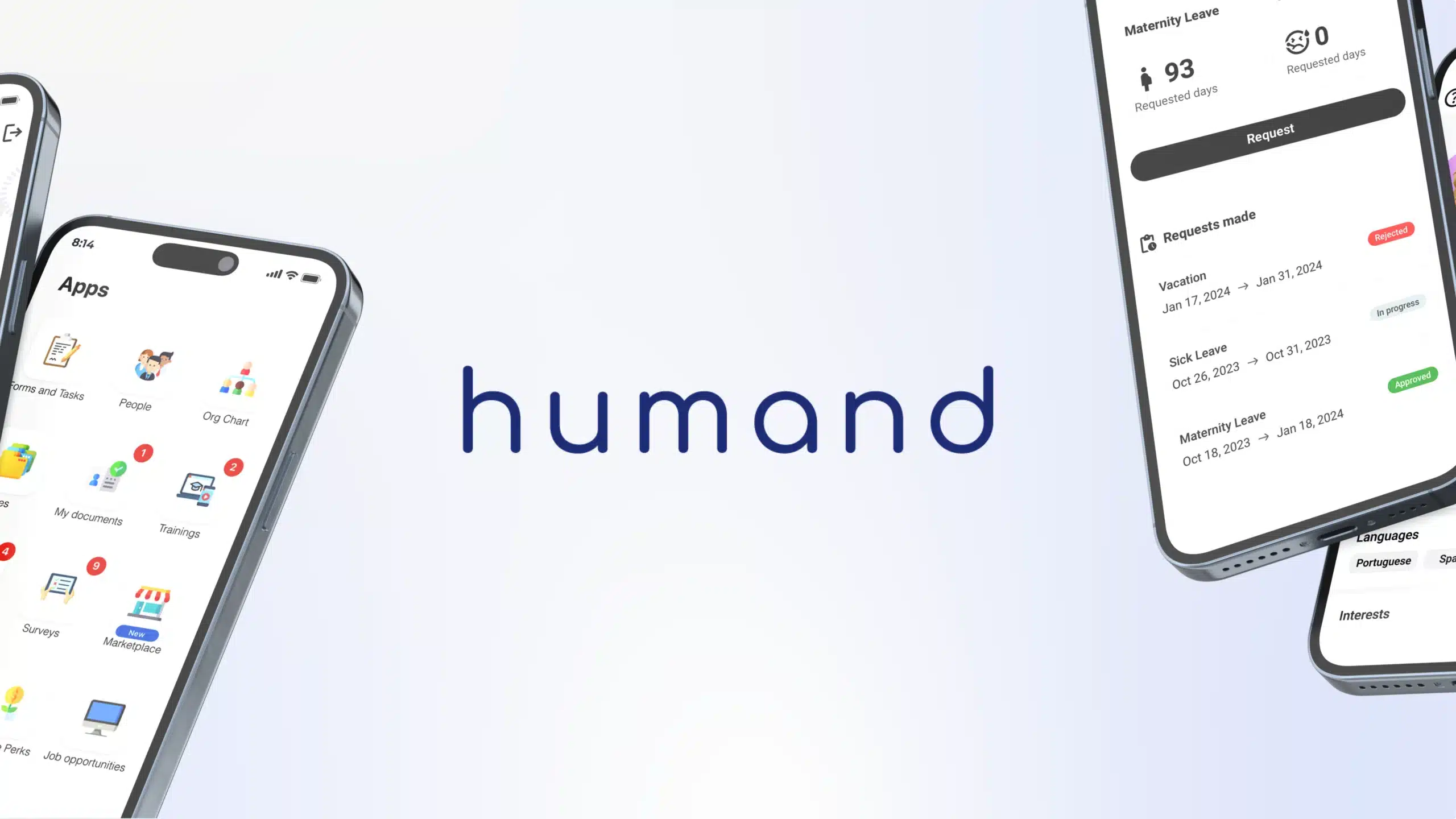
Humand's platform is structured around a simple premise: every HR interaction a frontline worker might need - from requesting time off to reading a company policy to getting recognized for a good month - should happen in one place, on the device they already carry. The result is a product that looks like a social app and functions like a complete HR department.
💬
Internal Communications
Social feed, segmented announcements, digital magazine, and live streaming for company events
🤖
Sammy AI
Natural language AI assistant that answers HR questions, processes requests, and automates onboarding
📋
Performance & OKRs
Goal tracking, 360 feedback, development planning, and performance cycles for frontline teams
🏆
Recognition
Peer-to-peer kudos, manager recognition, gamification, and employee of the month programs
📚
Training & LMS
Mobile-first learning management for onboarding, compliance, and skills development
⏰
Time & Scheduling
Leave management, time tracking, shift scheduling - without requiring a kiosk or desktop
📁
Digital HR Files
Contracts, paystubs, digital signatures, and document management - all mobile-accessible
📊
Surveys & Analytics
Pulse surveys, engagement tracking, and HR analytics dashboards for people teams
The Sammy AI integration, announced alongside the Series A in 2026, takes the platform further: employees can ask HR questions in natural language and get immediate answers, file requests, and trigger automated workflows without needing to find the right form or wait for an HR response.
"Humand started as an internal communication tool and evolved into a full HR operating system because frontline workers needed more than a company newsletter."
Nicolas Benenzon, CEO & Co-Founder, Humand
Milestones
From Buenos Aires hackathons to a $66M raise in six years.
2016
The Meeting
Nicolas Benenzon and Geronimo Maspero meet at a Marcos Galperin (Mercado Libre founder) talk at ITBA Buenos Aires. They co-lead the university's Entrepreneurs Club and start winning hackathons together.
2020
Humand Founded
Benenzon and Maspero launch Humand, initially focused on internal communications for companies with large hourly workforces. The pandemic accelerates demand for digital work infrastructure.
Jan 2022
Y Combinator W22
Humand joins Y Combinator's Winter 2022 batch and is recognized as the fastest-growing startup in the cohort. Seed funding gives the platform international momentum.
2023-2024
Global Scale-Up
Humand expands to 10 global offices including New York, Madrid, London, Singapore, and Lima. Platform grows to 1,500+ organizations across 51 countries. Team reaches 510+ employees.
2025
1.6 Million Workers
Platform reaches 1.6 million active workers. Customer list now includes Siemens, Home Depot, MINISO, OXXO, Domino's, and Chili's. Annual revenue estimated at ~$49.8M.
Feb 2026
$66M Series A
Humand closes a $66M Series A co-led by Kaszek Ventures and Goodwater Capital. Notable angels include Arash Ferdowsi (Dropbox), Guillermo Rauch (Vercel), and Rajat Suri (Lyft). Plans: US expansion, AI acceleration.
The Proof
The numbers are not modest.
Humand's growth trajectory is not a venture-capital-funded illusion. The platform serves real enterprise customers with real frontline workforces - companies that need an HR tool that actually reaches their workers on the factory floor and the restaurant kitchen, not just the corporate office.
Deskless Workforce: Who Works Where (Global, 2024 est.)
Combined: ~2.7 billion workers globally without a laptop as primary work tool. Humand has reached 1.6M of them. The runway is real.
The customer list spans some of the most demanding frontline industries on earth. OXXO alone has over 20,000 convenience store locations across Latin America. Managing HR for tens of thousands of hourly workers - each with a different schedule, different local manager, and different communication preferences - is a problem that paper memos and WhatsApp groups cannot solve sustainably.
Siemens AG
Home Depot
Domino's Pizza
MINISO
OXXO
Chili's
ArcelorMittal
Tenaris
NSG Group
Ogilvy
Sodexo
Deere & Co.
Customers span retail, manufacturing, hospitality, and professional services - wherever frontline workers show up for a shift, Humand shows up on their phone.
Funding
$66 million to build the operating system for the world's largest workforce.
$66M
Series A - February 2026
Co-led by Kaszek Ventures and Goodwater Capital. Humand's total funding reaches $66.13M.
Kaszek Ventures
Goodwater Capital
Y Combinator
Arash Ferdowsi (Dropbox)
Guillermo Rauch (Vercel)
Rajat Suri (Lyft)
Martin Varsavsky
Newtopia VC
The investor roster is a tell. Arash Ferdowsi co-founded Dropbox, which built its business on the premise that file storage should be available to everyone, everywhere. Guillermo Rauch built Vercel, which made deploying web applications as frictionless as possible. The pattern is familiar: founders with a history of removing barriers to access, betting on a company that is removing barriers to HR infrastructure for the world's most overlooked workers.
The capital will fund accelerated US market expansion, growth across the 51 countries where Humand already operates, and development of its AI layer - beginning with Sammy, the conversational HR assistant that turns employee requests into automated workflows.
Mission
Empowering people at work - all the people, not just the ones with email addresses.
Humand's stated mission is to make workers happier and more successful by building relationships, fostering belonging, enabling recognition, and supporting continuous learning. These are not abstract corporate values. They are functional features: the recognition system, the training module, the social feed, the org chart. Everything maps back to the mission in a direct and traceable way.
There is also a market argument embedded in the mission. Employee engagement and retention are more expensive problems than most CFOs model. In high-turnover industries like retail, hospitality, and food service, replacing a single hourly worker costs anywhere from $1,500 to $4,500 when onboarding, training, and lost productivity are accounted for. An HR platform that reduces churn by even a few percentage points can generate meaningful ROI - which is why enterprise buyers are willing to license a mobile app for workers who have never had access to software before.
"With Kaszek and Goodwater leading this round, we're doubling down on AI and US expansion to become the default platform for frontline work."
Nicolas Benenzon, CEO & Co-Founder, Humand
What Humand has built, in practice, is a proof of concept for a category that most enterprise software companies assumed either didn't exist or wasn't worth addressing. The existence of 1,500 paying customers across 51 countries - including some of the world's largest employers of frontline workers - is a fairly convincing rebuttal.
Why It Matters
That Domino's shift manager will get the app eventually. The question is who builds it.
The opening scene: a shift manager with a stack of paper time-off requests, a WhatsApp group that doubles as an HR department, and a benefits package she's never seen digitally. That is the current state of frontline HR at a remarkable number of the world's largest employers.
Humand's argument - now backed by $66 million and a customer list that spans continents and industries - is that this situation is both fixable and worth fixing. A mobile-first platform built for workers who live on their phones, not their laptops. An AI layer that answers HR questions without requiring a ticket to be opened. A social feed that replaces the break room bulletin board. An org chart that actually reflects who works there.
By the time that shift manager finally opens the app, she'll have her contract, her paystubs, her performance review, and a direct channel to HR - all in one place. Humand will have gotten there before Workday noticed the opportunity. That's not a disruption narrative. It's a market gap that a well-funded, fast-growing company is quietly closing, one shift at a time.
Links & Resources
More on Humand