YesPress Profile ■ Founder ■ Engineer ■ Investor
Founder & CEO, Vercel
"Programming is my main hobby" - and also his $9.3 billion company.
Guillermo Rauch is the kind of person who makes you question whether school ever mattered. Born in Lanús, a working-class suburb of Buenos Aires, he was building websites for Dutch entrepreneurs at 13, dropping out of one of Argentina's most prestigious high schools at 17 to join a startup in Lausanne, and writing code that would eventually run on hundreds of millions of devices by the time most people his age were finishing their degrees.
Today he runs Vercel, a $9.3 billion company that hosts and deploys the web applications of Netflix, TikTok, ChatGPT, Nike, the Washington Post, and thousands of startups. He co-created Next.js, the framework that engineers at those companies reach for first. He invented Socket.IO, the invisible library powering every real-time chat window and live dashboard you've used in the last decade. And he did it all while insisting - with total sincerity - that programming is just his hobby.
That combination of technical depth and founder instinct is not common. The ability to write a library that 500,000 developers use while simultaneously building the commercial platform that monetizes it - releasing both as open source and then charging for the cloud layer - is a business strategy that sounds obvious only after someone has already done it. Rauch did it. Twice, if you count Socket.IO and Vercel separately. Three times if you count Mongoose.
He is, in the most literal sense, self-made: no CS degree, no famous university lab, no Silicon Valley internship. He clawed his way into the developer community through open-source contributions on MooTools, built a reputation line by line, and parlayed that reputation into a career trajectory that eventually deposited him on the cover of tech media as one of the defining infrastructure founders of his generation.
And he is not done. In 2025, Vercel raised $300 million at a $9.3 billion valuation. Its ARR went from $100 million at the start of 2024 to a $340 million run rate by early 2026. AI agents now account for 30% of apps deployed on its platform. Rauch is openly signaling IPO readiness. The working-class kid from the outskirts of Buenos Aires is positioning his company to go public - and he'll almost certainly still be writing code the morning it lists.
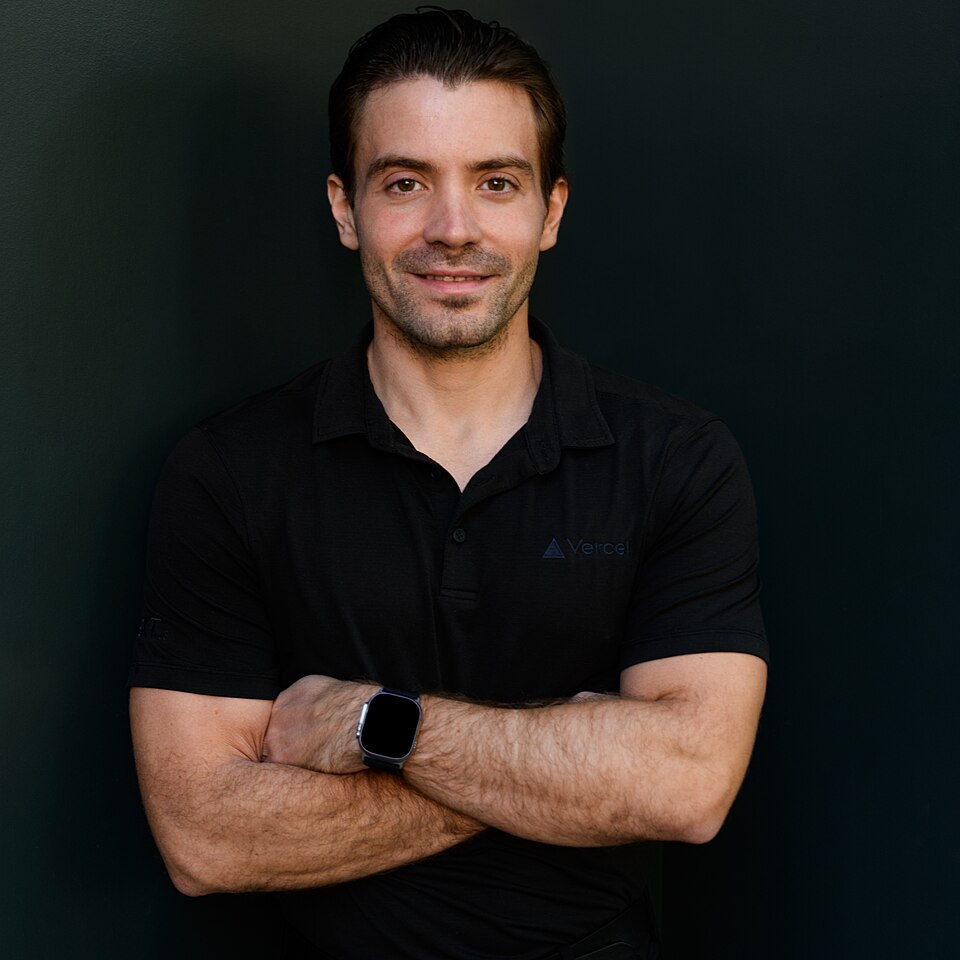
Open source is the best thing that's ever happened to me. It was the most open platform for learning in the world.- Guillermo Rauch
From $100M at the start of 2024. That's 3.4x growth in roughly 24 months.
Vercel's AI SDK is the company's fastest-growing open-source project - 3 million downloads per week.
Nearly a third of all applications deployed on Vercel are now built by AI agents. Two years ago that number was zero.
The first computers Rauch touched were running Windows, and he hated them. Specifically, he hated trying to compile a C program on Windows - the toolchain setup alone was maddening enough to send him looking for alternatives. He found Linux. Linux led to open source. Open source led to MooTools, a JavaScript UI library that needed contributors. And MooTools led to a full-time engineering job at 18 without a college degree.
That chain of frustration - from a broken compiler to a billion-dollar company - is very Guillermo Rauch. He does not sit with problems. He builds around them. His father, himself an engineer, planted an early seed: "If you are not combining these other industries with software, then we are not going to be effective long term." Rauch took that seriously. He combined everything with software.
At 13, while most kids his age were thinking about football, he was building one of the first browser-based interactive calorie counters for an entrepreneur in the Netherlands. By 16, he was a recognized figure in the online developer community - known not from school, but from pull requests. When a startup in Lausanne, Switzerland came calling at 17, he did the math and left Carlos Pellegrini High School, one of Argentina's most prestigious institutions, without a second thought.
The real-time event library that became the de facto standard for WebSocket connections in Node.js. Every chat window, live sports score, and collaborative document you've touched in the past decade probably has Socket.IO in its stack - and most people who use it have no idea who made it.
MongoDB's most popular object modeling library for Node.js. Mongoose turned a flexible document database into something structured enough for production apps. Millions of applications are built on top of it. Like Socket.IO, it was released into the wild for free.
Co-created and launched at ViennaJS on October 25, 2016. Now the world's most popular React framework, used by Netflix, TikTok, Uber, and ChatGPT. It introduced server-side rendering, file-based routing, and static generation to a generation of developers who had been wrangling these problems by hand.
Founded in 2015 as ZEIT. Renamed Vercel in 2020. The frontend cloud where Next.js lives commercially: deploy in seconds, global edge network, automatic HTTPS, branch previews. Now valued at $9.3 billion with $340M ARR. The infrastructure play that made all the open-source generosity make financial sense.
Vercel's AI-powered coding tool, launched in 2024. Tell it what you want to build in plain language. It generates the code. Over 3.5 million users are using it - and it represents Rauch's bet that AI-generated software will need a place to live. That place is Vercel.
His first company, a file-sharing and media platform built in San Francisco. Acquired by Automattic - the company behind WordPress. Rauch served as CTO before departing to start ZEIT. Not every chapter needs to be billion-dollar. Cloudup was the apprenticeship that earned the next act.
I have a sense of urgency and that tomorrow is not promised that stems from my childhood experience growing up in Argentina.
Embrace iteration. Whether it's for your product, your company or yourself: nurture an insatiable appetite for feedback. Your job is to keep learning, adapting and improving.
All of that software... it needs to go somewhere, and we think it's going to be Vercel.
There's no perfect timeline or quarter I can give. The company's ready and getting more ready for it every day.
I started like not paying attention to high school. That was like my thing.
The best way to predict the future is to create it. And the best way to create it is to make it as simple and accessible as possible for others to join you in that creation.
The 700-investment angel portfolio is not an accident. It is a philosophy operationalized. Rauch believes in developers. He has built for developers his entire career. Investing in developer tools companies - at the earliest stage, for relatively small checks - is the same bet he makes every time he ships open-source software: put the thing out there, see what happens, iterate.
His investment sweet spot is the $25,000 check into a pre-seed round. Not enough to move the needle at Vercel's scale, but enough to get meaningful equity in a company that might define an ecosystem. He's backed companies in developer infrastructure, AI, SaaS, and enterprise software. Rauch Capital is the vehicle; conviction is the strategy.
What makes him an unusual investor is that he is not a passive cheque-writer. He has been building developer tools since before most of his portfolio companies existed. When he gives feedback, it comes from someone who has shipped libraries used by hundreds of millions of devices. That context is hard to replicate.
The EY World Entrepreneur of the Year 2025 nomination - representing Argentina, where he grew up - closes a loop that started in Lanús with a broken compiler and a lot of frustrated energy. The urgency he learned in Argentina - "tomorrow is not promised" - became the operating system he runs on still. That urgency, combined with a genuine love for the craft, is the combination that made all of this possible.
Programming is my main hobby.- Guillermo Rauch, CEO of a $9.3 billion company
Rauch's core move: give the framework away free, sell the cloud platform. Next.js is open source. Vercel is the premium deployment layer. This model - counterintuitive when he did it - is now one of the most widely copied strategies in developer tools. He was early. He was right.
In 2024, Rauch pivoted Vercel's narrative toward AI. Not because AI is a trend. Because he saw that AI-generated applications need hosting infrastructure just like human-written applications do - and that agents building apps at scale would need the same things developers need: CI/CD, edge deployment, previews, performance. Vercel is already there.
Socket.IO is used by hundreds of millions of people every day. Almost none of them know it exists or who made it. That is what infrastructure looks like. Rauch is fine with that.
Next.js launched in 2016. It did not hit mainstream dominance until 2020 - four years of patient, iterative improvement before the world caught up. Rauch did not pivot. He just kept shipping.
ZEIT - German for "time" - was rebranded to Vercel in 2020, coinciding almost exactly with the pandemic-era explosion of remote work and web development. The timing was useful. The vision did not change.
rauchg.com is itself deployed on Vercel, built with Next.js. His personal blog is a live demonstration of everything he has built. That is not accidental. Every byte of his online presence is dogfood.
In 2026, 30% of apps deployed on Vercel are built by AI agents - not humans. Rauch's bet is that this number will keep rising, and that Vercel will be where all that software lands. The infrastructure play just got a new customer segment.
He is the founder and CEO of a company worth $9.3 billion with hundreds of employees. He still writes code. "Programming is my main hobby" is not a pose. It is a fact that shaped everything and continues to shape everything.
In an interview with TechCrunch, Rauch stated Vercel is "ready and getting more ready" for a public market debut. No timeline, no ticker symbol - but the language of a company that has done its homework: GAAP discipline, public-market cadence, revenue transparency.
Vercel raised $300 million in a Series F led by Accel at a $9.3 billion valuation. The raise was framed as an "AI pivot" - specifically the boom in AI-generated applications that need deployment infrastructure.
Named EY World Entrepreneur of the Year finalist representing Argentina - the country he left at 17 to write code for the world. The nomination is, among other things, a good story.
Vercel's AI coding tool v0 grew from launch to 3.5 million users. The AI SDK hit 3 million downloads per week. What started as a developer experiment became the company's fastest-growing product line.