freight
(40)
Datatruck Wants to Be the Operating System Trucking Runs On
A Chicago-founded startup is betting that trucking's back office - the spreadsheets, the phone tag, the paperwork - is a software problem AI can finally solve. About 500 carriers are already running on it.

The 30-Hour Spreadsheet That Built a Climate Startup
Trucking is the biggest carbon line item in almost every supply chain - and until recently, most carriers reported it by hand. Celine King built software to do it in seconds, and sold it to an industry that hates change.
The Robots Learned to Do the Paperwork
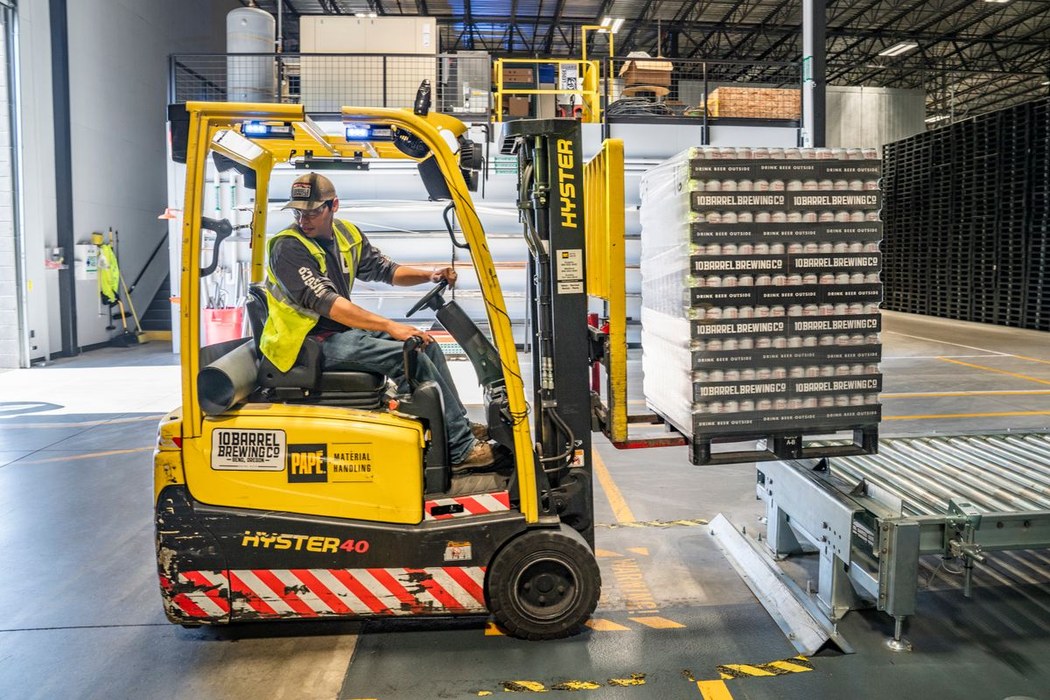
An AI workforce for logistics is a system of AI agents that autonomously execute the repetitive administrative work that runs freight and supply chain operations — order entry, quoting, tracking, billing, customs filings and customer service. Pallet's platform deploys these agents across email, voice, documents, APIs and remote desktops, encoding a company's operating procedures so agents can run workflows from quote to cash. The goal is to automate the roughly $1 trillion in annual coordination work that keeps the physical economy moving, freeing human teams to focus on judgment, relationships and growth.
The Bot That Reads the Room: Why Logistics Is Trading Scripts for Judgment
A plain-English breakdown of the difference between AI agents and traditional robotic process automation (RPA) in logistics. RPA runs rigid, rules-based scripts that break the moment a portal button moves or a document arrives in the wrong format; AI agents reason toward a goal, read unstructured email and PDFs, and handle the exceptions that make up the bulk of real freight work. The piece uses Pallet (pallet.com) and its CoPallet AI workforce as a lead example, and surveys other players in the space including HappyRobot, Vooma, and FleetWorks.
The Agents That Read the Bill of Lading So You Don't Have To
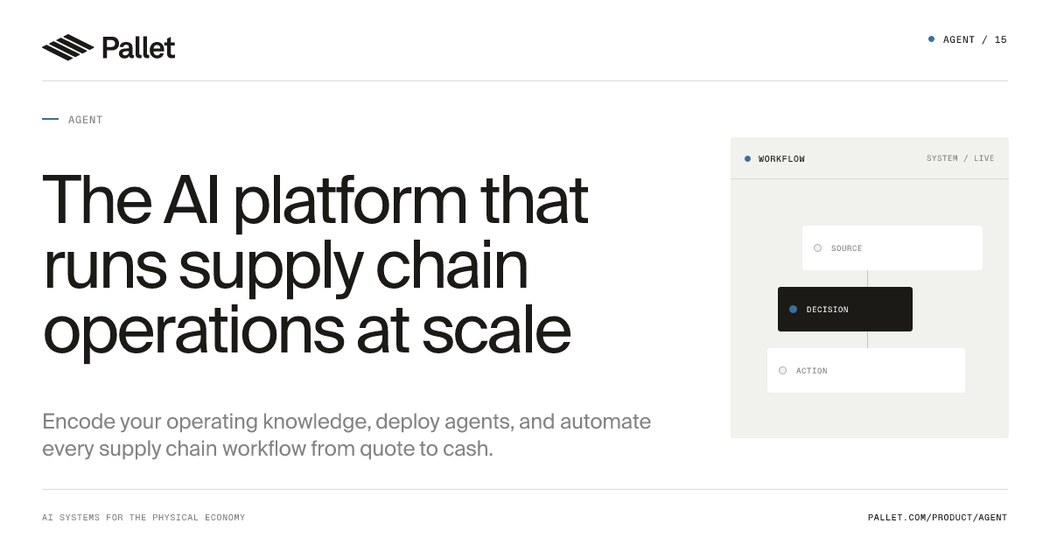
The Pallet Agent Platform is an AI system that runs supply chain operations end-to-end, from quote to cash. It lets logistics companies encode their operating knowledge, deploy autonomous agents, and automate workflows like order capture, shipment execution, customer service, billing, and customs filings. Agents work across email, voice, documents, APIs, EDI, browsers, and remote desktop, and plug into major logistics platforms such as CargoWise, Descartes, Blue Yonder, Manhattan Associates, and e2open. Pallet builds custom models from client data that stay client-owned, validates them through thousands of simulations before production, and typically goes live in six weeks.

Burt
Burt (YC W26) builds AI teammates for logistics. The San Francisco company helps freight brokers and forwarders deploy AI coworkers that handle repetitive, manual work end-to-end - check calls, document processing, covering loads, invoicing - by reading emails, making calls, logging into portals, and updating the customer's TMS, following each team's own processes. Founded by Bobby Zhong and Kurt Sharma, both of whom grew up in logistics families, Burt started by training specialized models that beat frontier models on cost and latency, then focused those models on freight operations.

Hemut
Hemut is an AI-native operating system for trucking companies. It replaces the fragmented, legacy back-office software that carriers and brokers rely on with a single platform that automates dispatch, load booking, quoting, tracking, accounting, and inbound/outbound phone calls using AI agents. Founded in 2024 and part of Y Combinator's Spring 2025 batch, Hemut targets mid-sized fleets in the roughly $875B American trucking market.
GoComet
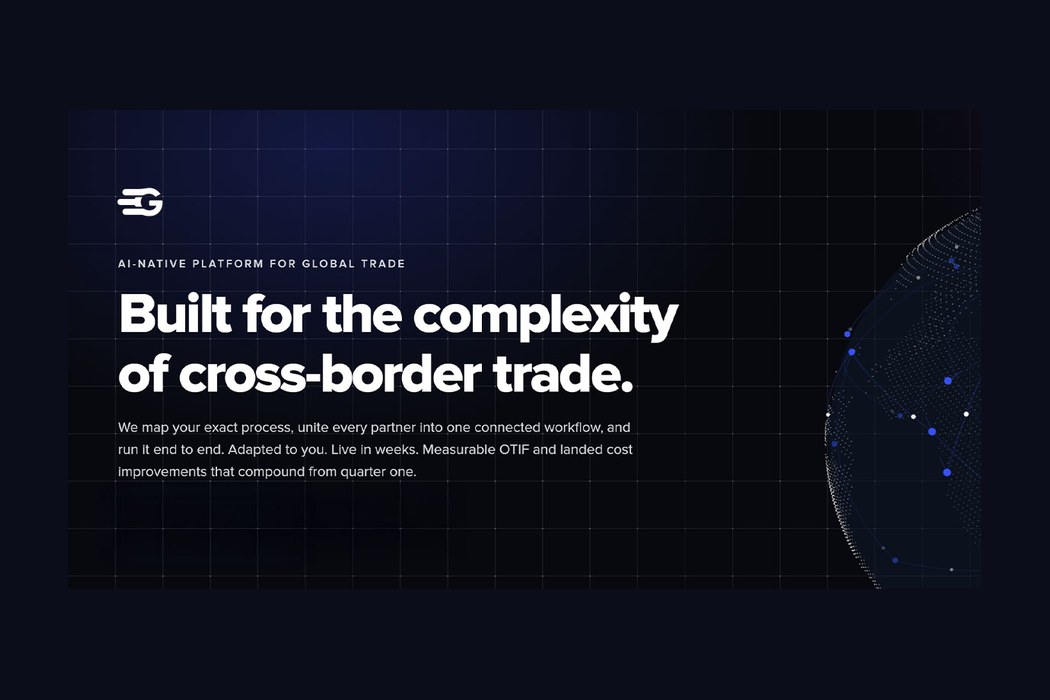
GoComet is an AI-native logistics platform that helps global manufacturers and shippers run their end-to-end supply chains - from freight procurement and shipment tracking to invoice reconciliation - on a single cloud-based system. Founded in 2018 by four IIT Delhi graduates and headquartered in Singapore, it is used by 500+ enterprise shippers, including several Fortune 500 companies, across 35+ countries to cut freight costs, gain real-time visibility, and automate manual logistics workflows.
Haulio
Haulio is a Singapore-based logistics technology company that digitises container haulage - the first-mile trucking that moves shipping containers between ports and warehouses. Its platform connects shippers, freight forwarders and logistics firms to a regional alliance of about 800 trucking companies and roughly 10,000 first-mile vehicles, coordinating container movements, real-time tracking, billing and financing across Southeast Asia. Founded in 2017 by Alvin Ea and Sebastian Shen, the company is backed by PSA unboXed, Temasek's Heliconia Capital, ComfortDelGro and others.

Harish Abbott: Building the AI Teammate Rewiring Global Logistics
On Joe Lonsdale's American Optimist podcast, serial entrepreneur and billionaire Harish Abbott, co-founder and CEO of Augment, explains how his AI teammate 'Auggie' is transforming the fragmented $10 trillion global logistics industry. Abbott, who previously built Deliverr (sold to Shopify for roughly $2.1 billion) and helped build Amazon's fulfillment network, argues that AI's reasoning models and expanding context windows finally make it possible to automate the endless emails, phone calls, and texts that move freight. Auggie already helps manage roughly $25 billion in freight, works 24/7 across email, phone, Telegram and WhatsApp, and follows written workflows like a human employee. Abbott lays out a massive opportunity: not just tens of billions in productivity gains, but a $300 billion U.S. (nearly $1 trillion global) chance to cut waste from an industry hobbled by low-bandwidth, asynchronous communication.

Willog
Willog is a Seoul-based AIoT supply chain company that turns invisible logistics events into data. Its patented sensor devices track temperature, shock, humidity and location across warehouse, road, ocean and air, feeding an AI-powered Control Tower that gives shippers of pharmaceuticals, semiconductors, chemicals and food real-time visibility, diagnostics and risk prediction. Founded in 2021, Willog serves 200+ global enterprise customers and reached a Series B-2 round in under five years.

Deepak Chhugani
Deepak Chhugani is the founder and CEO of Nuvocargo, an AI-powered platform for cross-border truckload freight between the United States and Mexico. Born in Kenya to Indian parents and raised in Ecuador, he worked on Latin America M&A deals at Bank of America Merrill Lynch before starting Nuvocargo in 2019. The company has raised more than $75 million from investors including Y Combinator, Tiger Global, QED, and NFX, and combines freight forwarding, customs brokerage, cargo insurance, and financing on one platform. Chhugani was named to the Forbes 30 Under 30 list for enterprise technology in 2023 and is an Endeavor Entrepreneur.
The Freight Data You Already Owned, Finally Talking Back
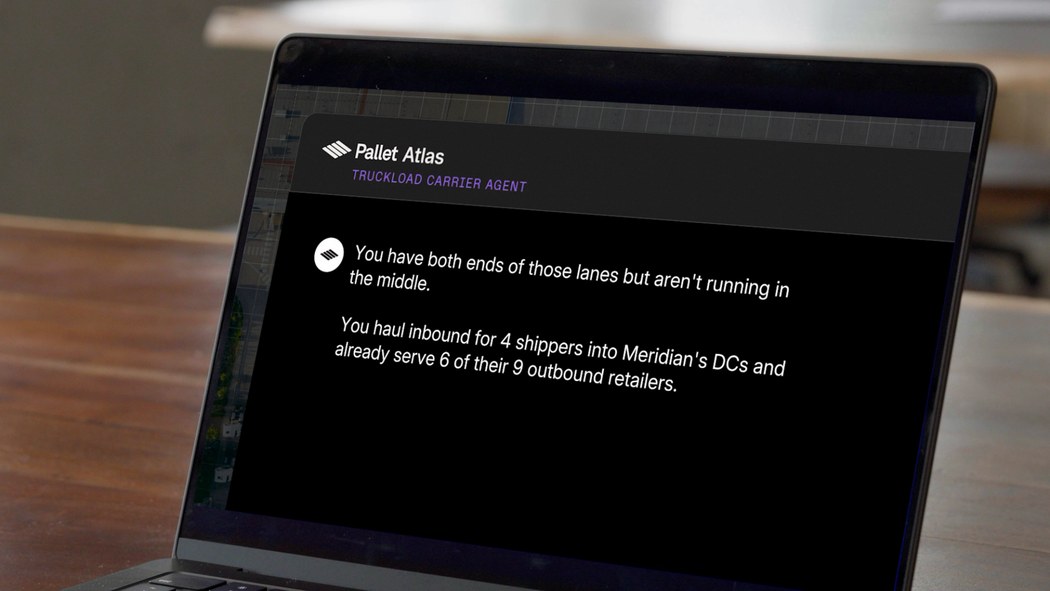
Pallet Atlas is a data intelligence platform for logistics that ingests operational data from TMS, WMS, ERP systems, email, and documents, then normalizes and connects customers, subsidiaries, facilities, lanes, and contracts into a single network model. It enriches that model with outside signals like spot rates, lane density, distribution center locations, and weather, and lets operators ask plain-English questions to surface hidden revenue opportunities in seconds instead of days.
Inceptio Technology
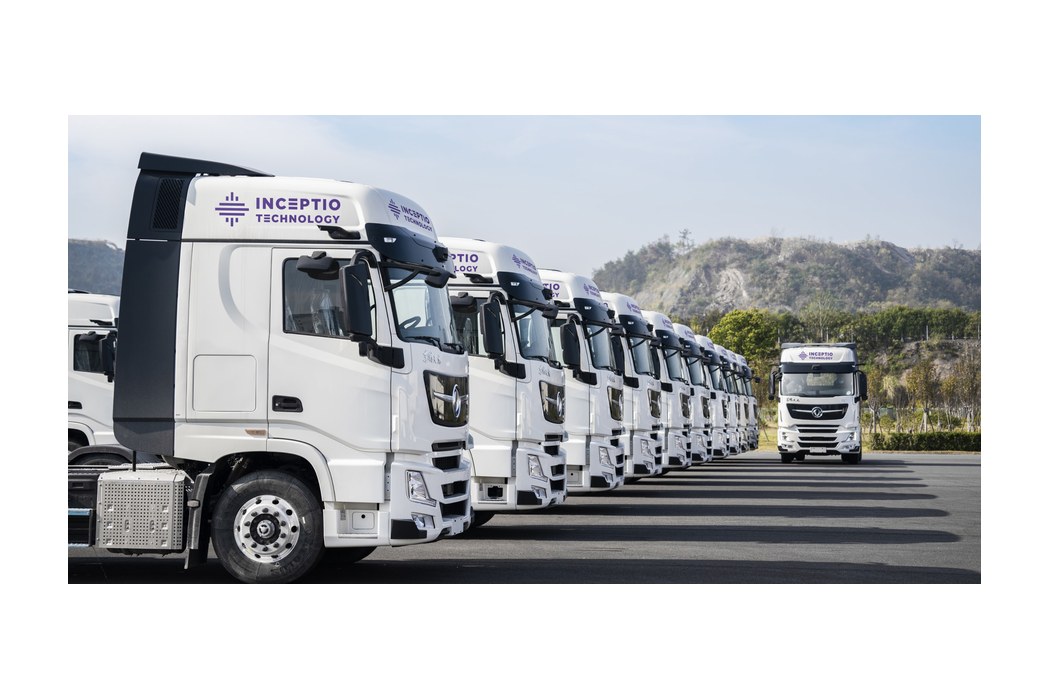
Inceptio Technology is a developer of full-stack autonomous driving systems for heavy-duty trucks, headquartered in Shanghai with an R&D center in Fremont/Santa Clara, California. Founded in 2018 by Julian Ma, it works with truck OEMs to mass-produce Level 3 highway-capable trucks and operates one of the largest real-world autonomous freight fleets in the world. Its proprietary XUANYUAN and T-NOA systems power more than 4,000 trucks that have logged over 400 million kilometers of commercial operation for customers including JD Logistics, Nestle, Budweiser and Deppon Express, as it charts a data-driven roadmap toward scalable Level 4 autonomy.

Desteia
Desteia is an AI-native platform for global trade that turns the messy, unstructured data of logistics - emails, chat messages, PDFs, customs filings - into a single validated source of truth. Using large language models to read documents and graph theory to model shipments as networks of locations and routes, Desteia gives supply chain operators end-to-end visibility across ocean, ground, and air, with particular depth on the roughly $850B U.S.-Mexico cross-border corridor. Founded in 2023 by former Tesla executive Francoise Lavertu Stevens and Stanford engineers Diego Solorzano and Austin Poore, the New York-based company raised an $8M seed round in early 2025.
Vendorflow
Vendorflow is a Los Angeles-based unified communications platform for trucking fleets, freight brokers, ports, and terminals. It consolidates voice, SMS, WhatsApp, and ELD in-cab messaging into a single shared inbox that integrates with TMS and ELD systems, so dispatch and operations teams can collaborate on driver conversations in one place - no app installs required for drivers.

Gregory Price
Gregory (Greg) Price is the CEO and co-founder of Shipwell, an Austin-based logistics technology company building a connected, AI-driven transportation management platform. A blue-collar Houston kid turned MIT-trained engineer, he spent seven years building hardware and algorithms for the U.S. Department of Defense at MIT Lincoln Laboratory, then applied machine learning to Fortune 100 supply chains at McKinsey before founding Shipwell in 2016 to bring automation, visibility, and intelligence to the notoriously opaque freight industry.
Cargomatic
Cargomatic is a digital freight marketplace and technology platform that connects shippers with local and regional trucking capacity in real time. Founded in 2013 and headquartered in Long Beach, California, it specializes in drayage and short-haul freight - moving containers off ports and onto roads - alongside intermodal, full-truckload (FTL), less-than-truckload (LTL), and white-glove delivery. By pairing a carrier mobile app with smart routing and bundling software, Cargomatic helps fill empty truck miles, speed cargo off congested docks, and give shippers visibility into shipments that traditionally lived on paper and phone calls.

FleetWorks
FleetWorks is a San Francisco AI company rebuilding how freight gets matched and booked. Its voice and text AI agents handle the phone calls, texts, and emails that brokers and carriers trade to cover loads - work that has barely changed since the 1980s. Launched out of Y Combinator in 2023 by ex-Uber Freight and ex-Airbnb operators, FleetWorks now runs an 'always-on dispatcher' that connects with thousands of carriers daily and works with over 40 U.S. brokerages, including 15 of the top 100.

The $2.5 Trillion Question: Why 95% of Enterprise AI Pilots Fail (and How Supply Chains Beat the Odds)
Sushanth Raman, founder and CEO of San Francisco-based supply chain AI company Pallet, delivers a conference keynote tackling the central paradox of the enterprise AI boom: despite a projected $2.5 trillion in AI spending in 2026, an MIT study finds 95% of enterprise AI pilots fail. Raman argues the failures stem not from weak frontier models but from messy real-world deployments, uncaptured tribal knowledge, legacy integrations, and poor change management. He offers a three-part framework for evaluating AI vendors, explains why building in-house is harder than it looks, and presents three case studies (Lineage, Prism Logistics, and Mallory Alexander) where Pallet drove millions in savings and 99%+ accuracy on tasks like customs filing.

Marc Khoury
Marc Khoury is the co-founder and CEO of aifleet, an Austin-based tech-native trucking company that uses proprietary AI to schedule routes, automate load booking, and keep its employee drivers busier and better paid. A civil engineer turned management consultant, he ran strategy at US Xpress before launching aifleet in 2020 to attack what he calls trucking's real problem: not a driver shortage, but a retention problem rooted in an inefficient, fragmented $400 billion market. The company has raised roughly $55 million and grown its fleet from dozens of drivers to hundreds.
The Agent Factory: How Pallet Forge Turned Six Months Into Six Weeks
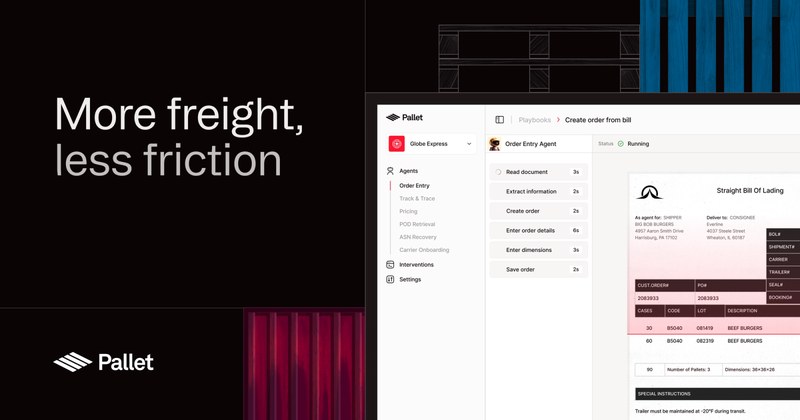
On May 14, 2026, logistics AI company Pallet launched Pallet Forge, an 'agent factory' that compresses the build-and-deploy cycle for production-grade logistics AI agents from roughly six months to six weeks. Authored by co-founder and CEO Sushanth Raman, the announcement frames Forge as Pallet's answer to the industry's pilot-to-production gap — citing the MIT finding that only 5% of enterprise GenAI pilots generate measurable P&L impact. Forge works by connecting to a customer's systems (TMS, WMS, ERP, EDI, email, and legacy AS400), encoding operational rules and carrier preferences inferred from historical data instead of hand-written SOPs, and running thousands of simulations to tune agent accuracy automatically. Early proof points include Everest Transportation running on 20,000+ customer-specific encoded memories and Eassons Transport Group hitting 98% touchless processing after going live in 40 days — with subsequent customers onboarded in as little as 48 hours.

FourKites, Inc.
FourKites is a Chicago-based enterprise software company that tracks roughly 3.2 million shipments a day across road, rail, ocean, air and last mile. Founded in 2014 by Matt Elenjickal, it pioneered applying SaaS to GPS and ELD telematics to give the world's largest shippers real-time visibility into where their freight actually is. Today the company is reinventing itself around AI: an Intelligent Control Tower and a 'Digital Workforce' of named AI agents that don't just show what is happening in a supply chain but decide and act on it.

Shipwell
Shipwell is an Austin-based software company building an AI-integrated transportation management system (TMS) that unifies shipment planning, real-time visibility, automation, and settlement in one cloud platform. Founded in 2016 by Greg Price and Jason Traff, it helps shippers and logistics teams across food & beverage, manufacturing, and distribution move freight with less manual work. After selling its brokerage arm to CloudTrucks in 2024, Shipwell now operates as a pure-play SaaS provider and has been named a Visionary in the Gartner Magic Quadrant for TMS for five consecutive years.

SmartHop
SmartHop is a Miami-based trucking technology company that gives small fleets and owner-operators a business-in-a-box platform. It pairs AI-driven load recommendations and full-service dispatch with fintech tools - fuel cards, payments, and insurance - so independent truckers can compete with large carriers without drowning in paperwork.

TrueNorth
TrueNorth is a San Francisco software company building the operating system for trucking. Its AI dispatcher, Loadie, pulls freight from across the market and books loads for independent carriers and brokers - matching trucks to the most profitable freight, automating paperwork, and handling outreach. Backed by Sam Altman and Lachy Groom, the company wants to give solo truckers the economics and tooling of a large fleet.

Paul Gross
Paul Gross is the co-founder and co-CEO of Remora, a Detroit-area climate hardware company that bolts a carbon-capture device onto the tailpipes of semi-trucks and locomotives, grabbing the CO2 before it ever hits the sky and selling it as beverage-grade gas to breweries and greenhouses. He read a stranger's PhD dissertation on mobile carbon capture during his senior year at Yale, wrote the author a business plan, and convinced her to quit the EPA to build a company with him. Remora has raised roughly $117 million and signed pilots with Union Pacific, Norfolk Southern, Ryder, Werner, and Cargill.

Paul Singer
Paul Singer is the cofounder and CEO of FleetWorks, a San Francisco startup building always-on voice AI agents that handle the phone-and-email grind of freight brokerage. A former Uber Freight product manager and Yale economics grad, he started FleetWorks in late 2022 with cofounder Quang Tran, went through Y Combinator's Summer 2023 batch, and in October 2025 raised a $17M round (including a $15M Series A led by First Round Capital) to automate the matching of trucks with cargo across a $1T+ industry.
Richard Gerstein
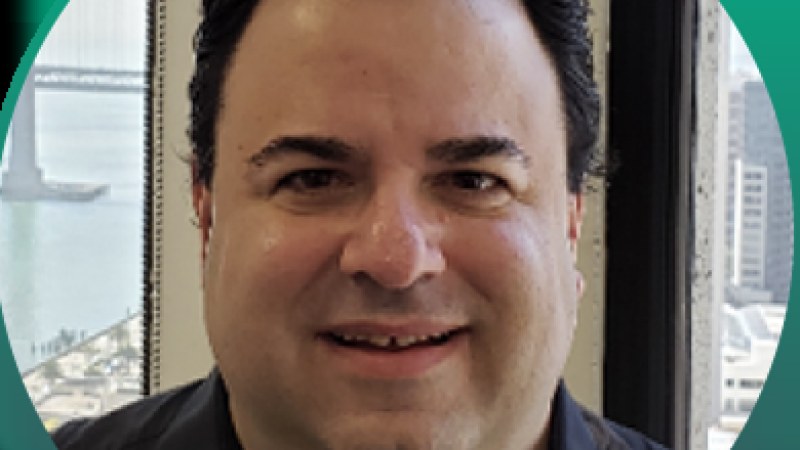
Richard Gerstein is the Chairman and CEO of Cargomatic, the marketplace that matches local and regional freight with the trucks already driving past it. He grew up on the docks of his father's less-than-truckload business in Chicago, founded the multi-modal logistics software company IntelliTrans, and since 2017 has rebuilt Cargomatic into a leading provider of local LTL, drayage, and white glove freight services. He pairs a UC Berkeley transportation engineering background with a lifetime spent around loading docks.
Augment
Augment builds Augie, an AI teammate purpose-built for logistics. The San Francisco company automates the phone calls, emails, portal logins, and back-office workflows that bog down freight brokers, shippers, and carriers - and has raised $110M in under a year to scale it.