Product Launch • Pallet
The Agent Factory: How Pallet Forge Turned Six Months Into Six Weeks
Most enterprise AI dies in the demo. Pallet built a factory for the 95% that never ship.
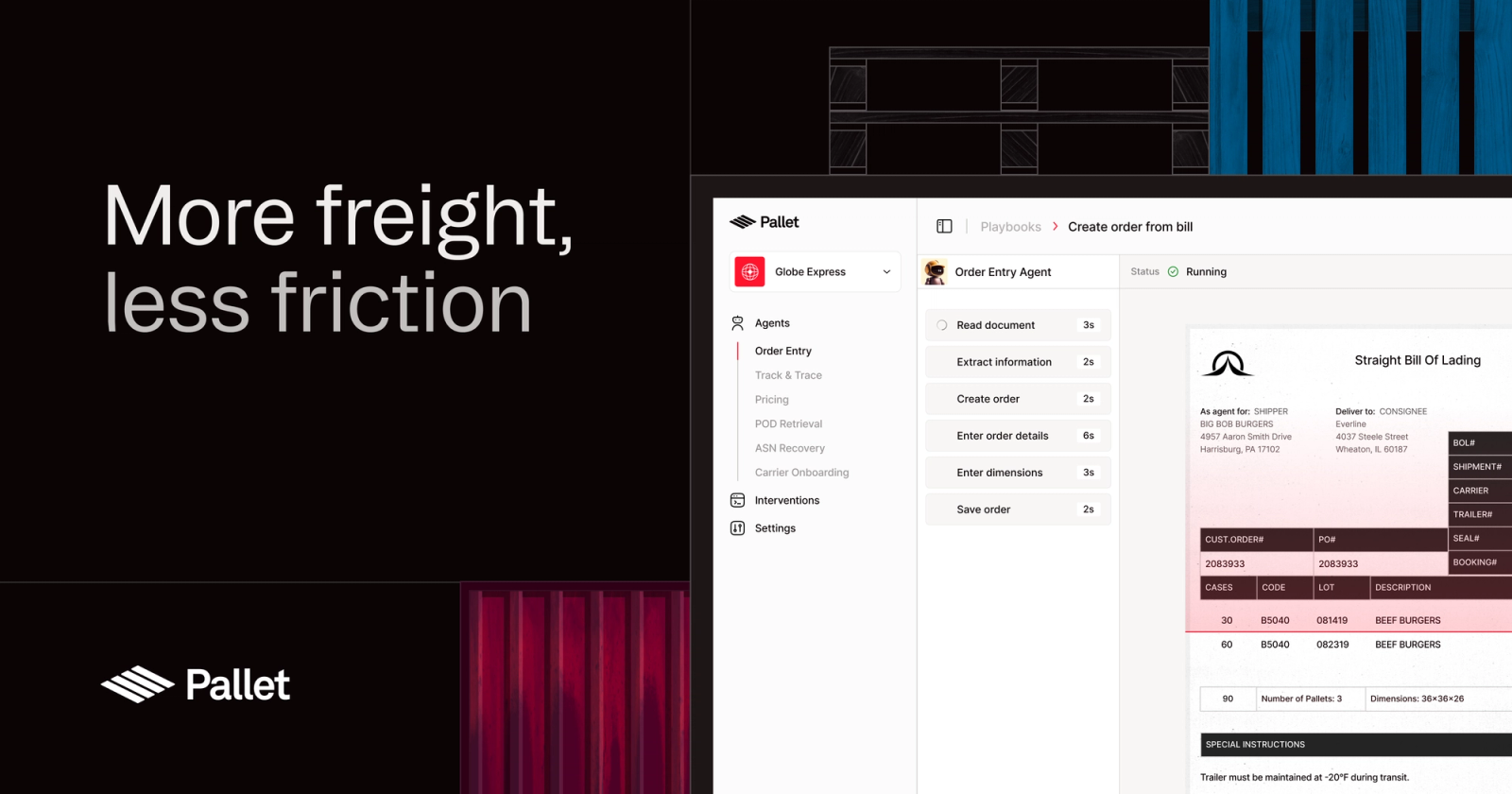
Most enterprise AI dies in the demo. Pallet built a factory for the 95% that never ship.
A logistics dispatcher once kept a binder. Inside it: every quirk, every customer's hatred of a certain carrier, every rule nobody bothered to write down. Pallet Forge is the machine that finally reads the binder.
On May 14, 2026, Pallet shipped a product with an unfashionably honest premise: the hard part of logistics AI was never the AI. It was everything around it — the undocumented rules, the carrier preferences nobody typed up, the email thread from 2021 that quietly governs how a customer wants their freight classified. Pallet calls the new product Forge, and it describes it with a phrase that sounds almost industrial: an agent factory.
The framing matters. A factory is not a demo. It is a repeatable line that turns raw material into finished goods, over and over, without a genius hovering over each unit. That is precisely the claim. Forge takes the raw material every logistics operator already has — historical orders, emails, chat logs, the exhaust of a business that has been running for years — and turns it into working AI agents in roughly six weeks instead of six months.
Start with the strange specific that haunts every CIO who has ever greenlit an AI initiative: the pilot that dazzled in the boardroom and then quietly died on the way to production. Pallet leads its announcement with the number that makes the whole industry flinch. According to research from MIT, only 5% of enterprise generative-AI pilots ever produce measurable impact on the profit-and-loss statement.
Ninety-five out of a hundred. Not because the models were stupid — the models are extraordinary — but because a model that has never seen your AS400 mainframe, your customer's allergy to a particular lane, or your dispatcher's hard-won instinct is a very confident stranger. It guesses well in a demo and badly in production. The gap between "look what it can do" and "we trust it to touch a real shipment" is where money goes to die.
That sentence, from co-founder and CEO Sushanth Raman, is the entire thesis compressed to a single line. Pallet did not launch another model. It launched the assembly line that turns a model into something a freight company will actually run on a Tuesday.
Strip away the noun "agent factory" and Forge does three concrete things, in sequence. None of them are glamorous. All of them are the reason the other 95% failed.
It plugs into the systems logistics actually runs on. Not a clean API and a hopeful prayer — the real stack. TMS, WMS, ERP, EDI feeds, the email inbox where half the business is conducted, and the legacy systems that refuse to die, including AS400 mainframes older than some of the engineers maintaining them. Forge meets the operation where it is, mess included.
It encodes the knowledge, instead of asking for it. This is the heart of the thing. Most automation projects begin with a doomed request: please document your processes. But the best operators carry their rules in their heads, not in a wiki. Forge inverts the ask. Rather than demanding hand-written SOPs, it infers the business logic — operational rules, carrier preferences, the customer-specific exceptions — directly from the historical data, emails, and chats the company already produced. The binder, finally read.
It tunes itself by brute simulation. Once the rules are encoded, Forge runs thousands of simulations against them, optimizing each agent's accuracy without a human babysitting the dials. Manual tuning is the silent killer of AI timelines; Forge automates the part that usually consumes the back half of a six-month rollout.
Connect to TMS, WMS, ERP, EDI, email and legacy systems — including AS400 mainframes.
Extract operational rules and carrier preferences from historical data, emails and chats. No SOPs required.
Run thousands of simulations to optimize agent accuracy automatically — no manual tuning.
A claim about speed is only interesting if someone has actually run it. Pallet's headline number — six weeks from zero to a live, production-grade agent, down from a typical six months — would be marketing on its own. What makes it a story is what happens after the first agent. The encoding and simulation loop, once built, compounds. Later customers, Pallet says, have gone live in as little as 48 hours.
Time from project start to a live, production agent. Source: Pallet.
Two customers anchor the launch. The first is Everest Transportation, which Pallet says runs on more than 20,000 customer-specific encoded memories. That word — memories — is doing real work. It is Pallet's name for the captured tribal knowledge that competitors keep failing to grab: not data, exactly, but context. Twenty thousand of them is the difference between an agent that sounds right and one that is right.
The second is Eassons Transport Group, whose numbers read like a dare. They reached 98% touchless processing — meaning nearly the entire workflow runs without a human hand — after going live in just 40 days. And the texture of that rollout is the part worth lingering on, because it sounds nothing like an enterprise software deployment.
"We sent over a couple examples late Wednesday. We had a call with Pallet Friday afternoon, and our customer was ready to go live."
— Cody Arsenault, Director of IT, Eassons Transport GroupWednesday to Friday. Examples to live customer in the span of a long weekend. In an industry where "go live" is usually a date negotiated quarters in advance, that compression is the entire pitch made tangible. It is also, quietly, the proof that the factory metaphor isn't just branding — the second unit off the line really is faster than the first.
Forge does not arrive alone. It sits inside a stack Pallet has been assembling deliberately: Agents that run supply-chain workflows end to end, and Atlas, which hunts for hidden revenue opportunities — all built on the company's underlying platform, Pallet Core. Forge is the part that builds the agents the rest of the system depends on. The factory, in other words, feeds the floor.
The company behind it has the receipts. Founded in 2021 by Sushanth Raman and Andrew Spencer — two former Retool engineers, each with logistics in the family — Pallet has raised roughly $50 million to date, including a $27 million Series B led by General Catalyst, with Bain Capital Ventures, Activant Capital and Bessemer Venture Partners along for the ride. Its customer list reads like a logistics industry roll call: Everest, Mallory Alexander, Knight-Swift, Lineage Logistics, STG Logistics.
But the most telling thing about the Forge launch is not the funding or the logos. It is the choice of enemy. Pallet did not pick a competitor to beat. It picked a statistic — that brutal 95% — and built a product whose entire reason for existing is to be on the right side of it. In a market drowning in demos, that is a refreshingly specific ambition: not to impress you, but to ship.
The dispatcher's binder was never the problem. The problem was that no software could read it without a human first translating every page. Forge skips the translation. It reads the business as it was actually run — coffee stains, exceptions, gut calls and all — and turns it into something that runs on a Tuesday, at scale, without anyone keying a hundred and fifty bills of lading by hand instead of watching the game. That is the unglamorous miracle. And it is, at last, in production.