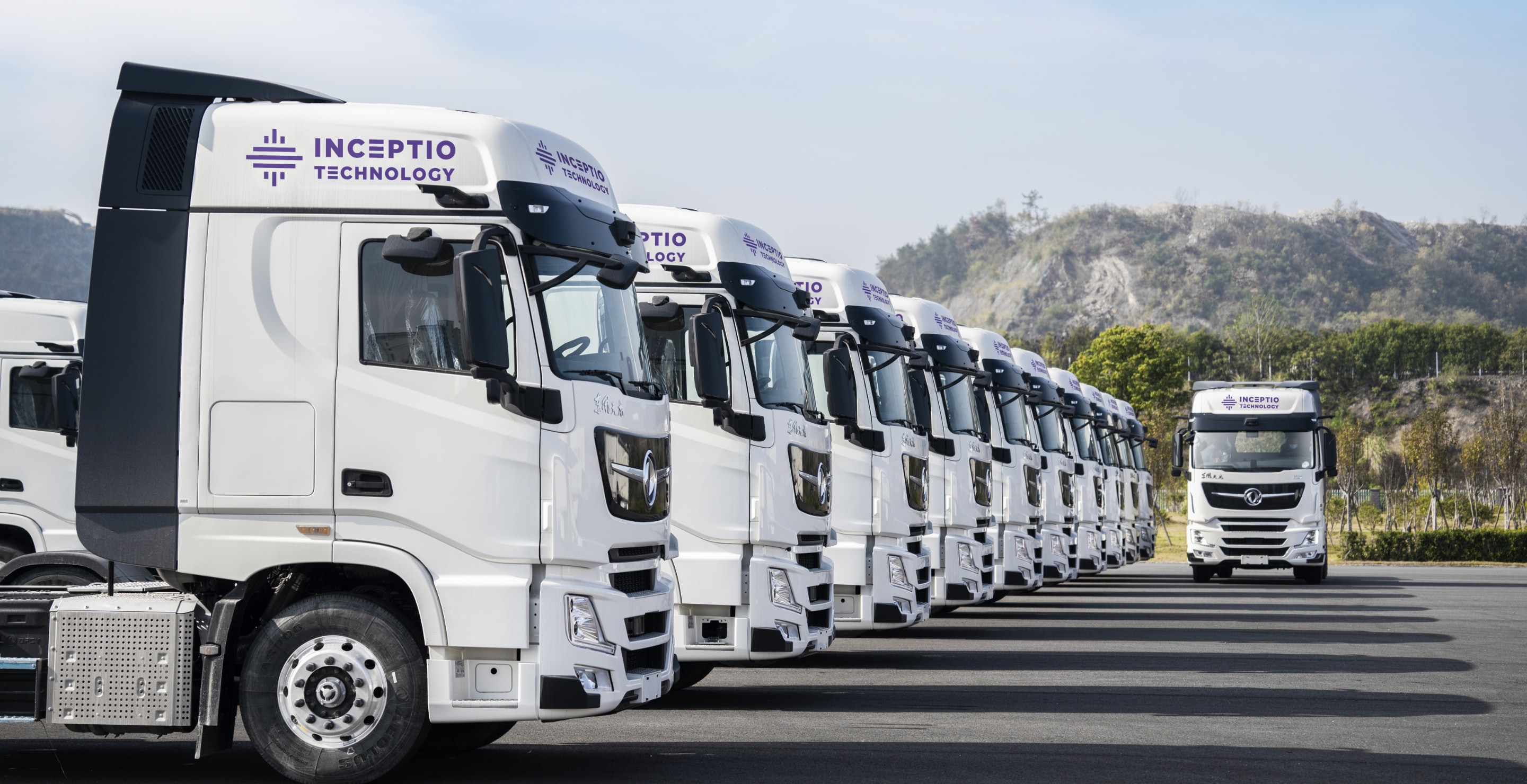
The company that stopped talking about self-driving demos and started measuring autonomy in the only unit freight understands: kilometers driven, safely, for paying customers.
Inceptio Technology develops full-stack autonomous driving systems for heavy-duty trucks. Rather than retrofitting sensors onto existing cabs, it co-develops trucks with manufacturers so the autonomy is engineered in from the factory floor. Founded in 2018 by Julian Ma, the company runs deep research out of Shanghai and a Silicon Valley center in California.
The pitch is deliberately unglamorous. Robotaxis chase crowded, unpredictable city streets; Inceptio chose the highway - long, repetitive line-haul routes where a system can prove itself lap after lap. That focus let it move from prototype to serial production while much of the industry was still iterating on demos.
Its customers are the companies that move things for a living: JD Logistics, Deppon Express, Nestle, Budweiser Brewing, Jinxin Logistics and Kuayue Express. More than 4,000 Inceptio-powered L2+/L3 trucks now run commercial freight across China.
Long-haul trucking runs on scarce, fatigued drivers, thin margins and high fuel bills. Inceptio's answer is a system that handles 95-99% of highway mileage, improves fuel efficiency 3-7%, and pays for itself in a claimed 10-24 months - safety sold on a spreadsheet.
A dual-track strategy: leverage real-world data and scalable production to accelerate toward Level 4 autonomy.
— Julian Ma, Founder & CEOAutonomy is a data problem wearing an engineering costume. Inceptio's approach is to put thousands of trucks to work today, log every kilometer, and let the fleet teach the next generation of software.
By mid-2028 the company aims to accumulate more than 5 billion kilometers of real-world driving data - what it describes as the largest dataset of its kind in the industry, and the fuel for its jump from Level 3 assistance to scalable Level 4 driverless operation.
Proprietary, production-oriented full-stack platform combining perception algorithms, Ultra Long Range Sensing (ULRS) and High Precision Lateral Sensing (HPLS) for highway autonomy.
The commercial Navigate-on-Autopilot system deployed across the fleet, delivering L2+/L3 autonomy that covers 95-99% of total highway mileage.
Next-generation autonomous driving compute unit for trucks, with mass production targeted around 2026 to power the path toward L4.
Mass-produced Level 3 highway trucks co-developed with OEM partners Dongfeng Commercial Vehicle and China National Heavy Duty Truck Group (Sinotruk).
Most autonomous-truck developers retrofit their stack onto vehicles they don't build. Inceptio partners with OEMs to design autonomy in at production - a decision that put its trucks on the road at scale and, it argues, made them more reliable and cheaper to maintain.
Where rivals such as Aurora, Kodiak, Waabi, Plus and Torc emphasize U.S. driverless pilots, Inceptio's edge is commercial volume and data density inside one of the world's largest freight markets.
Inceptio sits at the intersection of AI, hardware and logistics - a B2B supplier and operator rather than a consumer brand. It monetizes through vehicle sales, technology licensing and per-kilometer operating value.
The cap table reads like a who's-who of people who actually move freight and build batteries - not hype-cycle tourists. Bars scaled to round size.
Julian Ma launches the company in Shanghai to build full-stack autonomous systems for heavy trucks.
Raises a $100M Series A (GLP, G7) and a $120M round led by battery giant CATL.
Releases the XUANYUAN system, begins serial production of L3 trucks with OEMs, and closes a $270M Series B.
Adds a $188M Series B+ led by Sequoia China and secures an L4 driverless truck testing permit.
Inceptio-powered trucks pass 100 million kilometers of safe commercial operation.
At Next Truck 2025 in Berlin, Inceptio outlines its path to L4 and 5B+ km of data by 2028.