★MIT SPINOUT TEACHES 30-TON TRUCKS COMMON SENSE★$40M SERIES B LED BY FOUNDERS FUND★MAERSK IS BOTH CUSTOMER AND INVESTOR★AUTONOMOUS TRUCK OF THE YEAR, 2023★LAZER SPOT: 1,300+ TRUCKS, 400+ YARDS★NO HIGHWAY. NO SAFETY DRIVER. JUST THE YARD★MIT SPINOUT TEACHES 30-TON TRUCKS COMMON SENSE★$40M SERIES B LED BY FOUNDERS FUND★MAERSK IS BOTH CUSTOMER AND INVESTOR★AUTONOMOUS TRUCK OF THE YEAR, 2023★LAZER SPOT: 1,300+ TRUCKS, 400+ YARDS★NO HIGHWAY. NO SAFETY DRIVER. JUST THE YARD
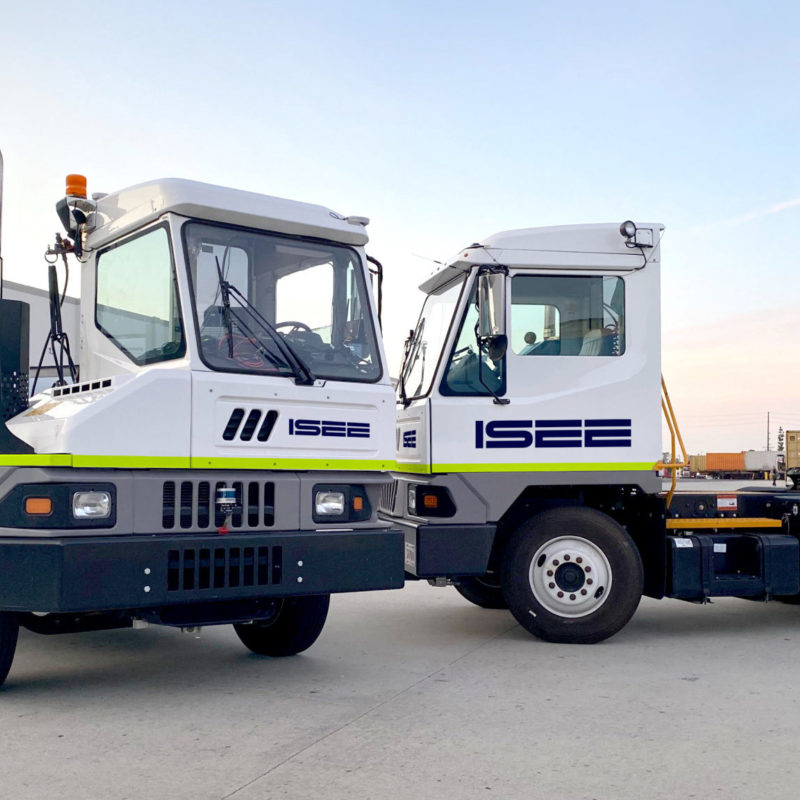
Two of ISEE's yard trucks idling at dusk, neon stripes and all. The drama is optional; the trailer still needs moving.
YesPress Profile // Company
ISEE.
The MIT spinout that decided the future of self-driving wasn't on the highway. It was in the yard, at 3am, reversing a trailer no one wanted to.
Cambridge, MAFounded 2017Autonomous yard trucks~69 people
A logistics yard at night is not glamorous. Floodlights, diesel, a maze of parked trailers, and a driver climbing into the cab of a spotter truck for the four-hundredth short, blind, repetitive move of the shift. This is where ISEE works. Not in a demo on a sunny test track - here, in the part of the supply chain nobody films.
ISEE builds self-driving yard trucks. The trucks move trailers around distribution centers, warehouses, and port terminals - the unglamorous shuffle that keeps freight flowing. The company calls its system "humanistic" AI, which sounds like marketing until you watch a yard for ten minutes and realize how much human judgment a single trailer move actually requires.
"Yard trucks operate in environments where the work is challenging, repetitive, and dangerous."
- Yibiao Zhao, Co-Founder & CEO, ISEE
The problem they saw
Everyone watched the highway. ISEE watched the yard.
For most of the last decade, autonomous driving meant one thing: a car on an open road, hands off the wheel, freeway exits gliding by. Billions went into it. The yard - cramped, chaotic, full of pedestrians and blind corners and weather - was treated as a rounding error.
That was the mistake ISEE noticed. The yard is harder, not easier. A highway is predictable; a working yard is improvisation. But the yard also has something the highway doesn't: a tightly bounded, private, repetitive operation where automation actually pays for itself. The job is dull, the injuries are real, and qualified drivers are getting harder to find. A truck that never gets tired and never cuts a corner is worth a great deal there.
The irony writes itself. The industry chased the romantic version of self-driving and skipped the version that businesses would actually buy.
Filed under: things that are harder than they look
A yard truck makes hundreds of short moves a shift - hitching, reversing, threading between trailers - often in the dark, often near people on foot. It is the most boring driving job in logistics. It is also one of the most dangerous.
The founders' bet
Theory of mind, meet the loading dock
In 2017, three people - Yibiao Zhao, Chris Baker, and Debbie Yu - spun ISEE out of MIT with an unfashionable idea. Most autonomy stacks lean on enormous piles of labeled data and hope the road looks like the training set. ISEE's founders bet on cognitive science instead.
Their wager was "theory of mind" - the human knack for guessing what other people intend. Baker and Zhao argued that to drive safely around people, a machine has to model not just where a pedestrian is, but what that pedestrian is about to do. MIT Technology Review profiled the approach in 2017 under a headline that aged well: a driverless system with "some common sense."
It is a tidy bet. Build an AI that understands the physics, psychology, and causality of a scene, and it should handle situations it has never seen before - which, in a yard, is every situation.
"We set out to build the first AI that understands the physics, psychology, and causality of complex situations."
- ISEE, on its founding bet
EXHIBIT A. The fleet, looking moody. In daylight these are ordinary yard trucks; the difference is the sensor suite bolted on and the AI deciding, frame by frame, whether that shadow is a forklift or a person.The product
Keep the truck. Swap the driver for software.
ISEE doesn't ask customers to buy a strange new vehicle. It retrofits the trucks they already run - electric, CNG, or diesel - with drive-by-wire controls, a sensor stack, and its autonomy software. The result is a yard truck that drives itself: hitching trailers, navigating the lanes, yielding to people on foot, and repeating the loop without complaint.
The pitch to a logistics operator is refreshingly unromantic. No robotaxi fantasy. Just fewer accidents, steadier throughput, and capacity that shows up for every shift. By November 2022, ISEE was claiming something concrete: the first fully autonomous operations in the yard-truck space - meaning no safety driver in the cab.
Underneath the hardware sits the part that's harder to copy: an autonomy engine built to learn from data rather than memorize a route. Sensor fusion stitches together what the truck sees; the prediction layer guesses what the humans and forklifts around it will do next; the planner decides how to move without scaring anyone. The system is designed for what ISEE calls dynamic environments - the polite term for a yard where a worker can step out from behind a trailer at any second. The design goal is not a perfect map but a flexible reflex.
For the customer, the integration is meant to be boring in the best way. The truck slots into an existing operation, talks to the yard management system, and starts taking the moves no one fought to keep. ISEE has spanned electric, CNG, and diesel platforms precisely because real fleets are mixed, and a solution that only works on one chassis is a science project, not a product.
2017
Spun out of MIT
$40M
Series B (2022)
~$58M
Total raised
~69
Employees
Milestones
How ISEE got to the yard
2017
Spun out of MIT
Zhao, Baker, and Yu found ISEE on a cognitive-science approach to autonomy. MIT Technology Review profiles the "common sense" driving AI.
2018
First truck outfitted
The team puts its AI to work in logistics, retrofitting its first yard truck and semi-truck with the ISEE autonomous driving system.
2021
Solution launches publicly
ISEE unveils its autonomous yard-truck solution and names real-world deployments with Lazer Spot and Maersk.
2022
$40M Series B
Founders Fund leads, with Maersk Growth, Eniac Ventures, and New Legacy. ISEE claims first fully autonomous yard-truck operations.
This is where ISEE separates from the slideware crowd. Its named customers are not pilots-of-pilots. Lazer Spot is the largest yard operator of distribution centers in North America - 400-plus locations, more than 1,300 trucks. Maersk is one of the largest shipping companies on earth, and, conveniently, an ISEE investor through Maersk Growth.
ISEE has said the shippers it works with account for hundreds of yards and roughly 10,000 trucks - many of which could, in principle, be automated. A single customer's fleet dwarfs most robotaxi programs that get ten times the press.
It is not alone in noticing the opportunity. Outrider, Forterra, and Cyngn are all circling versions of the same idea, and the incumbent alternative - a human in a spotter truck - is not going quietly. What separates ISEE in the pitch room is the combination of a marquee customer that is also a strategic investor, a public claim to driver-out operations, and an industry award to point at. In a category long on demos and short on deployments, proof is the scarce resource. ISEE has been collecting it.
Where the money came from
ISEE funding by round // approximate, USD
Early rounds
~$17.7M
Series B '22
$40M
Total raised
~$57.7M
The 2022 Series B alone is bigger than every prior round combined - a vote of confidence from Founders Fund, Maersk Growth, Eniac Ventures, and New Legacy that the yard, not the highway, is where autonomy ships first.
"We're committed to building a future where autonomous yard trucks can thrive alongside people, seamlessly and safely."
- Yibiao Zhao, Co-Founder & CEO
The mission
Alongside people, not instead of them
ISEE is careful about its framing, and for once the framing is honest. The yard truck job is the kind of work that wears bodies down: repetitive strain, long shifts, real injury risk. The company positions autonomy as taking over the dull and dangerous loop so human workers can do the parts that need a human. Whether you read that as genuine or as good PR, the operational logic holds - the moves it automates are exactly the ones people least want to make.
The bet underneath is bigger than yard trucks. If an AI can reason about intent and causality well enough to survive a chaotic yard, that same "common sense" should travel - to ports, terminals, and other bounded industrial spaces where the environment is messy and the stakes are physical.
Why it matters tomorrow
Back to the yard at 3am
Return to that floodlit yard. The diesel, the maze of trailers, the four-hundredth move. In ISEE's version, the cab is empty. The truck hitches the trailer, threads the lane, pauses for the worker crossing on foot, and sets the trailer down - then does it again, all night, without the strain or the blind-spot risk that made the job dangerous in the first place.
The flashy story was always the car on the freeway. The useful story turned out to be a yard truck that nobody wanted to drive. ISEE bet on the second one. So far, the freight - and the customers - are moving its way.
Want to see the trucks move? Search "ISEE autonomous yard truck" on
YouTube
for product demos and interviews with co-founder & CEO Yibiao Zhao. ISEE has not published an official channel link, so these point to public search results rather than a verified page.