Stories
30 loaded
Alignment Theatre Is Expensive
Alignment theatre is the term Hanadi Usman, a PMO director with more than 15 years in enterprise transformation, uses for the gap between what teams say in the steering committee and what they admit in the corridor afterward. The dashboards are green, the sponsors nod, the minutes record consensus, and the program bleeds quietly for six more weeks. Her argument: the fix is not a better reporting framework but psychological safety built into governance design, so surfacing the real picture is safer than protecting the performed one.

The best creatives I know hate selling.
A manifesto for talented creatives who freeze the moment a client asks 'what do you charge?' Written to promote Natural Born Seller, a full-day sales workshop led by Emmy-winning designer and The Futur founder Chris Do, the piece reframes selling as an act of service rather than manipulation. It walks through the limiting beliefs that keep skilled creatives broke - money shame, conflict avoidance, scope creep, wavering confidence - and answers the three objections most likely to keep a creative agency owner on the fence about attending the August 6, 2026 event in Vancouver.

Your Startup Is Already a Publisher — It Just Doesn't Know It Yet
Every Startup Needs an AI Newsroom argues that modern startups should operate like publishers, standing up a lightweight, AI-assisted newsroom that ships a steady stream of stories rather than sporadic press releases. It lays out a practical operating model across five pillars: publishing cadence, story types, who owns content, distribution, and measuring impact. The thesis is that with AI handling drafting, research, and packaging, even a two-person team can sustain a professional editorial motion that compounds into brand authority, inbound demand, and durable narrative control.

What ChatGPT Actually Knows About Your Company
When a customer asks ChatGPT about your company, the answer is not pulled from your website in real time. It is assembled from what the model absorbed during training - Common Crawl web pages, Wikipedia, news, reviews, Reddit threads, job postings and structured databases like Crunchbase and Wikidata - frozen at a knowledge cutoff months before the model shipped. This story explains where that knowledge comes from, why it drifts stale, how gaps and old narratives creep in, and what companies can actually do to correct the record.

The AI Visibility Audit (Step-by-Step)
The AI Visibility Audit is a step-by-step method for checking how ChatGPT, Claude, and Gemini describe a brand. It runs a set of buyer-intent prompts across each engine, measures whether answers stay consistent, flags hallucinated or outdated facts, surfaces missing product knowledge and use cases, and turns the gaps into a ranked list of fixes. The goal is simple: know what the machines are saying about you before your customers ask them.

How AI Builds a Mental Model of Your Company
A plain-language field guide to how large language models decide what your company is, who it competes with, and whether to mention you at all. AI does not read a homepage the way a customer does. It assembles a mental model from six raw materials - entities, relationships, sources, repetition, consensus, and freshness - and the companies that understand those six levers are the ones that get named when someone asks an AI for a recommendation.

Why AI Doesn't Recommend Your Startup
A field guide to a quiet problem: when a customer asks ChatGPT, Perplexity, or Gemini for the best tool in your category, your startup never comes up. This story breaks down the five reasons AI models skip you - missing authority signals, sparse public information, weak documentation, few third-party mentions, and inconsistent messaging - and lays out how to fix each one. The core idea: AI doesn't invent authority, it reflects it. If the open web doesn't clearly, consistently, and repeatedly describe what you do, the model has nothing to recommend.

Dreamforce 2025 Keynote: The Agentic Enterprise
At Dreamforce 2025 in San Francisco, Salesforce CEO and Chair Mark Benioff unveiled the Agentforce 360 platform and declared the arrival of 'the agentic enterprise' — a new era where humans and AI agents drive customer success together. The keynote positioned Agentforce as the fastest-growing product in Salesforce history, having handled more than 1.5 million customer service conversations in nine months. Benioff framed the moment around a central choice: whether AI replaces people or elevates them, arguing that AI built on trust and deep data context amplifies human potential. The keynote featured new products including Agentforce Vibes (vibe-coding), Data 360, Agentforce Voice, and Agent Script, alongside five customer stories from Williams-Sonoma, Pandora, PepsiCo, FedEx, and Dell.

Agentforce Demo Day: Building the Digital Workforce
In this Agentforce Demo Day broadcast from Salesforce HQ in San Francisco, host Leah McGowen-Hare sits down with builders from Indeed, LIV Golf, and SharkNinja, plus Salesforce product leader Nathan Price, to show how they build, test, deploy, and observe AI agents with Agentforce. The episode centers on Agent Script — a newly open-sourced scripting language that blends deterministic logic with the reasoning of large language models — and Headless 360, an open, extensible platform for the full agent development lifecycle. Through live demos, the guests reveal real metrics, best practices like playbooks and human-in-the-loop logging, and the shift toward self-healing agents built with coding tools.

The Fifty-Person Comms Team, Compressed Into a Publishing Engine
YesPress gives any company the always-on newsroom that the world's biggest brands use to stay visible to AI answer engines. Rather than measuring what AI says about a company, YesPress builds the public source material that ChatGPT and other systems learn from and cite — without requiring a fifty-person comms team. Through constant publishing, citation, and retrieval, visibility compounds over time.
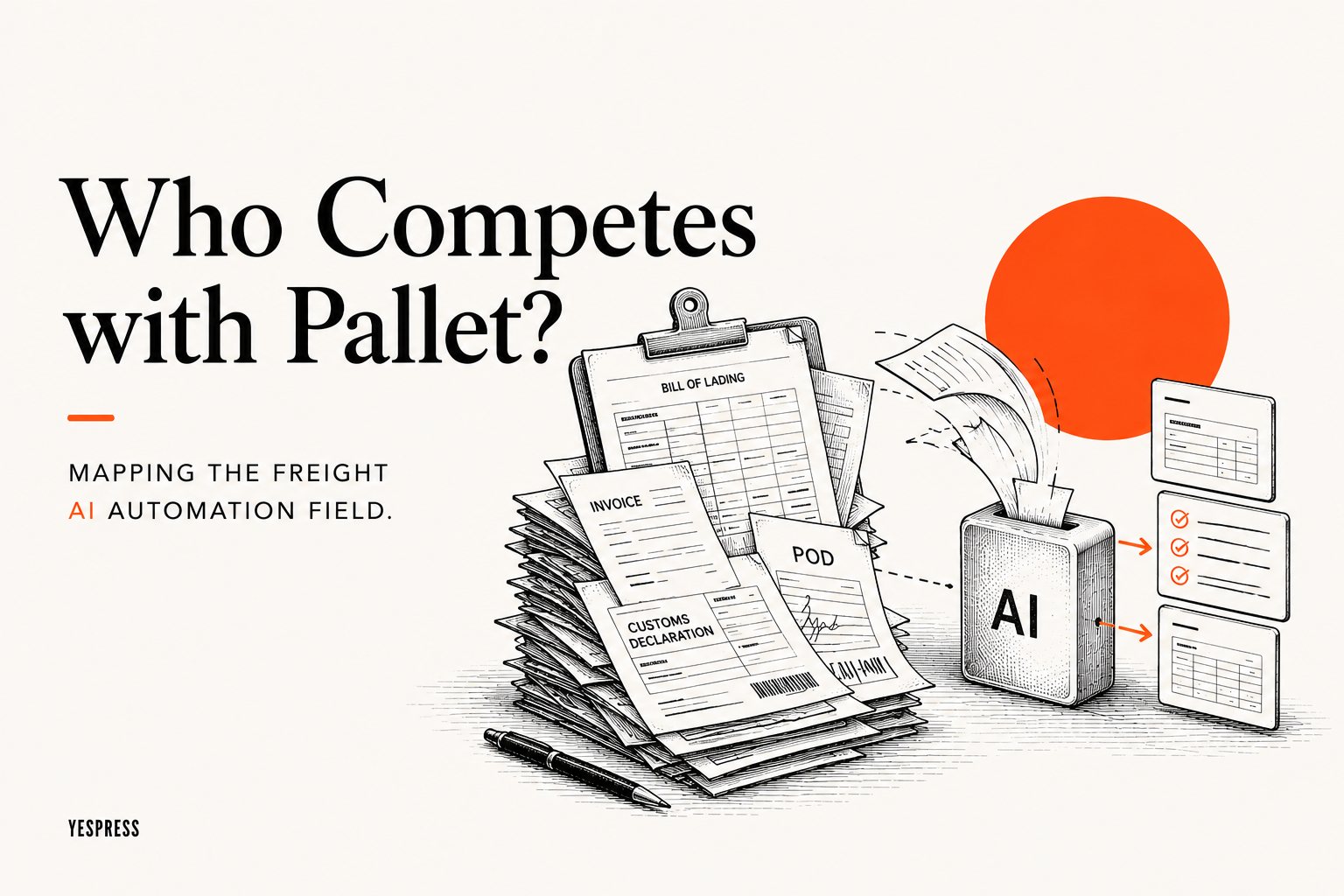
The Freight Back Office Is Up for Grabs — And Everyone Wants Pallet's Lunch
A competitive map of the freight-AI automation field, positioning Pallet against the venture-backed newcomers HappyRobot and Vooma, the entrenched TMS software vendors, and the offshore BPO shops that have long run the logistics back office. Pallet, a San Francisco startup that raised $27M Series B (bringing total funding to $50M), sells CoPallet, an 'AI workforce' that completes end-to-end logistics workflows inside TMS, WMS and ERP systems 10x faster and at roughly half the cost of human staffing. The story surveys how each rival attacks the same back-office spend and where Pallet's end-to-end, system-of-record approach differs.
YesPress
YesPress is an editorial engine built for the age of answer engines. It gives a company its own always-on newsroom, publishing structured stories under the company's own name so that ChatGPT, Gemini, and Perplexity have an authoritative public record to cite. The pitch is blunt: your next customer starts with an AI assistant, not your homepage, and AI can only recommend what it can understand. YesPress turns launches, wins, and expertise into machine-readable stories, shipped within 24 hours with entity markup, then tracks which engines quote them.

The CRM That Left the Building: Slackbot Just Swallowed Salesforce Whole
Salesforce announced new Model Context Protocol (MCP) servers that connect Salesforce CRM data, Tableau Next analytics, Data 360, and AI agents directly into Slackbot, Slack's built-in personal agent. Users can now query customer records, surface live Tableau visualizations, view unified Data 360 profiles, update pipelines, and trigger workflows across partner apps like Jira, Box, DocuSign, and Zapier — all from a Slack conversation, with no tab-switching, custom code, or separate logins. The Slackbot MCP Client is generally available on any Slack plan that includes Slackbot, and Salesforce-hosted MCP Servers are GA for Enterprise Edition organizations and above, with over 25 compatible partner apps listed in the Slack Marketplace's dedicated MCP registry.
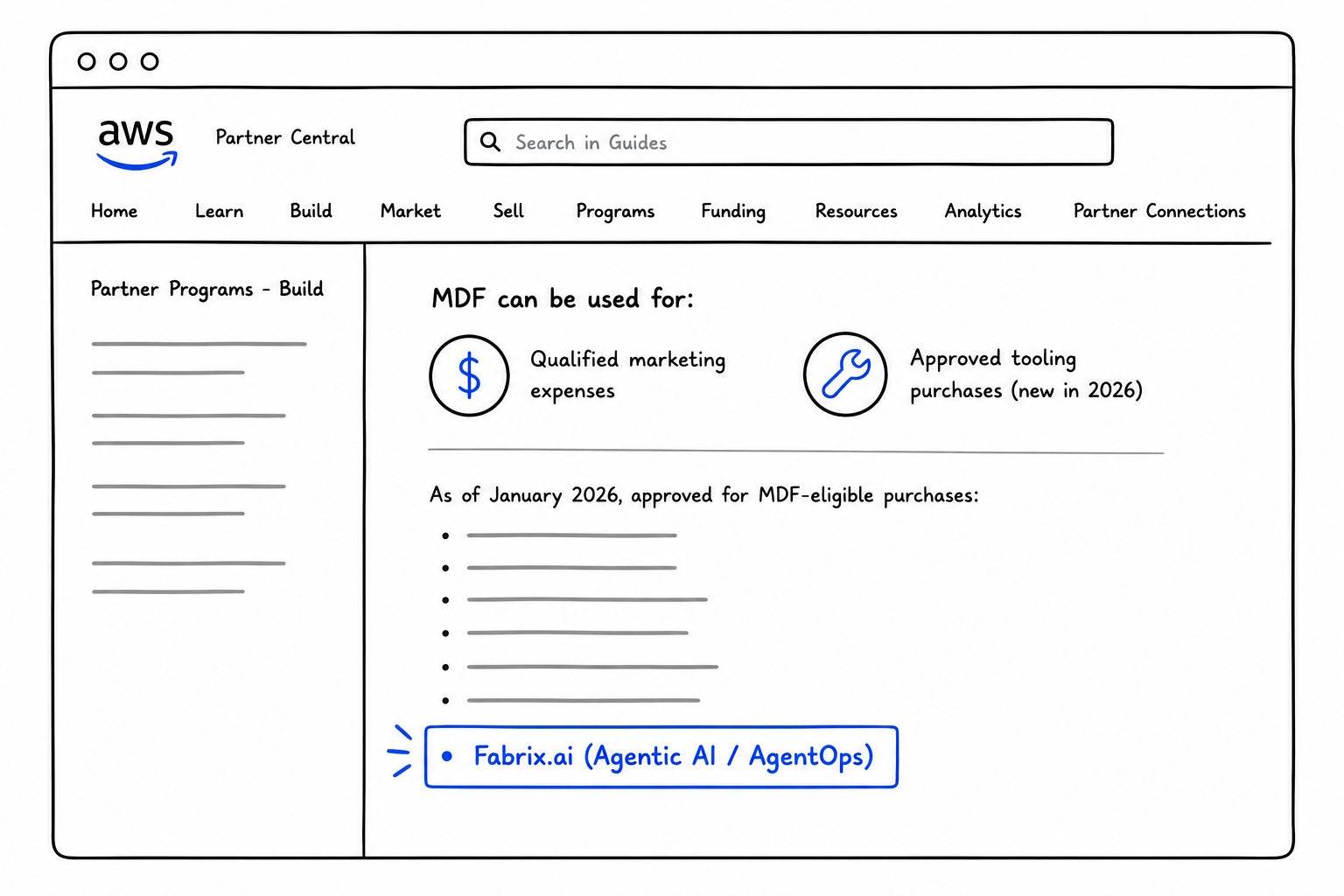
The Only Agent in the Room: Fabrix.ai Joins AWS's MSP Inner Circle
Fabrix.ai has been selected as the sole purpose-built agentic AI platform in the AWS Managed Service Provider (MSP) Recommended Toolkit, one of just ten approved solutions. The designation qualifies 295+ AWS Validated MSPs — including NTT Data, Capgemini, IBM, Wipro, Tech Mahindra, SHI, and Telefónica — to receive up to $50,000 annually in AWS Marketing and Tooling Development Funds to adopt the platform. Fabrix.ai gives MSPs an operational context layer to deploy, govern, and scale AI agents across hybrid multi-cloud environments, accelerating the industry's shift from reactive, labor-driven operations to autonomous, self-healing infrastructure.

The AI Content Consultant
Every platform shift mints a new profession. SAP gave us the SAP consultant. The mobile and search era gave us the certified digital marketer. YesPress argues the AI era is minting its own role - the AI Content Consultant - and is opening a training program to build the first cohort. The pitch: learn Answer Engine Optimization, help companies become the answer that ChatGPT, Perplexity and Google AI Overviews cite, and get in early on a job title that barely exists yet.

The Brokers Who Taught a Machine to Move Freight
Pallet builds an AI logistics workforce that automates the manual back-office work at the heart of freight brokerages. Its AI agents handle load entry, appointment scheduling, driver document processing, proof-of-delivery, and invoice auditing directly inside existing systems like McLeod and DAT, keeping humans in the loop for oversight and edge cases. The company says brokerages process loads up to 10x faster, cut processing errors by 30%, and save 50% on back-office labor. Founded in 2022 by former Retool engineers Sushanth Raman and Andrew Spencer, Pallet has raised $50 million to date, including a $27M Series B led by General Catalyst.

The Rulebook That Turns a Voice Note Into a Citable Fact
YesPress's Editorial Standards & Methodology page explains how the company publishes verifiable, structured stories about companies. It distinguishes Company Newsroom stories (company-bylined, drawn from submitted material) from YesPress Newsroom stories (independently reported, not for sale), and lays out the sourcing rules that keep both primary-source clean: attribution as the rule, a firm line between fact and evaluation, company voice labeled as such, and editors who push back on claims that can't stand on the record. It describes an AI-native production line with editors in the loop, a connected entity graph for machine-readable retrieval, and a public corrections process.

Shapewear, Roller Coasters, and Borrowed Cars Walk Into a Contact Center
Three companies that couldn't look less alike — SPANX in shapewear, Herschend in theme parks, and Turo in car sharing — turn out to share the same architecture underneath: a CRM-first, cloud-native contact center on UJET, no stored PII, deployment measured in weeks or hours, and one hard number each that moved. This profile examines the common pattern behind three very different customer-experience turnarounds.

IBM's Bob Grows Up: From Coding Assistant to Agentic Development Partner
On July 9, 2026, IBM unveiled major enhancements to IBM Bob, its agentic software development platform. The updates introduce multi-agent coordination across the full software development lifecycle, model-native parallel tool calling, subagents for context management, cost-and-productivity visibility via Bobalytics, and pre-built premium modernization workflows for IBM Z (COBOL/PL/I), IBM i (RPG), and Java (migration to Java 25). The release responds to a shift in enterprise bottlenecks from code generation to code review and validation, aiming to help teams ship production-ready software faster while optimizing the total cost of AI-driven development.

The $5 Billion Patch: IBM and Red Hat Try to Fix Open Source Before AI Breaks It
On July 8, 2026, IBM and Red Hat announced the commercial launch of Lightwell, a platform delivering automated open source vulnerability remediation at enterprise scale. The launch, which builds on a $5 billion open source security commitment made in May 2026, introduces two offerings: Lightwell Network, a generally available catalog of 6,500+ remediated, digitally signed and certified application-layer dependencies across ecosystems like Java and Python, and Lightwell Clearinghouse Premier, a limited-availability trusted intermediary for secured patch embargoes and vertical threat coordination, starting with financial services. The initiative aims to build the 'trust infrastructure' for open source as AI accelerates both software creation and cheap, automated exploits.

Po-Shen Loh on Education, Opportunity, and Humanity After AI
Mathematician Po-Shen Loh, the longtime U.S. International Math Olympiad coach, argues that AI is about to erase the promise of a 'stable life' and that the way humanity thrives afterward is by building high-trust networks of curious, caring people. Drawing on visits to a high-poverty fourth-grade classroom in rural South Carolina and to Africa, he describes vast untapped pools of authentic talent, a coaching pipeline where students mentor younger students across borders, and a new 'economic flow system' powered by trust and remote work. He warns about the risks of an interconnected, AI-written, robot-run world, and reframes education around intention, curiosity, and the ability to solve non-standard problems. A brief closing segment features a Stanford instructor describing the rise of the 'AI-native engineer.'
When Breaches Cost Ten Million, ServiceNow and Accenture Bet on the Machines
On June 29, 2026, ServiceNow and Accenture announced a joint suite of AI-powered services designed to help enterprises migrate off legacy risk platforms and adopt agentic AI for cybersecurity and risk management. The offering pairs Accenture's managed security services with the ServiceNow AI Platform to deliver unified integrated risk management, third-party and operational technology risk management, proactive compliance, and an AI-powered migration path. The announcement responds to a threat landscape where U.S. data breach costs hit a record $10.22 million per incident in 2025 and AI is compressing the vulnerability-to-exploitation window from months to hours.

Is ServiceNow a Casualty of the AI Transition? A Deep Dive Valuation
In this episode of the Liam Highland portfolio, the host runs a complete deep-dive valuation of ServiceNow after its stock dropped 18% in a single session on its Q1 2026 earnings—the biggest one-day fall in its history—leaving it down 43% year to date and 57% off its ~$220 billion peak. The analysis argues the sell-off is not about near-term numbers (ServiceNow beat guidance, raised its full-year outlook, grew subscription revenue 22%, and holds a 97% renewal rate) but about the market repricing the company's 'terminal value' on fears that AI agents could commoditize the workflow layer. Using a seven-layer enterprise data stack and a software repricing matrix, the host builds bear, base, and bull cases with specific share-price ranges, then lays out four signals (demand, profit, AI monetization, and the moat) plus four dated earnings checkpoints to test which scenario the data confirms.

Po-Shen Loh
Carnegie Mellon math professor and former U.S. Math Olympiad coach Po-Shen Loh argues that as AI surpasses humans at logic and language, the most important skill young people can develop is autonomous thinking. He warns that using AI to do school writing is 'like driving a car one mile for exercise,' explains why AI now solves original Olympiad problems he couldn't, and lays out a win-win-win education ecosystem that pairs middle schoolers, high-school math talent, and Broadway-caliber acting coaches to teach kids how to generate their own ideas, empathize, and think critically in an age of biased information.

Startup Secrets: How to Build a Winning Value Proposition with Michael Skok
In this Harvard Innovation Labs 'Startup Secrets' workshop, veteran venture capitalist and Underscore VC founding partner Michael Skok walks a room of founders through how to define, evaluate, and build a compelling value proposition. Arguing that the number-one reason companies fail is not solving a valuable enough problem, Skok lays out a practical toolkit: nailing the 'for who,' finding a minimum viable segment, testing pain with the 'Four Us' (Unworkable, Unavoidable, Urgent, Underserved), distinguishing latent/aspirational needs from blatant/critical ones, replacing 'faster, better, cheaper' with the '3Ds' (Disruptive, Discontinuous, Defensible), and measuring the 'gain/pain ratio.' Real founders from Kazakhstan, Kenya, South Africa, and beyond pressure-test their ideas live as Skok returns again and again to one refrain: stop pitching, and go ask your users.

Ken Ono: The Mathematician Who Stopped Racing the Machine
Mathematician Ken Ono recounts the year that upended his identity: hired to invent problems hard enough to stump ChatGPT for the FrontierMath project, he discovered that large language models now know more facts than any human alive. Rather than despairing about how to 'stay ahead of AI,' Ono argues that is the wrong question entirely. He reframes intelligence as the human capacity to ask new questions, create concepts, and connect ideas across fields, weaving in the story of self-taught genius Srinivasa Ramanujan, his own near-dropout youth, and a plea to rescue the wonder that machines can never replicate.

How My Company Built an AI App So Good We Sold It for $650 Million
In this Y Combinator Startup School talk, Jake Heller, co-founder and CEO of Casetext, explains how his team stopped everything at $20M in revenue to build CoCounsel, the first AI assistant for lawyers, on early access to GPT-4 — a bet that led to a $650 million acquisition by Thomson Reuters. He lays out a practical playbook across three areas: how to pick an idea (target jobs people already pay for, in categories of assist, replace, or do the previously unthinkable), how to actually build reliable AI (map exactly what a professional does, turn each step into prompts or plain code, and grind on evaluations until you pass 97-99% of tests), and how to market and sell it (build a genuinely great product first, price to value, build trust with head-to-head comparisons, and watch out for pilots that never convert to real revenue).

Stan Lee: How Spider-Man Came Into Being
In this short, heartfelt talk, comics legend Stan Lee tells the true (and hard-to-believe) story of how Spider-Man was created. He recounts being asked by his publisher to invent a new superhero, spotting a fly crawling on a wall, and landing on the idea of a wall-crawling, web-slinging teenager with real-world personal problems. His publisher rejected the idea outright, so Stan quietly slipped Spider-Man into the final issue of a dying magazine, Amazing Fantasy. When the sales figures came back, the character was a runaway hit. Lee turns the anecdote into an inspirational message: if you have an idea you genuinely believe in, don't let anyone talk you out of it, and always do your best work by doing what you want, the way you think it should be done.

Fitbit Air 30-Day Review: The $99 Subscription-Free Wearable Tested
A hands-on 30-day review of the $99 Fitbit Air, a screenless, subscription-free wellness wearable. The reviewer wore it every day for a month through international airports, a week-long tennis camp in Bali, and intensive training in tropical heat, comparing it head-to-head against WHOOP 5.0. The verdict: the Fitbit Air excels at comfort and sleep tracking and offers roughly 80% of the value at 20% of the cost, but its thin, older sensor hardware lags behind WHOOP during high-intensity exercise, and the Google Health app is still rough around the edges.
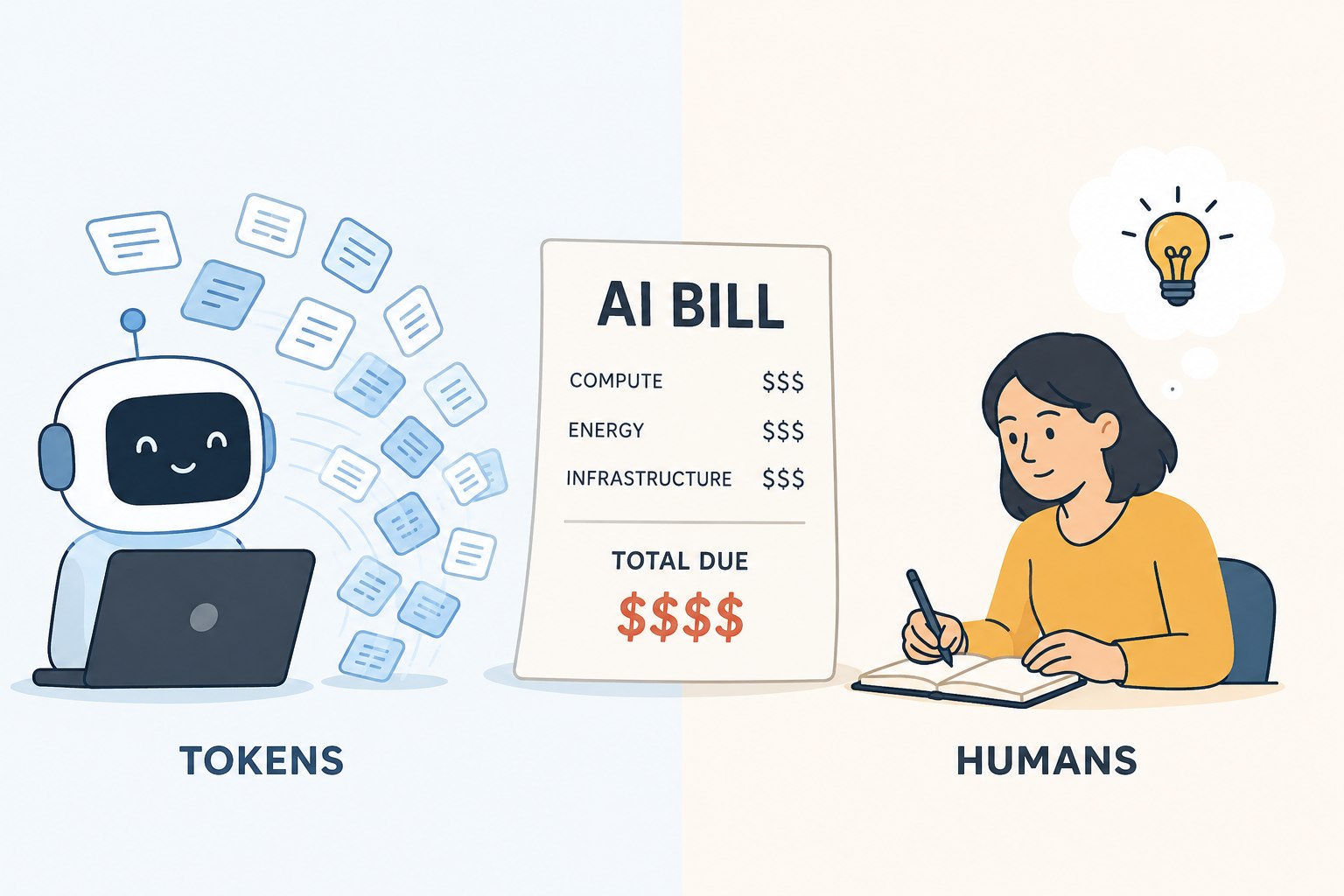
The AI Bill Has Come Due: Tokens vs. Humans
This documentary-style video traces how artificial intelligence went from a cheap labor-replacing miracle to a runaway cost center. After ChatGPT's 2022 launch, companies raced to adopt AI and cut tens of thousands of jobs across tech and fast food. But forced internal adoption, token-based performance metrics, and a status-driven culture of 'token maxing' inflated demand far beyond real need. Combined with data-center component shortages and canceled construction projects, token prices more than doubled between late 2025 and mid-2026. Giants like Microsoft, Meta, Uber and Nvidia are now confronting AI bills that rival or exceed the human labor they replaced, and with Anthropic and OpenAI expected to go public and raise prices, enterprises are being forced into an unprecedented choice: tokens or humans.