The Freight Back Office Is Up for Grabs — And Everyone Wants Pallet's Lunch
More than 50 startups, a wall of legacy TMS vendors, and a 20-year army of offshore desks are all fighting for the same logistics back office. Here's the map — and where Pallet is betting it wins.
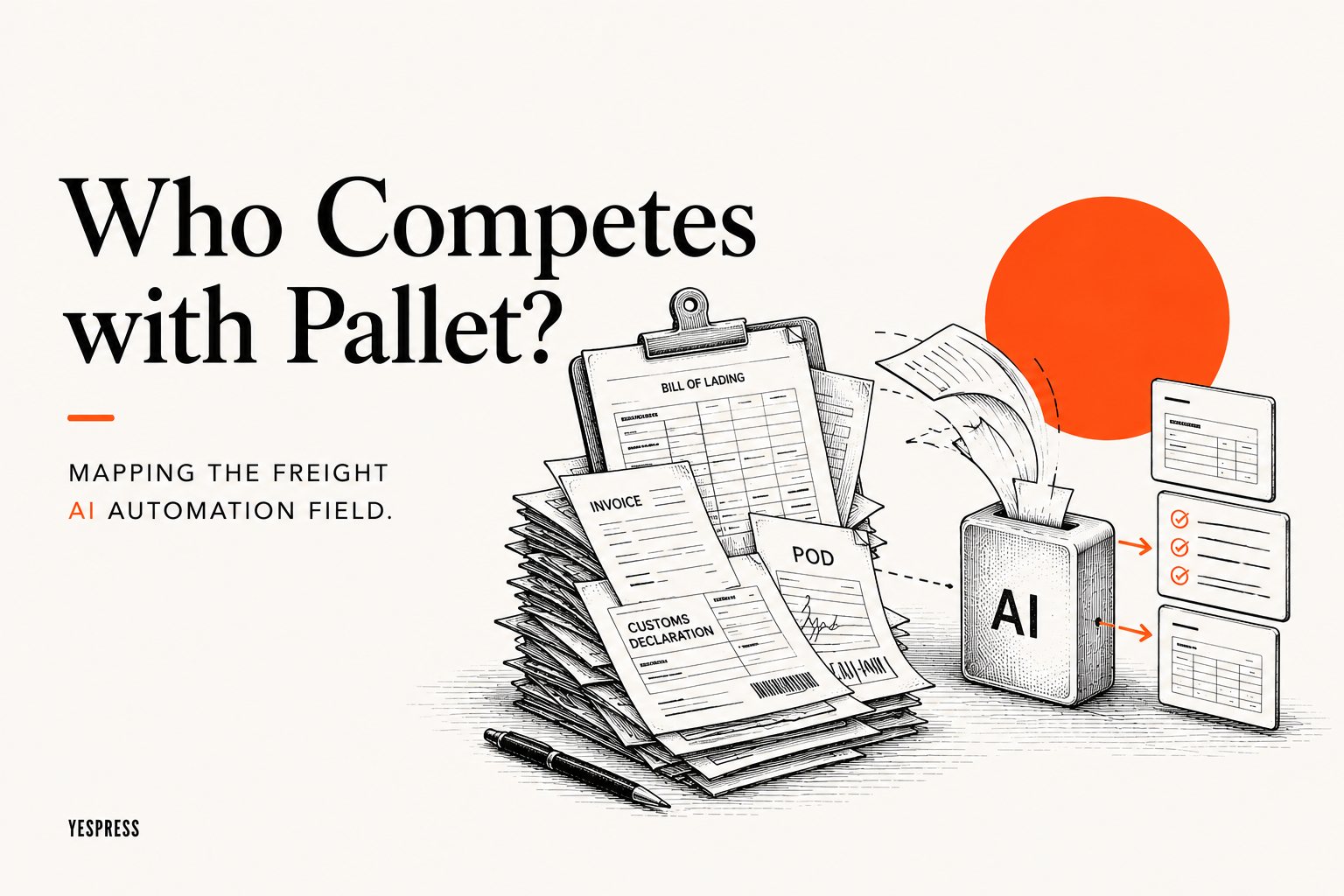
Every freight broker, third-party logistics provider, forwarder and carrier runs on a quiet army of people typing the same things into the same screens all day: order entry, quoting, portal updates, track-and-trace, document retrieval. It is unglamorous, expensive, and — until very recently — stubbornly human. Pallet's bet, like that of a dozen well-funded rivals, is that generative AI can finally do this work end to end. The prize is enormous, which is exactly why more than 50 companies are now pitching AI-native platforms into the same logistics back office.
The result is one of the most contested corners of enterprise software in 2026 — a field crowded with venture-backed newcomers, defended by entrenched software vendors, and shadowed by an offshore labor industry that has quietly owned this work for two decades. To understand where Pallet fits, you have to draw the whole map.
01 / The ArenaThe $50 Billion Question Nobody Puts on a Slide
Back-office labor is the hidden line item of the freight industry. It rarely shows up in a pitch deck, yet it is where a startling share of a brokerage's operating cost actually lives. Automate it and the economics of the whole business change. That is the arena — and the combatants fall into four distinct camps.
02 / The Home TeamPallet's Play — an AI Workforce, Not a Feature
Founded in 2022 by CEO Sushanth Raman, the San Francisco startup sells CoPallet, which it deliberately describes as an "AI workforce" rather than a copilot. The distinction matters. A copilot suggests; an AI workforce finishes the job. CoPallet uses AI and reasoning to complete tasks end to end inside the systems a broker already runs — TMS, WMS and ERP — and Pallet says it does so 10 times faster and at roughly half the cost of traditional staffing.
Customers report cutting staffing costs on repetitive workflows by 50 to 70 percent while lifting throughput as much as tenfold. Just as important as the automation is what accretes beneath it: Pallet has built a data layer that functions as a system of record — a durable position that is far harder to rip out than any single bot. It serves all four operator types, prices per task, and offers 60-day risk-free pilots. In 2025 it raised a $27M Series B led by General Catalyst, with Bain Capital Ventures, Activant Capital and Bessemer returning, bringing total funding to about $50M.
CoPallet is pitched as an AI workforce, not a copilot — it completes end-to-end workflows inside the TMS, WMS and ERP a broker already runs. The core of Pallet's positioning
03 / The ChallengersThe Venture Twins — HappyRobot and Vooma
The most direct challengers are also the best funded. HappyRobot has raised roughly $62M and positions itself as an AI-native operating system — a drag-and-drop "factory" where brokers, 3PLs and shippers assemble their own custom AI workers to handle routine communication and operational tasks. Its enterprise logos are heavyweight: DHL, Ryder and Schneider.
Vooma took a different route to the same place. It began as a quoting tool and expanded into a multi-channel agent platform spanning carrier sourcing, load management, tracking, voice and autonomous agents across what it calls the "full load lifecycle." Its customer roster includes Echo, MODE, Arrive Logistics and NFI — and Vooma is confident enough to publish head-to-head comparison pages that frame rivals on "AI agents, lifecycle coverage, and freight-specific depth."
◆ Disclosed Funding — Freight-AI Newcomers
Bars scaled to disclosed totals; Vooma's amount undisclosed and shown illustratively.
04 / The DefendersThe Incumbents — TMS Vendors Who Own the Screens
The AI startups do not operate in a vacuum. They operate inside the software brokers already pay for. Traditional TMS, WMS and ERP vendors own the systems of engagement where the work physically happens, and they are busily adding AI features of their own. Their advantage is distribution and switching cost — they are already installed, already trusted, already in the budget.
Their disadvantage is architecture. A bolt-on AI feature rarely completes a workflow the way an agent-native platform can; it suggests a next step rather than executing all of them. Pallet's counter is instructive: instead of trying to replace the TMS, CoPallet operates inside it — and quietly accretes a system-of-record data layer underneath, turning the incumbent's own screens into its distribution channel.
05 / The Old AnswerOffshore BPO — the Incumbent Nobody Names
Long before any AI agent booked a load, brokers solved back-office cost the old-fashioned way: they offshored it. A mature ecosystem of logistics BPO providers — Valoroo, FreightBridge, Info-X, Corpshore, ARDEM and many others — runs dedicated offshore teams for carrier onboarding, FMCSA/RMIS compliance, invoice auditing, POD/BOL retrieval and track-and-trace with exception escalation.
These shops promise 30 to 70 percent faster workflows and 40 to 60 percent lower overhead, and they are increasingly wrapping AI around human agents in hybrid models — software handles data entry, people handle the exceptions and the creative problem-solving. The AI-in-BPO market alone is projected to grow from $2.6B in 2023 to $49.6B by 2033. For Pallet, this is the true incumbent to beat: not a competitor with a pitch deck, but a line item every prospect already understands and already trusts.
For Pallet, offshore labor is the true incumbent to beat — not a competitor with a pitch deck, but a line item every prospect already understands. The real benchmark
06 / The VerdictHow the Battle Lines Actually Fall
Strip away the branding and the field sorts along three axes. The first is breadth: Pallet and HappyRobot chase all four operator types, while Highway serves brokers only and Parade focuses on brokers and 3PLs. The second is depth: point solutions — a quoting bot here, a tracking agent there — versus true end-to-end workflow completion. The third, and the one Pallet is betting on, is moat: whoever owns the data layer beneath the automation, a system of record rather than merely a system of action, is the hardest to displace.
Everyone else is betting on speed, logos and lifecycle coverage. Pallet is betting that when the dust settles, the winner will be whoever the data can't leave. The freight back office — worth billions in annual labor spend — is the arena. And for the first time in decades, its owner is genuinely in play.
Whoever owns the data layer beneath the automation — a system of record, not just a system of action — is hardest to rip out. Pallet's thesis for winning