The Whisper That Roared: Salesforce's Bet That Agents Will Save the Human at Work
A year ago Agentforce was, in Mark Benioff's words, "just a whisper." At Dreamforce 2025 he pronounced it the fastest-growing product in company history — and staked Salesforce's future on a single question: will AI replace us, or will it elevate us?
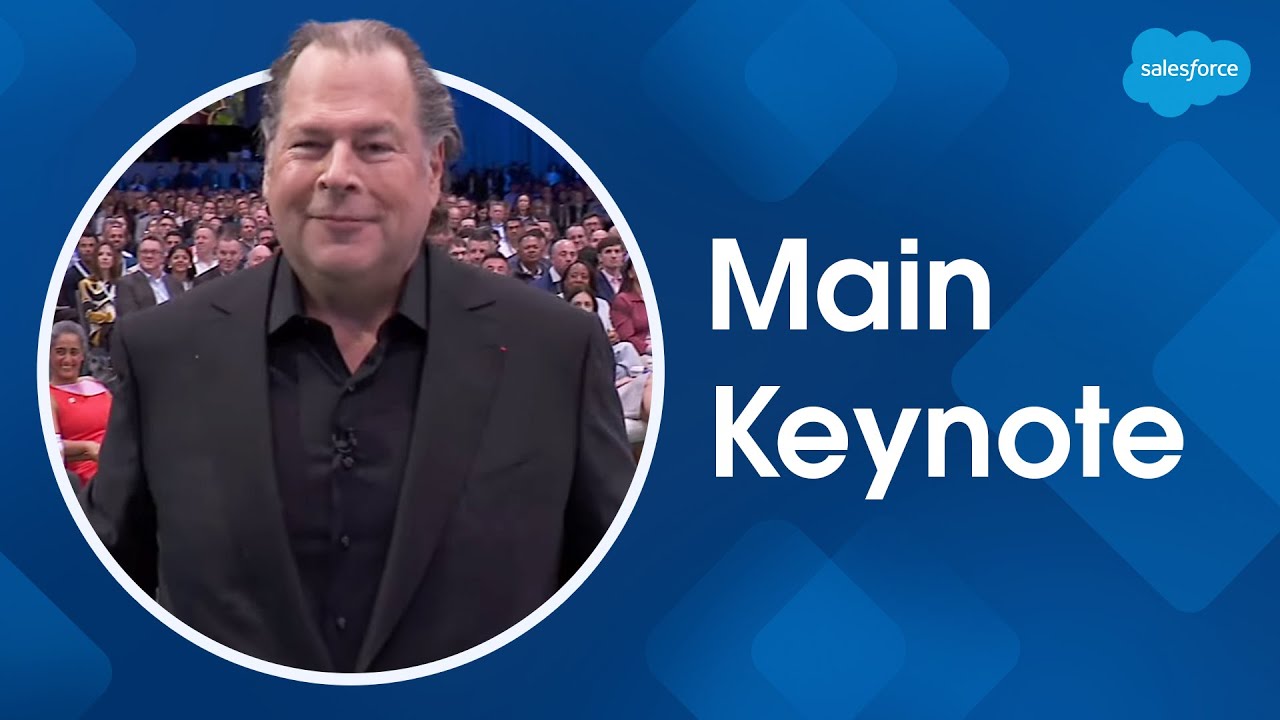
A year ago, Agentforce was just a whisper — an idea murmured in hallways and sketched on whiteboards. On the Dreamforce 2025 stage in San Francisco, Mark Benioff turned that whisper into a roar. "Today," the Salesforce chair and chief executive told a packed Moscone crowd, "it's the fastest growing product we've ever launched." What followed was not merely a product unveiling. It was a manifesto for how work itself should feel in the age of artificial intelligence — and a wager, placed in front of thousands of customers and a lineup of the world's most powerful CEOs, that the winning move is not to replace people but to elevate them.
The through-line of the keynote was a single, almost philosophical question, posed in a cinematic opening film before Benioff ever took the stage. "Is AI going to replace us? Or are we going to be in command of it?" a narrator asked. "As Salesforce, we've made our choice. We're building AI that elevates people — where agents handle the busy work, so we can focus on the work that matters." The company's answer to the anxiety of the moment was blunt and, characteristically for Benioff, sentimental: "AI doesn't feel. AI doesn't care. But we do. And that's what sets us apart."
The Number That Anchored EverythingA milestone, not a metric
If the film supplied the emotion, the data supplied the credibility. Since Salesforce rolled out Agentforce roughly nine months earlier, Benioff said, the platform had handled more than 1.5 million customer service conversations. He was careful to frame the figure not as a vanity metric but as a human one: "That's over a million questions answered with precision, a million customers understood with empathy and care. And most of all, more than a million times, our people were empowered to drive greater value."
Benioff insisted Salesforce was not selling something it hadn't lived. The company, he said, had made itself "customer zero." He conceded the rollout had been imperfect — "Have we been perfect in rolling it out? No. Have we been listening to you? Yes" — and pointed to help.salesforce.com as a living laboratory. He also offered a striking confession about the cost of the old, understaffed way of doing business: over 26 years, somewhere between 20 and 100 million customers who contacted Salesforce never got a call back. "We didn't have enough people," he said. "It fueled our competitors." This week, he countered, the company's AI sales-development rep is calling back 50,000 customers a week.
The Central IdeaThe "agentic divide"
To explain why enterprises need Agentforce rather than a do-it-yourself model, Benioff drew a line down the middle of the modern technology experience. At home, he said, everyone now wields astonishing consumer AI on their phones. At the office, that power evaporates. "When we get to business, do we have that same level of power? I don't think we do." He called this gap the "agentic divide," and argued it cannot be closed by rolling your own models — citing an MIT study he said showed DIY approaches fall short. The bridge, in his telling, is data and context.
"You don't have your data right, you're not going to get your AI right."
Mark Benioff, Chair & CEO, SalesforceThat conviction — data before dazzle — is the spine of the newly announced Agentforce 360 platform, which Salesforce said it would use to rebuild every one of its products on an agentic layer: sales, service, the new marketing SDR, commerce, Slack, a new IT service (ITSM), HR service, revenue management, a brand-new supply chain product, field service, MuleSoft's new "agent fabric," and a fresh version of Tableau. Underneath sit the capabilities Benioff argued an LLM alone can never provide: governance, trust and security, observability and orchestration, agent-to-agent communication, MCP servers, model choice, and — the phrase he kept returning to — "context engineering" rather than mere prompt engineering.
The ShowstopperVibe coding comes to the enterprise
The keynote's most theatrical moment belonged to Patrick Stokes, who introduced Agentforce Vibes — a tool he pitched to Salesforce's 21 million "trailblazers" as "the fastest, and frankly the most fun way to build absolutely anything with Salesforce, just from a description." On stage, Stokes built a live "Dreamforce Command Center" dashboard by writing plain English. He typed "add the rest," and the system — reading his Tableau semantic model — wired real analytics into real charts. Then he asked it to plot badge scans on a map, and to "build a flow to deploy our mascots," at which point the tool stopped writing code and began generating and deploying Salesforce metadata: a screen flow that would otherwise take hundreds of manual clicks.
"For the first time, our people, our AI, our business, and our ideas all speak the same language — our own."
Patrick Stokes, SalesforceThe demo doubled as an argument. "The AI is elevating Patrick as the developer," Benioff said afterward, "and the AI is elevating every aspect of the enterprise." Companion announcements reinforced the theme of reliability: Data 360 promised "intelligent context" — parsing documents so agents deliver complete answers instead of pointing to a PDF, while applying governance that masks sensitive data. Agent Script converts messy natural-language instructions into deterministic code, and a redesigned Agentforce Builder and Agentforce Voice round out the platform.
From One to FiveThe pace of the agentic revolution
Benioff traced Agentforce's velocity from version one a year ago, to two, to a "2DX" at TrailheadDX, to three, and now a new generation "built on every app we make, one with voice, one that is predictable and accurate, one that is intelligent and with context." To prove the vision was already real, he handed the stage to five customers — Williams-Sonoma, Pandora, PepsiCo, FedEx, and Dell — each demonstrating a different face of the agentic enterprise.
- 01Williams-Sonoma — "Olive," an AI sous-chef, built start-to-finish in 30 days and live on the site that weekend. CEO Laura Alber: "My gift to you is the gift of time."
- 02Pandora — "Gemma," a personal-shopper agent powered by Agentforce Commerce and Voice, unifying online shopping and in-store service in one seamless interaction across 6,000 stores.
- 03PepsiCo — agentic sales, marketing, and field service; the company aims to be "agentic-AI-first" across every part of the business by the end of 2026.
- 04FedEx — Data 360 and Agentforce IT Service applied to two petabytes of data and 100 billion daily transactions; correct, governed answers instead of a link to a 200-page PDF.
- 05Dell — 19,000 users on Agentforce Supply Chain (powered by Regrello), cutting supplier onboarding from 60 days to 20.
Each cameo carried its own memorable line. Williams-Sonoma's Alber, 30 years at the company, promised customers "the gift of time." Dell founder Michael Dell delivered the keynote's most bracing strategic logic, recounting how he warned his own team that a faster, cheaper competitor would inevitably arrive — so Dell resolved to become that competitor. "We've totally reset the business, reimagined the business," he said, "and I think all companies will have to do that." Accenture CEO Julie Sweet, whom Benioff called the person he goes to "to change my company right now," reframed the mandate as reinvention: if she can't articulate a "big delta" between how the company used to operate and how it operates now, "then I know I'm not serving my clients."
"A new competitor is going to come along... The only way we're going to prevent that is we're going to become that company."
Michael Dell, Founder & CEO, DellValues & a FarewellTrust, philanthropy, and Jane Goodall
For all the product velocity, Benioff anchored the morning in Salesforce's founding values — trust, customer success, innovation, equality, sustainability — and in loss. He paused to honor Jane Goodall, "one of my closest personal friends," who had spoken at Dreamforce for years and appeared this time in a posthumous video. "What is evolution really," she asked, "but innovation in slow motion?" Her parting charge: "Caring for this planet that has forever cared for us is simply the next great step in human evolution."
Benioff used the moment to recount Salesforce's 1-1-1 model, begun 26 years ago when the company had "no equity, profit, or time" to give. Since then it has donated nearly a billion dollars, logged over 10 million volunteer hours, and inspired 19,000 companies to give away $3 billion of their own. At the event, Salesforce raised another $9 million for the Benioff Children's Hospital, reaching $130 million cumulatively. Business, he argued — echoing Goodall — "can be the greatest platform for change."
The Fine PrintNew pricing for a new era
Recognizing that agentic technology breaks old licensing math, Salesforce introduced flexible models: an Agentic Enterprise License Agreement offering unlimited Agentforce and unlimited Data Cloud, alongside action-based and flex-credit options. "One pricing model is not right for every company in the era of the agentic enterprise," Benioff said. With OpenAI COO Brad Lightcap appearing to affirm the partnership — "AI systems are going to unlock potential for humanity at levels that we today can't even comprehend" — the message was that Salesforce intends to be foundational infrastructure for this shift.
By the end, the argument had come full circle. The keynote wasn't ultimately about scale, Benioff suggested, but about a choice — and about what happens to people when the busy work falls away. "In the future of work, it's not artificial. It's profoundly human." Whether the market rewards that framing will play out across the 1,500 sessions Salesforce packed into Dreamforce 2025. But the whisper, at least, is a whisper no longer.