The Brokers Who Taught a Machine to Move Freight
Pallet's AI logistics workforce quietly runs the freight-brokerage back office — load entry, scheduling, documents, proof-of-delivery and invoice audits. The promise: 10x faster operations, 50% lower labor cost, and humans still in the loop.
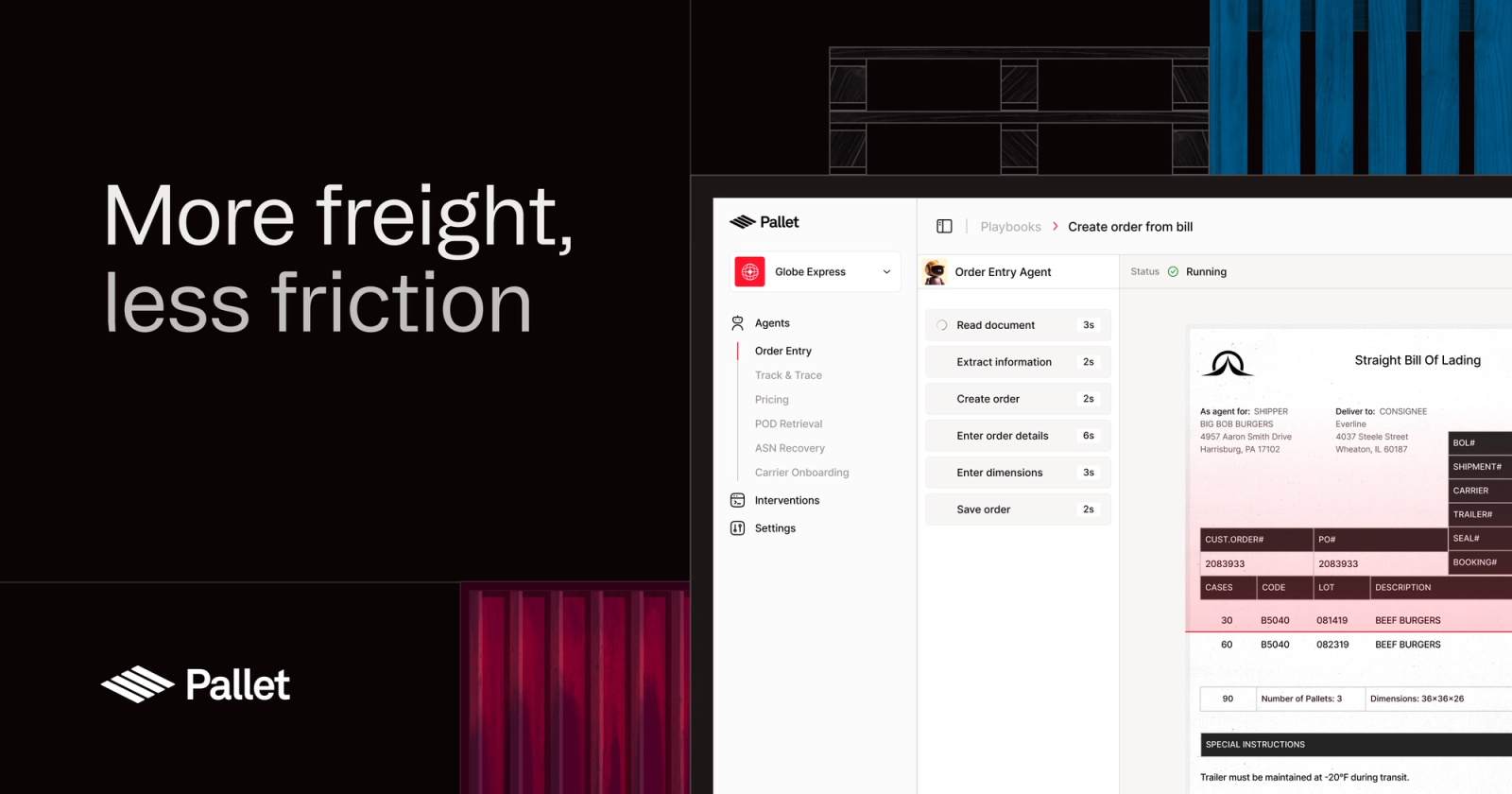
In freight brokerage, the deal is only half the job. Behind every booked load sits a mountain of manual work: keying orders and bills of lading into a transportation management system, chasing carrier appointments, sorting scale tickets and lumper receipts, hunting down proofs of delivery, and reconciling invoices line by line. Pallet, a San Francisco company building what it calls an AI logistics workforce, is betting that machines can absorb almost all of it — and that brokers will spend the reclaimed hours doing the one thing software can't: selling more freight.
The pitch is deceptively simple. “Sometimes, half the employees in a logistics company are tasked with back-office work and customer support,” co-founder Sushanth Raman has observed. For a multi-trillion-dollar transportation and warehousing industry that still runs on siloed, decades-old systems — despite spending more than $30 billion a year on management software — that back office is both an enormous cost center and, Pallet argues, an enormous opportunity.
Pallet has cut the cost of our load execution in half. Now that I no longer spend my days wrestling with operations, I focus my time on selling more freight.— President, national freight brokerage
01The back office was the bottleneck
Ask any brokerage operator where the day goes and the answer is rarely “closing deals.” It's data entry. It's portal logins. It's the receipt that didn't scan cleanly and the appointment that has to be rebooked. These are the tasks that don't scale with a team's ambition — they scale with volume, headcount and overtime. Pallet's thesis is that this work is repetitive enough for AI to handle, and consequential enough that handling it well changes the economics of a brokerage.
Rather than sell another dashboard, Pallet built AI agents that actually perform the work end to end — reading the documents, making the entries, booking the appointments — inside the systems brokerages already use.
02Five workflows, handled end to end
Pallet's AI agents cover the operational spine of a brokerage. Each is scoped to a concrete, high-volume task rather than a vague promise of “automation.”
The Pallet AI Workforce — core workflows
03No rip-and-replace
The graveyard of logistics software is full of platforms that demanded a company throw out what worked. Pallet took the opposite stance. Its AI plugs into existing tools — McLeod, DAT, shared inboxes — adapts to a company's own procedures, and keeps “humans in the loop” for oversight and the unusual cases automation shouldn't close on its own. The result is efficiency without disruption: the software moves into the workflow instead of forcing the workflow to move.
processing
errors
labor savings
04The numbers brokers care about
The measurable case is blunt: loads processed roughly ten times faster, processing errors down about a third, and back-office labor costs halved. Pallet markets its AI workforce as CoPallet, which it says completes time-consuming tasks like order entry, quoting and portal updates at less than half the cost of traditional staffing — and with human-level accuracy.
Early traction backs the story. Within eighteen months of launch, Pallet reached a roughly $3 million annual run rate with about 60 customers — and, tellingly, adoption stuck: some 70% of employees at client companies were using the tool daily, a rate that's rare for enterprise software and rarer still in an industry known for resisting new tech.
05From Retool to the loading dock
Pallet was founded in 2022 by Sushanth Raman and Andrew Spencer, both early engineers at low-code startup Retool. The problem is personal for both: Raman's grandfather was in the shipping business, and Spencer's father runs the engineering team at transportation management company MercuryGate. Raman's motivation crystallized after meeting Bay Area logistics businesses and discovering how much of the work was still done by hand.
An order starts and gets sent to you, and you can deliver it without a human in the loop.— Sushanth Raman, on Pallet's vision of the “contactless order”
That phrase — the “contactless order” — is Pallet's north star: a world where an order moves from origin to delivery without a person having to shepherd the paperwork at every step. It sounds like science fiction on a freight dock. Pallet is trying to make it a Tuesday.
06Backed to scale
In May 2025, Pallet announced a $27 million Series B led by General Catalyst, with continued support from Bain Capital Ventures, Activant Capital and Bessemer Venture Partners — bringing total funding to $50 million. The capital is aimed at scaling the AI workforce beyond brokerages to third-party logistics providers, freight forwarders, carriers and shippers.
The wager underneath the round is unglamorous by design. Freight's back office — the scale tickets, the lumper receipts, the POD chasing — is enormous, manual and, Pallet insists, fixable. If the company is right, the most valuable thing it builds won't be a slicker interface. It will be the hours it hands back to the people who move the world's freight.