IBM's Bob Grows Up: From Coding Assistant to an Agentic Development Partner
IBM has rebuilt its agentic software development platform around a hard truth: AI made writing code fast, but reviewing and shipping it is now the bottleneck. Multi-agent coordination, cost visibility, and pre-built modernization workflows are its answer.
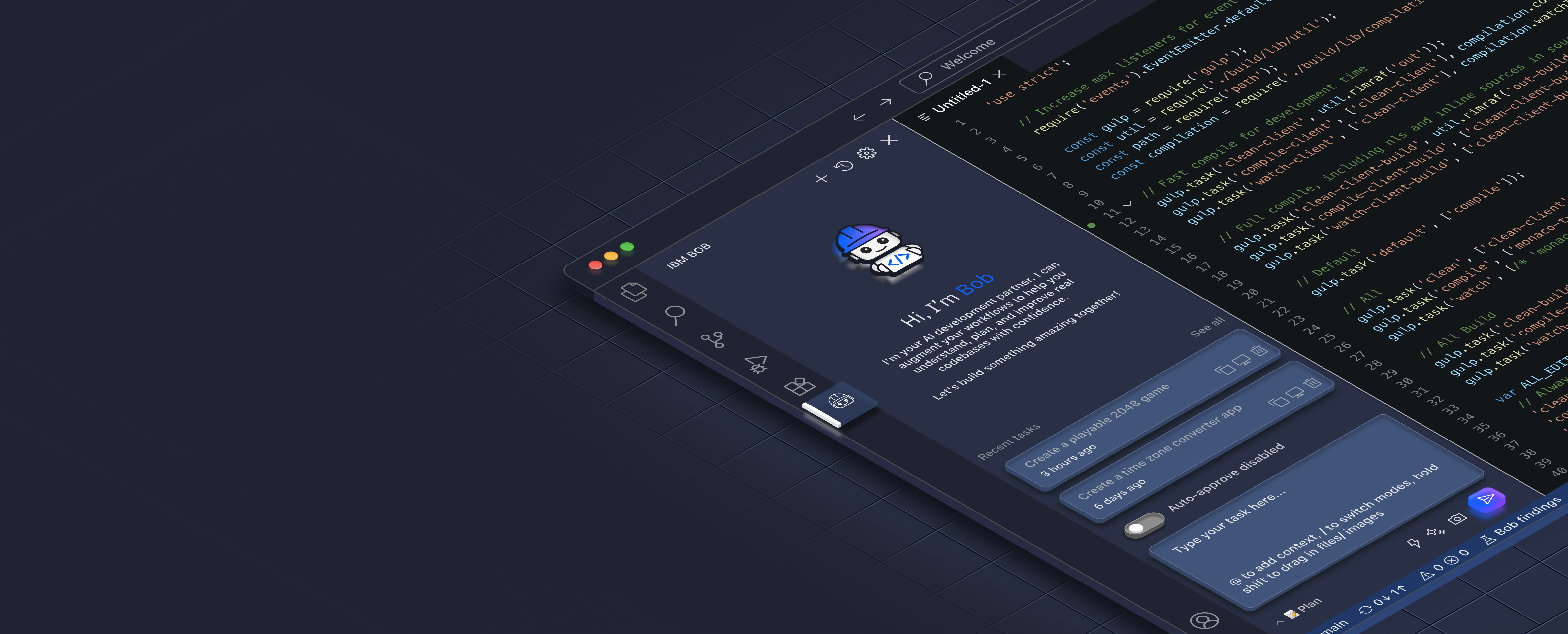
On July 9, 2026, from its Armonk, New York headquarters, IBM unveiled a sweeping set of enhancements to IBM Bob — the company's agentic software development platform — and in doing so made a quiet but pointed argument about where enterprise AI is actually headed. The era of the standalone coding assistant, IBM contends, is ending. What comes next is a coordinated crew of AI agents working across the entire software development lifecycle.
The pitch rests on a diagnosis that will resonate with anyone shipping software at scale. Generative AI has made writing code astonishingly cheap and fast. But speed at the keyboard simply pushed the constraint downstream. According to IBM, 85% of DevSecOps professionals now report that bottlenecks have shifted to the code review and validation stages — the unglamorous, high-stakes work of making sure AI-generated code is actually production-ready.
Where the Bottleneck Went
Source: IBM, share of DevSecOps professionals reporting the shift.
One Foundation, Many Agents
Rather than isolating AI to a single-task interface, the updated Bob is built on a unified foundation that lets teams coordinate across the full lifecycle. The platform intelligently matches models to specific tasks and orchestrates their execution across multiple agents. In practical terms, Bob stops behaving like a lone copilot and starts behaving like a team — one that can plan, generate, review, and validate in concert.
"The bar for enterprise AI is no longer a better coding assistant. It's an end-to-end agentic development partner."
Neel SundaresanGM, Automation and AI, IBM
Underneath that coordination sit two engineering choices aimed squarely at cost and reliability. Parallel, model-native tool calling lets a model request several tools at once instead of waiting turn by turn. And subagents that manage isolated context keep each agent's working memory lean — reducing cost while maintaining performance, a persistent tension in agentic systems where context bloat quietly inflates every bill.
Usage & Cost Visibility
Bobalytics monitors consumption and resource allocation so teams can scale AI appropriately — not blindly.
Parallel Tool Calling
Model-native design lets agents request multiple tools simultaneously, cutting round-trip latency.
Context-Managing Subagents
Isolated context handling reduces cost while preserving output quality across complex tasks.
Bobalytics: Putting the Meter in Plain Sight
A recurring theme in IBM's announcement is money. Bob, the company says, is built to optimize the cost of AI-driven development "beyond the model" — an acknowledgment that the sticker price of a foundation model is only one line in the true cost of shipping AI-assisted software. The new Bobalytics feature gives enterprises built-in visibility into consumption and resource allocation, turning what is often a mysterious cloud bill into something a platform team can actually manage and forecast.
The Modernization Play
For enterprises sitting on decades of legacy code, the headline feature is a set of premium packages with pre-built, customizable workflows. These target precisely the systems that keep CIOs awake at night — mainframes, midrange platforms, and aging Java estates — and package the modernization work as repeatable flows rather than bespoke, multi-year expeditions.
The value proposition here is unusually concrete. Modernization is the least glamorous work in enterprise IT and, arguably, the most valuable — the code that runs banks, insurers, and supply chains rarely gets a rewrite because the risk and effort are so high. By turning that effort into a guided, agentic workflow, IBM is betting that the decision enterprises have long dreaded becomes something they simply run.
Proof From the Field
Numbers do the persuading, and IBM offers a striking one. Blue Pearl, an early adopter, reported completing a modernization project that would have taken 14 engineers nine months in just three days using IBM Bob. Its chief executive was careful to point past the raw velocity.
"The most powerful outcome wasn't the speed – it was the combination of operational efficiency and cost optimization."
Saireshan GovenderGroup CEO, Blue Pearl
A second customer story reinforces the modernization angle from a different platform. At Jack Henry, a provider of technology to financial institutions, the team applied Bob to the IBM i world — and to the institutional knowledge locked inside long-lived systems.
"Our developers are able to accelerate RPG development workflows, improve code quality, and gain deeper insights into decades of accumulated system knowledge."
Kevin SligarChief Technical Architect, Jack Henry
Why It Matters
Strip away the product names and IBM is making a bet about the shape of enterprise AI. As models commoditize and code generation becomes table stakes, the differentiator moves to orchestration, trust, and cost control — the ability to coordinate many agents, validate their output, and keep the whole thing economically sane at scale. Bob's release reads as an attempt to own that layer, and to do it precisely where IBM has always been strong: the deep, unfashionable, mission-critical systems that most of the industry would rather not touch.
Whether that bet pays off will depend on results beyond a handful of marquee customers. But the framing is clear. The question is no longer whether AI can write your code. It is whether AI can help you review it, modernize it, trust it, and afford it. IBM Bob is a wager that the answer to all four can live in one platform. IBM Bob is available for download at bob.ibm.com/download.