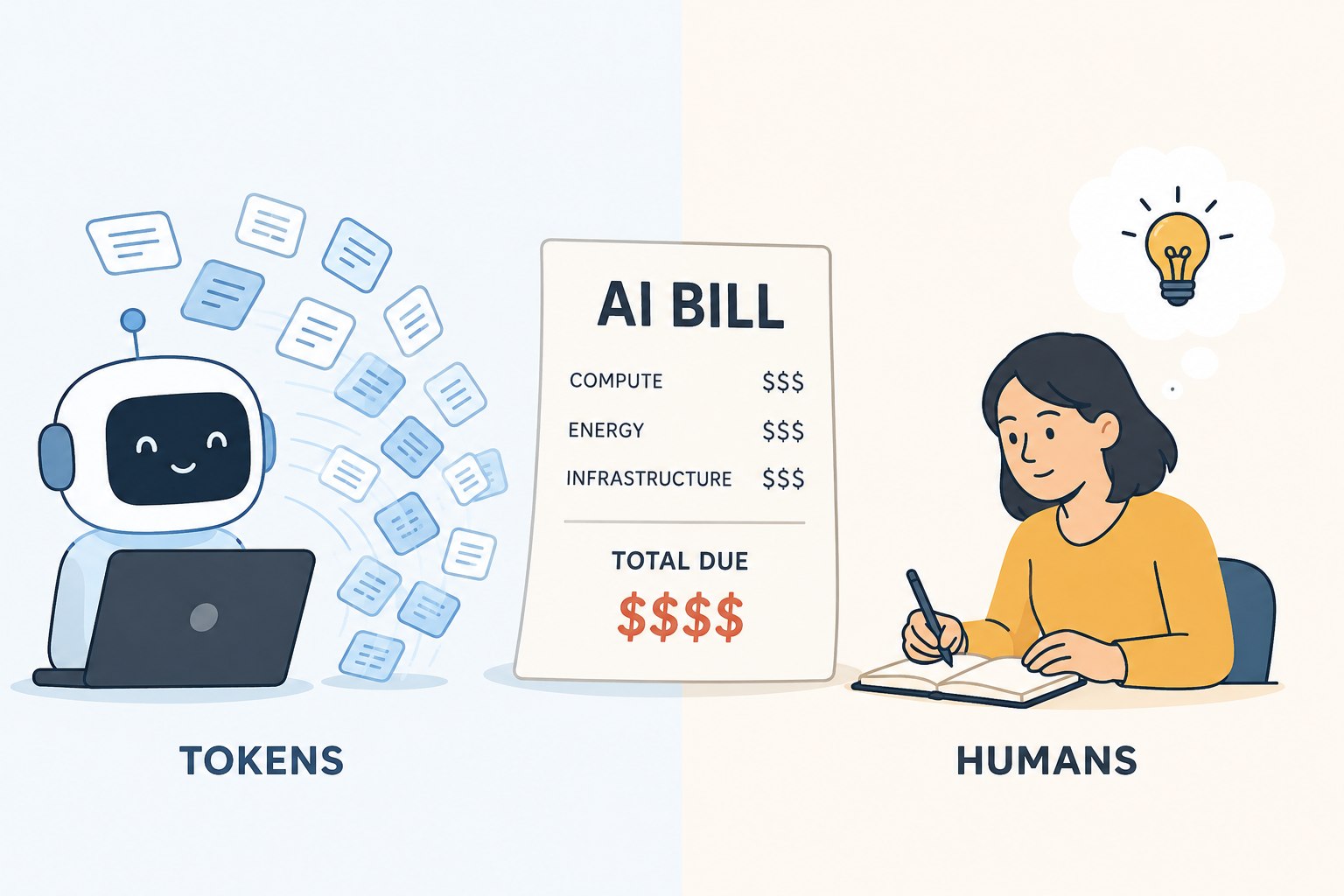
It was supposed to be the cheapest hire in history — a tireless digital worker that could do the job of ten people at a tenth of the price. Three years later, the machine that replaced the workers is threatening to cost more than the workers ever did.
▶ Watch on YouTube →When ChatGPT arrived in 2022, the growth that followed was, by any measure, staggering. Hyperrealistic images. Code that wrote itself. Complex tasks delegated with a single sentence. AI seemed capable of doing everything, and doing it with unnerving ease. Companies looked at the demonstrations, looked at the price tag, and started adopting AI exponentially. They folded it into their processes. And they discovered it was extremely cheap. That, the video argues, is precisely where the trouble began.
The layoffs came in waves. Amazon. Chegg. Microsoft. Meta. Salesforce. Tech companies shed tens of thousands of jobs, and the cuts didn't stop at the office park. Fast-food chains announced that artificial intelligence would soon work the drive-thru at hundreds of locations by the end of the year. "You could soon be ordering from an AI machine instead of a real person," one broadcast warned. AI, the narration notes, was wiping out almost any type of job — performing the work of entire teams in minutes, largely because it was more efficient, but above all because it was cheaper to maintain.
Then, in recent months, something cracked. "Because AI maybe is becoming too expensive to scale," one clip observes. Another lands the metaphor that gives this story its shape: "Using open cloud these days is like driving a Ferrari." The signal that turned heads was internal and blunt — Microsoft banned its own employees from using Anthropic's Claude Code because of its cost. "So Microsoft starts canceling Claude code licenses," a voice reports. And it wasn't just Redmond. Uber, Nvidia, Amazon and hundreds of other companies reported the same problem, one severe enough that even top executives struggled to justify the spend.
The Rise of "Token Maxing"
To understand how a technology sold as a bargain became a budget-devouring liability, you have to understand how companies measured it. Starting in 2023, firms didn't just encourage employees to use AI tools — they forced them to. Demand for the models grew uncontrollably. And the unit of measurement was the token: the fragment of text an AI model reads and writes. Roughly 750 words costs about 1,000 tokens. Images, video and code cost far more.
A high token count became a status symbol. Burning tokens proved you were going above and beyond to hit your key performance indicators. So employees did what employees do when a number becomes a scoreboard — they gamed it. They used tokens excessively, sometimes on genuinely insignificant tasks, simply to look more efficient at the end of the month. A culture was born, and it got a name: token maxing. "Token max, like that's actually the coolest thing you can do now," one commentator marvels.
The incentive came from the very top of the industry. In one of the video's most jarring moments, Nvidia's CEO — whose company is among the biggest beneficiaries of the entire AI boom — is quoted urging developers to consume tokens with abandon.
The problem, the narration is careful to point out, is that all this demand did not correspond to real demand. It was artificially inflated. "Silicon Valley engineers are now being scored on how many AI tokens they use," a reporter notes — a metric that "may end up inflating overall AI demand." When a hyperscaler like Amazon's Andy Jassy tells Wall Street in his annual letter that demand is outstripping supply, the analysts in the video pose the uncomfortable follow-up.
The Supply Squeeze
Inflated demand met a shrinking supply, and the collision showed up in the price. Shortages of the electronic components needed to build data centers began delaying projects across the industry. According to Bloomberg, cited in the video, nearly 50% of all data center construction projects planned for 2026 in the United States have been canceled or delayed. Many of those projects had been greenlit on the assumption that the enormous demand AI companies were reporting was real. The Economic Times, also cited, notes that demand for AI infrastructure continues to greatly exceed supply.
So the price moved. According to Bloomberg Finance, the average cost of tokens from large language models has more than doubled since 2025. In December of that year, the average was $1.01 per million tokens; by May 2026, it had reached $2.12 per million. That may sound trivial — pennies per million — until you remember the volumes involved. "Employees in a company use about $200 worth of tokens every week, 50 weeks a year, that's 10,000 bucks in tokens," one voice calculates. "You have 40,000 employees, that's $400 million. You have 90,000 employees, that's $900" million. AT&T alone reported consuming nearly 8 billion tokens every single day.
Extremely Profitable — For Now
The surge has been a windfall for the two companies at the center of it. According to Reuters, Anthropic aims to nearly triple its annualized revenue in 2026 on the back of enterprise AI agent adoption — from roughly $3 billion at the end of 2025 to nearly $9.6 billion. But the flip side is that employers are blowing through their AI budgets, arriving at a place where it is no longer obvious that AI is cheaper than hiring people. And the AI companies are starting to notice.
That internal Microsoft memo — the one from an executive vice president instructing engineers to stop using Claude Code — was initially framed as a push toward tools inside the same ecosystem, like GitHub Copilot. But the real reason, the video says, later became clear: the enormous cost of Claude Code. Fortune reports other companies are pulling back too. Reuters found that Meta consumed nearly 60 trillion tokens in a single month — roughly $900 million worth at Anthropic's blended prices.
The pressure is landing squarely on corporate finance. A Gartner survey found three-quarters of the executives polled expect technology budgets to rise this year, and nearly half anticipate double-digit percentage increases. A sizable chunk of that goes to AI, projected to account for more than a fifth of total enterprise technology spending by 2035. Global spending on AI agents and models is estimated to hit $680 billion by 2027 — more than double 2025 levels.
The IPO Time Bomb
Here is the twist that makes today's prices look like a discount. Those $680 billion estimates were built on current average costs — and both Anthropic and OpenAI are still not profitable. They are operating at a loss, subsidizing the true cost of tokens with generous, abundant funding. But both companies are expected to go public in the coming months, and once they answer to shareholders, that arrangement ends. To generate profit, they will inevitably raise the price of using their tokens and agents. In other words: what companies pay today could multiply.
And if the cost keeps climbing, there is a point at which hiring people becomes cheaper than paying for tokens. This is not a forecast, the video insists — it is already happening. "Maybe human labor will be more cost-efficient after all," one reporter says. "Uber and Microsoft are starting to second-guess aggressive AI adoption. That's partly because the cost of using AI can exceed the cost of human employees."
According to Reuters, the current cost of running AI agents is already comparable to human labor, and in some cases higher. The picture is task-by-task: coding is still undeniably cheaper with AI; data entry is roughly a wash; but for work like call centers, human labor can actually come out cheaper. The subsidies that hid the real cost of tokens, the narration warns, appear to be coming to an end.
The Wall Street Journal reports that enterprise customers are beginning to question the true return on these investments. Stack it all together — the public listings of Anthropic and OpenAI, investor pressure for returns, and the ongoing component shortages — and you get the perfect formula for token costs to keep rising. The video closes on the recursive irony at the heart of the whole saga: a moment when companies start asking whether it makes sense to pay more for a simple tool than they used to pay many of the workers they laid off to adopt it.
The concern is no longer hypothetical. When the market first absorbed the rising cost of AI, the video notes, it triggered a major tech stock sell-off that dragged the S&P and Nasdaq down more than 500 points. The Ferrari, it turns out, is thrilling to drive. It's the standing still — engine running, meter ticking — that nobody priced in.