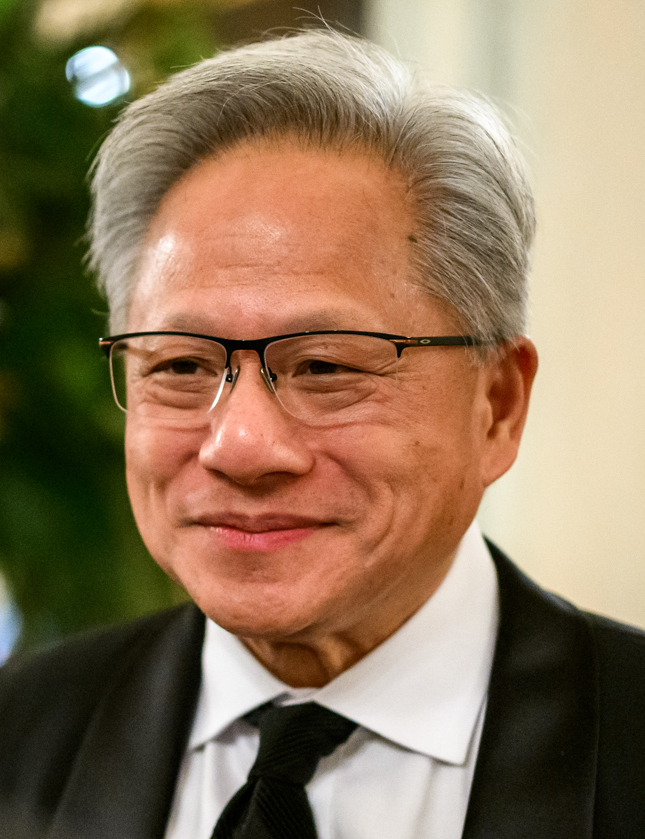
The Dishwasher Who Rewired the World
Most origin stories start with a garage. Jensen Huang's starts with a toilet brush. At nine years old, shipped ahead of his parents to the United States, he and his older brother landed not at the prestigious boarding school their uncle intended, but at the Oneida Baptist Institute - an all-boys reform school deep in rural Kentucky. His daily chore: cleaning the boys' bathrooms. He was the smallest kid there, spoke accented English, and knew nobody. He stayed for two years.
By the time he was 15 and living in the suburbs of Portland, Oregon, he was working graveyard shifts at a local Denny's - dishwasher first, then busboy, then waiter. He was a nationally ranked table tennis player, a straight-A student, and quietly the most competitive person in any room he entered. This is the part of Jensen Huang that Silicon Valley tends to skip when it tells his story. The leather jacket and the GPU keynotes are easier to lead with.
NVIDIA was incorporated on April 5, 1993, in a Denny's booth on Berryessa Road in East San Jose. Jensen Huang, Chris Malachowsky, and Curtis Priem sketched out what would become the world's most powerful chip company on napkins over coffee. Years earlier, Huang had bussed those same kinds of tables. He considers the symmetry one of the best jokes the universe ever told.
Before NVIDIA, Huang ran stints at AMD and LSI Logic, where he climbed fast and studied faster - earning a Master's in Electrical Engineering from Stanford while working full-time, reading textbooks at night after his colleagues had gone home. He didn't pause to celebrate the degree. He went back to work.
The early NVIDIA years were survivalist. The company nearly collapsed multiple times - bad bets on chip architecture, a botched partnership with Sega, a near-death pivot that required reinventing the entire product line in months. Other CEOs would have smoothed this over in retrospect. Huang talks about it plainly: "I think that's what's thrilling about leadership - when you're holding onto literally the worst possible hand on the planet and you know you're still going to win."
Greatness comes from character, not from people who are smart. Greatness comes from people who have suffered.
- Jensen HuangThe inflection point that changed everything wasn't the GPU - it was CUDA. In 2006, Huang bet that the parallel processing power of graphics chips could be weaponized for general computation. Almost nobody agreed with him. Scientific computing ran on CPUs. GPUs were for gamers and animators. CUDA was a $600 million bet on a market that didn't exist yet.
Researchers started quietly using CUDA for neural network training around 2012. The AlexNet breakthrough that year - trained on NVIDIA GPUs, outpacing every competing approach by a margin that stunned the field - was less a discovery than a detonation. The AI age had a fuse, and Huang had lit it six years earlier.
Since then, NVIDIA has been less a chip company than an infrastructure play. Every major AI model - GPT, Gemini, Claude, Llama - runs on NVIDIA hardware. The data centers Huang now calls "AI factories" are the industrial base of a revolution that others are still naming. He named it first.
There may be people smarter than me, but no one is ever going to work harder than me.
- Jensen HuangIn October 2025, NVIDIA's market capitalization crossed $5 trillion - the first company in history to do so. The number is almost meaningless in its scale. The US GDP is $28 trillion. NVIDIA alone is worth nearly 18% of that. Huang's personal stake - roughly 3.3% - makes him worth approximately $180 billion, placing him in the top ten wealthiest people on the planet.
His base salary is relatively modest for a man of his standing. His annual bonus runs about $4 million when earned. This is the kind of detail that tells you something important: Jensen Huang is not primarily interested in money. He is interested in winning.
He runs the company with radical transparency. No one-on-ones. No backchannels. "Almost everything that I say, I say to everybody at the same time." His organizational chart is notoriously flat. Over two hundred senior employees report directly to him. He communicates the same information to everyone simultaneously, the way you'd want to be updated by someone who actually trusts you.
The leather jacket is not an accident. Jensen Huang has worn his signature all-black leather jacket at every major public appearance for years. It is so thoroughly associated with him that Mark Zuckerberg posted a photo in March 2024 wearing it, captioning the swap: "He's like Taylor Swift, but for tech." Huang accepted the comparison with the same expression he uses when someone asks a question he already answered three years ago.
In 2014, to celebrate NVIDIA stock crossing $100, he got the NVIDIA logo tattooed on his left arm. He cried during it. He immediately swore off any future tattoos. The stock has since risen by roughly 10,000%. The tattoo remains.
His children, Spencer and Madison, both work at NVIDIA. His wife Lori was his lab partner at Oregon State University. The Jen-Hsun and Lori Huang Foundation, seeded in 2007 with $300 million in NVIDIA stock, now holds over $12 billion in assets - making it one of the largest private foundations in the United States. In 2022, they gave $50 million to Oregon State for an AI and robotics research complex. They named it the Jen-Hsun and Lori Huang Collaborative Innovation Complex. The university where he once washed beakers now carries his name on a building.
At his annual GPU Technology Conference, the GTC, Huang delivers keynotes that tech media now routinely compares to Apple product launches. The audience is tens of thousands. The livestream draws millions more. He unveils chip architectures the way others unveil albums. For the AI industry, Jensen Huang's keynote is the event of the year.
Leadership is about empowering people to do their life's work.
- Jensen HuangHis current vision - "physical AI" and what he calls "AI factories" - reframes NVIDIA's data center business not as a technology service but as an industrial revolution. The chips aren't products. They're the means of production for an entirely new kind of economy. Whether that framing proves prophetic or grandiose is a question Jensen Huang will answer by continuing to work while everyone else is still asking it.
In April 2026, he received the IEEE Medal of Honor - the IEEE's highest individual honor, which carries a $2 million prize. He was also appointed to the President's Council of Advisors on Science and Technology by the Trump administration. That same month he said that some AI CEOs predicting apocalyptic job loss had a "God complex" that was creating unnecessary worker shortages. He did not name names. He didn't need to.
He was 62 years old in 2025. He has held the same job title for 32 consecutive years. The average Silicon Valley CEO tenure is approximately four years. Jensen Huang has outlasted eight generations of tech leadership, two dot-com crashes, a pandemic, and the rise and partial fall of every major AI hype cycle before this one.
His formula has never changed: longer time horizon, deeper technical conviction, and a willingness to endure the years before you're proven right. The dishwasher at Denny's already knew this. The reform school kid cleaning bathrooms knew it too. Some people are built from the outside in. Jensen Huang was built from the suffering out.
Direct & Unfiltered
"I think that's what's thrilling about leadership - when you're holding onto literally the worst possible hand on the planet and you know you're still going to win."
Jensen Huang - on adversity"I don't do one-on-ones. Almost everything that I say, I say to everybody at the same time. I don't believe there's any information that only 1-2 people should hear about."
Jensen Huang - on transparency"Aging gracefully. No more tattoos. It hurts way more than anybody tells you."
Jensen Huang - 2023, on his NVIDIA tattoo"Engineers ultimately are the ones that take an invention and advance it in such a way that it's safe, beneficial, ultimately transformative to society."
Jensen Huang - 2026 IEEE Medal acceptance