In 2008, two brothers from Karachi sat down to solve a problem that probably seemed small from the outside: how do businesses talk to their field teams, their franchisees, their customers - reliably, at scale, without everything breaking? One of them, Syed Amir Jafri, had no engineering background. His brother Syed Asif Jafri was in the same boat. What they had was a clear view of a gap in the market, and the stubbornness to fill it.
That company became Eocean. Seventeen years later, it processes over two billion API requests a year, maintains 99.97% uptime, and serves clients like Google, Unilever, Visa, HBL, and Careem across 180+ countries. Not bad for a startup that began without a codebase.
The Man Who Learned on the Job - Then Won Global Awards
Jafri has described his early inspiration as Steve Jobs - specifically Jobs' willingness to build around a vision without being constrained by formal credentials. That philosophy stuck. Where others looked at Pakistan's communication infrastructure in 2008 and saw limitations, Jafri saw the exact shape of the opportunity.
Eocean's first real breakthrough came in 2011, when the company partnered with Summit Bank to launch SMS-based customer engagement. At the time, mobile messaging as a business tool was still nascent in Pakistan. Eocean made the bet early. They secured a Class Value Added Service (CVAS) license from Pakistan's PTA - a signal that this wasn't a side project but a serious infrastructure play.
The company spent the next decade quietly building what most companies don't talk about: reliability. Compliance frameworks. ISO 27001 certification. The kind of back-end credibility that makes a bank or a hospital willing to put their customer communications through your pipes. By the time WhatsApp for Business emerged as the next communication frontier, Eocean was ready. In 2021, they became an official WhatsApp for Business Meta Partner - a status that positioned them as the go-to implementation layer for enterprises wanting to reach customers on messaging apps.
"Our journey has always been about more than technology - it's about trust, reliability, and empowering businesses to communicate securely."
- Syed Amir Jafri, CEO, EoceanThe Connector Who Didn't Wait for a Conference Room
In 2017, Jafri did something that a lot of successful operators skip: he organized a conference not for himself, but for his ecosystem. Momentum ran for three editions (2017-2019) and brought together 200+ entrepreneurs, investors, and technology leaders at a time when Pakistan's startup scene was still finding its footing. No flashy VC money behind it. Just a recognition that networks don't build themselves.
The kind of infrastructure thinking that built Eocean also shaped Kistpay, the fintech co-venture he launched with Asif Jafri in 2022. Kistpay targets a problem hiding in plain sight: most people in Pakistan who want a smartphone can't afford one upfront. Kistpay aggregates finance, telecom, insurance, and mobile tech into a single financing ecosystem. The World Bank and GSMA noticed. The company opened offices in Abu Dhabi and Kigali, suggesting this isn't a local experiment - it's a model designed to travel.
AI Before AI Was Cool in the Region
When ChatGPT dropped in late 2022, most companies issued memos about responsible use. Jafri integrated it directly into Kistpay's customer service operations via WhatsApp - before "AI-powered customer service" became a box on every pitch deck. His take is typically pragmatic: "ChatGPT will become an important tool if you 'train' it correctly." Not hype. Not skepticism. Just a read on what actually works.
That same year, he enrolled in MIT Sloan Executive Education's Chief Digital Officer program, completing it in 2023. The certification matters less as a credential and more as a signal: Jafri isn't coasting on what built Eocean. He keeps updating the operating system.
The 2025 Moment
In 2025, Eocean won the Best XaaS Solution at the Global Connectivity Awards - one of the telecom industry's most competitive categories. The judges cited the company's "wide-ranging communications suite (WhatsApp/SMS/voice) reaching 180+ countries," "strong platform orchestration," "good AI integration," and "clear cost-saving advantages for clients." That's not marketing language. That's a technical committee calling a bootstrapped Pakistani CPaaS the best in its category against global competition.
Jafri attended the Banking of the Future Forum 2025 in Karachi and the Singapore FinTech Festival 2025 - the kind of forums where the next five years of financial infrastructure get sketched out. He's clearly not planning to slow down.
What the Awards Don't Tell You
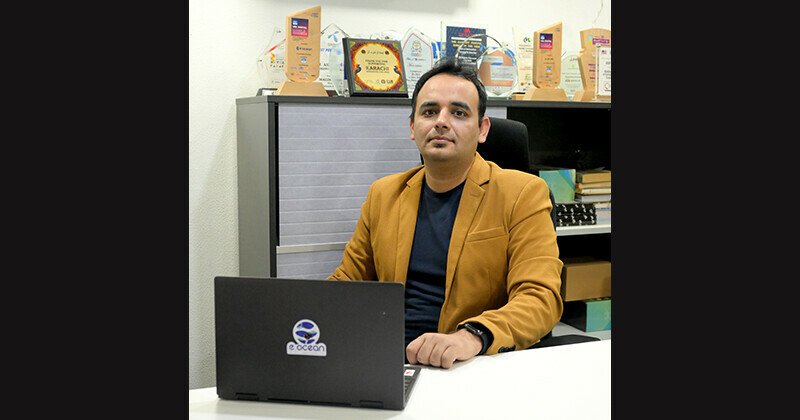
The most interesting thing about Jafri isn't the trophy shelf (which is, by all accounts, visible and substantial - you can see it in his office photos). It's the pattern. He built a communications company without a tech background. He launched a conference to strengthen an ecosystem he was still part of. He co-founded a fintech to solve the affordability gap he watched play out around him. He went to MIT not to validate past work but to prepare for the next chapter.
That's not luck. That's a repeatable approach to spotting gaps, building conviction, and executing without waiting for permission. Whether Eocean becomes the dominant CPaaS across South Asia and the GCC, or Kistpay replicates its smartphone financing model across Africa, the underlying method is the same: find the infrastructure nobody has built yet. Build it properly. Stay in the room long enough to win.
In an industry full of people who talk about digital transformation, Syed Amir Jafri has been delivering it since 2008.