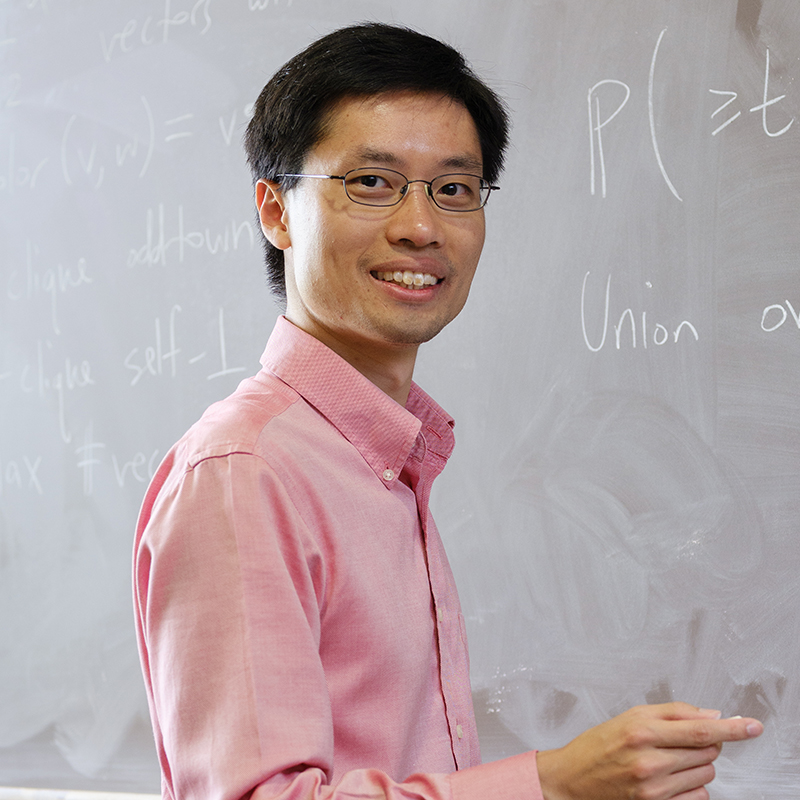
For most of recorded history, Po-Shen Loh points out, humans held an unglamorous but unchallenged title: the most capable thing on the planet. He does not think that will last much longer. "Soon," the Carnegie Mellon math professor says, almost cheerfully, "it will not be that case." Then he adds the line that reframes everything else he says over the next twenty minutes: "The only unique thing about human intelligence is that we hopefully care that humans still exist."
It is a strange sentence to hear from a man who has spent his life at the summit of human reasoning. Loh is a mathematician who coached the United States International Math Olympiad team, a professor at one of the country's most demanding technical universities, and, by his own description, "a mathematician who likes to solve real-world problems." He is also, increasingly, an evangelist for a single, urgent idea — that in an era when artificial intelligence can out-reason and out-write us, the ability to think for yourself is no longer just an academic nicety. It is survival.
The Machine That Beat the Coach
Loh's alarm is not theoretical, and it did not arrive gradually. "My biggest surprise," he says, "was last year the International Math Olympiad problems — four of them were solved by Google's artificial intelligence." To understand why this landed like a thunderclap, you have to understand how the Olympiad works. Its six questions are engineered to be unprecedented. "When the national coaches meet," Loh explains, "they all look at the problems and they all try to make sure nothing too similar to those problems has ever appeared in any contest or anywhere in the world before." Originality is the entire point.
And yet the machine cracked four of the six. Loh delivers the punchline without a trace of ego: it was "more than I can do." Here is a man who has trained the best young mathematical minds in America, conceding that a large language model had, on the hardest and most original test in the discipline, out-performed him. If creativity was supposed to be the moat protecting human intelligence, the moat had just been forded.
The artificial intelligence was able to come up with solutions to four out of six — which is more than I can do.
— Po-Shen LohHis diagnosis of why is disarmingly simple, and it doubles as his central argument. "You just have to think, what is that AI anyway? It's a large language model. How is that AI so good? It's because it's good at language. It's good at looking at the patterns of words that often appear." The engine of the revolution, in other words, is the letter L. Language. Which means the skills schools have always claimed to teach — "reading and writing, communication, logic" — are not obsolete in the age of AI. They are, Loh insists, precisely the terrain on which the machines have chosen to compete.
Why He Won't Let You Skip the Writing
This is where Loh turns from observer to something closer to a prophet with a grievance. In schools, he notes, "one of the biggest places where students are using AI to cheat on their homework is for their writing." And he wants to be very clear about why that is a catastrophe and not a convenience. His analogy is the sort of thing that lodges in the brain and refuses to leave.
Using AI to do your writing homework in school is like saying, "I'm not going to run a mile for exercise. I'm going to drive my car one mile." How much exercise do you get? You get none.
— Po-Shen LohThe point of the mile, he means, was never the mile. The point of the essay was never the essay. "That writing is actually part of your own learning," he says. A working adult using AI to draft a report is fine — "you're using it to do a job." But a student outsourcing the struggle is skipping the workout that builds the mental muscle. And the stakes, when multiplied across a generation, are civilizational: "If many kids lose this ability, we'll get many kids who grow up and aren't able to think logically. All they're able to do is just take whatever anyone else gives them. They'll just be dependent."
Loh is so committed to this that he extends it, provocatively, to his own family. A father of three, he says he doesn't "really even care too much if all of my children go to university," because by the time they get there "the world will be so different." The only credential he trusts to hold its value is "that ability to synthesize your own idea."
From Doing Homework to Grading It
If the old model of education was learning to produce the right answer, Loh believes the new one inverts the whole enterprise. "People used to go to school to learn how to do the homework and do the exams," he says. "Today, everyone needs to learn how to grade the homework. This is the huge difference." When a machine can generate a plausible answer in seconds, the scarce and valuable human act becomes judgment — the ability to look at an answer, especially a confident and polished one, and decide whether it is actually right.
This is also why Loh has spent years quietly waging war on an entire industry: test-prep cramming. He remembers doing math competitions in the 1980s, when "the way you got good at it was by thinking. Every problem which was new was a chance to practice mental flexibility." Today, he says, a vast machine exists to eliminate exactly that surprise — drilling students through every conceivable variant of a question "so that when the students see the test questions, they are never surprised." The result is kids shuttling from school to after-school to more after-school, which he calls "actually very bad for the student." But the deeper cost is subtler: "It takes away the student's chance to invent."
His own method is a deliberate inversion. When he interviews the high-school students who want to work with him, he asks questions "until it's very clear from their body language that they have never seen this question before." The expectation, he tells them, is that they will fail to solve it. What he is watching for is what happens next — how they metabolize hints, "how quickly can you synthesize them into a solution for a problem we have never seen before." That, he says, "is also creativity. We really need this skill."
The Win-Win-Win Nobody Could Imagine
What makes Loh more than a worried commentator is that he has built a machine of his own to fight back — an "ecosystem," as he calls it, that took eight years to invent and two more to scale. Its origins are almost comically indirect. Loh, trying to become a better communicator of mathematics, once enrolled in improvisational comedy classes. "Improv comedy classes are acting classes," he says. "Even a math nerd like me can take those classes and then become able to talk to a few more people."
That detour cracked open a three-sided puzzle. There were middle schoolers who needed to learn how to think. There were brilliant high-school math students who needed to build the human skills — the EQ, the warmth — that pure competition never gave them. And, when Loh wandered into his university's drama department, he found a third group: extraordinarily talented actors hungry for "a stable part-time job, flexible hours, that they can use to support their passions." Line them up, and everybody wins.
Anytime anyone wants to ask a high school student to do anything, my answer is always: can we explain to their parent why, for a very busy high school student, that thing is the best thing they can do with their time?
— Po-Shen LohThe discipline is strict. "We will never have a high school student doing something unless I could explain myself to their parent," he says. The justification, in this case, writes itself: the students get to learn from "a Broadway or Hollywood quality actor or actress." The classes, he says, look "as good as a Twitch gaming stream" and are "taught by math geniuses who are smiling." Loh estimates the model could eventually reach 100,000 U.S. high schoolers — one percent of the total — who would in turn teach roughly a million middle schoolers.
Notably, the curriculum is narrow on purpose: algebra, geometry, combinatorics, number theory. Not because those subjects are sacred, but because they are "a curriculum that teaches you how to think," drawing on middle-school competition problems precisely "because the people making those problems were trying to make problems that you don't see in school." The endgame is almost self-abolishing. "Our goal," Loh says, "is to make it so that as fast as possible, you don't need any classes from anyone ever again."
Empathy as an Economic Survival Skill
Loh's philosophy did not always look like this. As national Olympic coach he watched "so clever, so capable people who were still so depressed," young champions who "thought that the point of life was to find ways to prove you're better than other people." The realization reshaped his mission. "The philosophy in life should not be: how do I outdo everyone else?" he says. "If you do that, you'll probably never be satisfied." The alternative he found is almost addictive: "It is actually addictive to make a bunch of other people happy. Oh, now I can do it for five people. Oh, now I can do it for 500."
In an AI economy, he argues, this is not soft sentiment — it is hard strategy. As the machines absorb more and more tasks, the reason anyone will want you on their team is that "they somehow felt like you are going to create some value and they like that vibe." Empathy also turns out to be the engine of problem-solving itself: "You can't solve a problem unless you can visualize it through their eyes." He calls the master skill "simulating the world" — the ability to imagine a product or a strategy "and then play it forward in your head." It is, he says, "the superpower that makes someone able to be a successful entrepreneur."
Even here, AI is a tool, not a crutch. Loh describes catching a talented singer in a Nashville bar and using AI to understand the ecosystem of country-music performance — but pointedly not to write his conclusions for him. "I wasn't using the AI to write the report for me," he says. "I was using AI to make myself better at that particular goal," building "the logic inside my brain."
"I'll Be Frank, I Have an Agenda"
The darkest thread in Loh's argument is about deception. A world that loses the ability to reason, he warns, becomes trivially easy to manipulate. "Depending on how you tell the story of what happened, you can say statements that are all true which make you come up with a different feeling." And AI supercharges the danger precisely because it is so persuasive. "The AI is going to be so good at looking complete that you may think you have the entire story on a controversial situation, but you don't."
In a move few public figures would make, Loh turns the lens on himself. "I'll be frank, I have an agenda. I'm trying to build a more thoughtful world. And I'm going to be very, very upfront with you on that." His point is that everyone does — every author, every institution, every AI model carries bias — and the only defense is a citizenry that can think. He practices what he preaches with almost startling rigor: "I don't only go to CNN.com, I also go to Fox News. I tune my social media so that my X is all tracking right-leaning viewpoints and my Facebook is all tracking left-leaning viewpoints. And I look at both of them every day." With only a handful of dominant AI models — "we have Claude, we have OpenAI, there's also Gemini... in China there's DeepSeek" — shaping how billions perceive reality, he frets that the "menu of options" is dangerously short in a world that actually holds "7 and a half billion different viewpoints."
The Kids With No Phones
Loh does not theorize about the real world from a faculty lounge. He rode an overnight bus to New York City for this very conversation — "some people don't take the overnight bus because who knows who you're taking the bus with. But for me, that's just called real world." He has hauled AV equipment "from park to park" across America to give free math talks that drew 50 to 100 people to public shelters, an accidental exercise in customer discovery that, one to two months later, birthed his big idea.
The story he saves for last may be the most hopeful thing he says. Substituting in a high-poverty rural elementary school, Loh wrote on the blackboard: 1 + 3 + 5 + 7 + 9 =. Before he finished, a chorus of children behind him shouted "25." It was, he says, "one of the best classrooms I have ever taught" — kids brimming with ideas and "very respectful of each other's ideas." He asked whether they played games on their phones. They didn't have phones, he was told, or often even internet. So what did they do for fun? "They just figure out how to make their own games."
They don't have phones. So what do they do for fun? Well, they just figure out how to make their own games.
— Po-Shen LohFor Loh, that is not a story about poverty. It is a story about potential — "an enormous untapped pool of authentically interested and curious kids" whose creativity was forged, not despite the absence of screens, but because of it. It is the living proof of his entire thesis: that thinking is a muscle, that boredom can be its gym, and that the human capacity to invent is worth defending precisely at the moment the machines have learned to imitate it.
"The fun part of life," he says near the end, "is having your own contribution to the life that you live." That, ultimately, is what he is trying to protect — not against the machines, but for the people who will have to live alongside them. "I want more and more people to discover: it's fun to think."