The Substitute Teacher Who Saw the Future
A mathematician walked into a high-poverty classroom expecting the usual. He walked out convinced he’d glimpsed the shape of the global economy after artificial intelligence.
He writes his name on the blackboard as “Mr. Poe, the substitute teacher,” and for a moment the disguise holds. Then Po-Shen Loh — combinatorics professor at Carnegie Mellon, the man who coached the United States to Math Olympiad gold four times in five years — turns his back, chalks out a puzzle, and waits to see who in the room is really awake.
In a fourth-grade classroom in rural South Carolina last December, he barely finished the equation. “As soon as I wrote equals, behind me, I heard a bunch of kids yelling 25,” he recalls. The room, he says, was one of the best he has ever taught. The area was high-poverty. The class was 95% African-American. And the kids, he would learn, had no phones and possibly no internet. They made up their own games for fun.
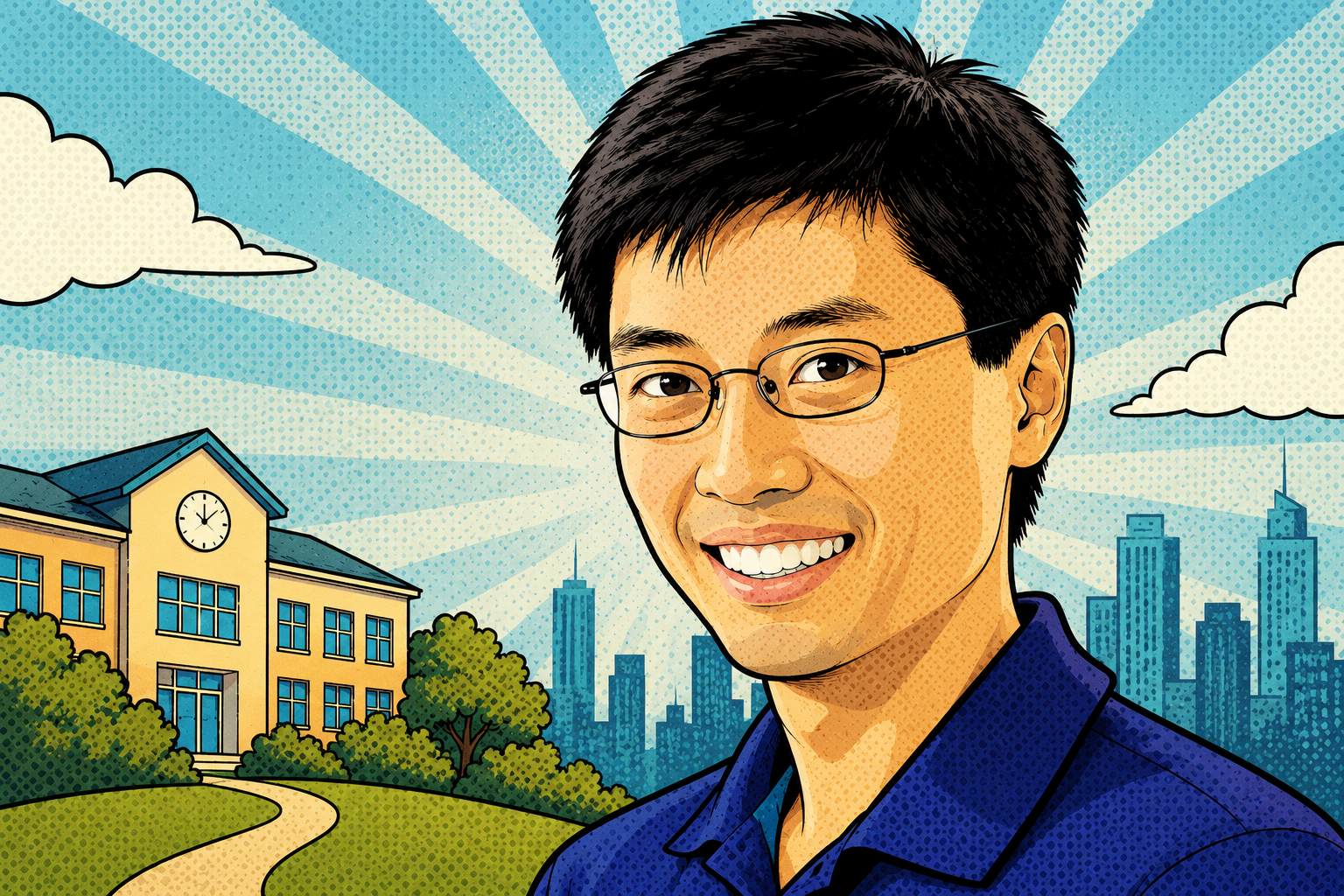
For a decade, Po-Shen Loh occupied one of the most rarefied perches in American education: national lead coach of the U.S. team at the International Mathematical Olympiad. From 2014 to 2023 he shepherded the country’s most gifted young minds through problems most adults cannot parse. But somewhere along the way, the mathematician got, in his words, “very distracted by the real world.” His main focus now is not proofs but people — specifically, how humanity survives, and even flourishes, once artificial intelligence has swallowed the work most of us assumed would always be ours.
The thesis he lays out in this conversation is at once alarming and strangely hopeful. AI, he insists, is coming for nearly everything humans are “good at.” The refuge is not a skill. It is a disposition — curiosity, flexibility, and a genuine care for other people — wired together into what Loh, a self-described network theorist, calls a high-trust network. That, he believes, “might just be what we need for the 21st century after AI.”
The Classroom That Rewired His Map
Loh has been, quite literally, running around rural America — he speaks in more than a hundred cities a year — and what he found in those overlooked places reorganized his sense of where talent lives. The South Carolina fourth-graders didn’t just get the answer; they debated ideas for twenty minutes, listened to one another, and stayed authentically engaged. “It even felt more authentic,” he says, “than what I found in cities.”
The problem, as he diagnoses it, is not the children. It is the curriculum. “Standard curriculum is designed just to make sure that you know how to do a standard problem,” he says. “In this future world, we need people who can do non-standard problems.” The irony writes itself: a system built to reliably produce competent, interchangeable graduates is optimizing for exactly the trait machines now supply for pennies.
The untapped pool
Across rural America, Loh says, there are “so many kids who are actually really, really interested in challenging themselves.” He sees them as an enormous, unnoticed reservoir of potential — not just in the United States, but worldwide — that could “create a totally new economic flow system.”
The same instinct carried him to Africa in December. He went, he is careful to say, not to prescribe solutions but to learn. What he saw was a continent of capable people whose economic development lagged not because talent was scarce but because the wider world simply couldn’t see them. “There is a place called Africa. How do you send resources?” he says, mimicking the distant, abstract way opportunity is usually routed. “Somebody is professional at receiving resources. That’s not as good as knowing this person can really use the resources.”
A New Economy, Routed Through Trust
Here is where the network theorist takes over. Loh describes a system in which high schoolers coach middle schoolers, the coaches drawn “from anywhere in the world” and selected not for raw scores but for two things: whether they genuinely care about people, and whether they can think on their feet to crack unfamiliar problems. Pairs of them are brought together — he mentions Paris as a meeting ground — so that trust becomes personal, face-to-face, durable.
Why does any of this matter economically? Because trust, he argues, is the missing rail on which opportunity can finally travel directly. Remote work, he notes, “does work well. The only issue is who would you hire?” A founder in the United States, Korea, China, Canada or Europe who has spent months co-teaching alongside a brilliant partner in Rwanda or Ethiopia already knows the answer. When that founder needs a collaborator or an employee, “I anticipate that they might call up the person that they know.”
Then comes the arbitrage. “The amount of money that people are used to earning in different countries is very different,” Loh observes. “If you split the difference, both sides win massively. One side will save a lot, the other side will get to live really, really, really well.” Resources, in his telling, stop bouncing through professional intermediaries and start flowing straight from developed economies to the specific, verified, capable people who can use them — a shortcut carved by human relationships rather than institutions.
The heart of it
“The heart of entrepreneurship is finding pain points in other people and solving them,” Loh says. Connect thoughtful people to one another, he argues, and they “naturally will start to try to find ways to create value.” Some become entrepreneurs. Money follows, because a problem got solved.
“Good Luck — AI Is Going to Take That”
If the vision sounds utopian, Loh’s reading of the labor market is bracingly not. For a while, he notes, the conventional wisdom held that the safe job would be blue-collar — a plumber, something physical AI couldn’t touch. He isn’t buying it. “If you look at how many humanoid robots there are, there are a lot of them.”
He points to Boston Dynamics, the famous American robotics company, and its acquisition by Hyundai. “As soon as I saw that Hyundai had bought them, I know what Hyundai wants to use those robots for. Not for dancing,” he says. Hyundai manufactures at enormous scale and has the money to deploy “tons of robot workers.” His forecast is blunt: it won’t be long before humanoid robots are making “all kinds of stuff” across Hyundai’s plants — and that, he warns, “is going to wreak havoc across the blue collar as well.”
Which brings him to the line that lingers longest. “I will also say for everyone who wanted a stable life, good luck cuz AI is going to take that.” It is delivered almost gently, but it is the hinge of his entire argument. If stability is gone, the question is no longer how do I get a safe job? It is what, exactly, is special about people?
His answer is disarmingly human. What’s special, he says, is that some people actually care whether humanity still exists — “and the best part is the ones who do, if you talk to them, you can read it from their eyes.” You can sense when a person cares about the big picture more than themselves. A robot offers no such reassurance.
The Car With No Eyes
That theme — trust as infrastructure — turns unexpectedly dark when Loh considers the machines already among us. “An EV is basically a computer with four wheels,” he says, and many electric vehicles receive constant software updates. Then the thought experiment: what if someone hacked the update system? “Next week, one particular brand of EVs at 5:30 p.m., they all accelerate to full 100%.”
The more interconnected the world, he warns, the easier it is for a single move to cause catastrophe — and the danger compounds when code is written with AI, because “it’s actually possible to make weird things happen without even fully understanding.” His image is unforgettable: “The car which was supposed to help you can change into the car that was supposed to hurt you. You have absolutely no way of knowing because it has no eyes.”
And so the risk loops back to the opportunity. Someone has to be trusted to watch over these automated systems — people who “care about things that are bigger than themselves and aren’t easily bought off by someone bribing them for a million dollars.” “The more automation there is,” he says, “the more things that can go wrong. We don’t even have enough good people to watch out for all this stuff.”
Hiring for the Soul, Not the Skill
This reshapes how Loh himself hires. When he meets someone with great intention and great learning capacity, he doesn’t hunt for a job description — he tries to invent a place for them. “This kind of person, you can plug into anything,” he says. What he avoids is the opposite: “I don’t want to hire someone who has been trained to do one particular task, because now I’ve discovered — wait, one or two more years, I can use the AI to do that task, and it’ll be way cheaper.”
AI, he happily concedes, is a spectacular tutor. His own ChatGPT history, he admits, currently holds questions about what’s in the Quran. Riding an overnight bus to the interview, he used Claude’s Opus 4.5 to solve advanced contest problems and generate hints for a math video game he’s building. “In the old days, I had to actually do the math problems myself,” he says. “The AI today can do those problems like this.” His conclusion is candid to the point of self-effacement: “Even a very sophisticated math coach can be replaced by the AI tool if you decide you want to do it.”
Human robots
Shown an AI app in China engineered to boost exam rankings, Loh demurred: “I don’t think I would do it that way, because I think that’s just creating people who are human versions of AI. You’re just making human robots.”
The Coming Crisis — and the Way Out
The playing field for learning, Loh argues, has been leveled: anyone with an AI can learn almost anything. Which detonates the old bargain. Students once ground away for rank, then university, then a good job. “But today, even if you do that, you still can’t get a job. It’s actually quite sad.” He foresees a generation working “very hard for about 20 years” on their parents’ promise, only to graduate into nothing — “a major mental health crisis.”
His healthier alternative is intention. “What I love is when I see a kid whose eyes are saying, ‘I want to help you,’” he says. Such people stay curious, keep learning, and “can become arbitrarily good.” Better still, thoughtful people enjoy each other’s company; connect two of them and a trusted friendship forms almost instantly, and the network strengthens itself.
His practical advice is refreshingly concrete. First, learn English to high fluency — it “gives you access to a huge world of opportunities” beyond the systems of your native language. Second, cultivate genuine care for others, because “that is actually what’s going to make people want to pull you out of those systems.” A program in Korea, he offers as an example, isn’t designed to take only the top ten percent; it’s designed to take “all the great people” — where great simply means you like other people and can think through a strange problem you’ve never seen.
Sometimes, he adds, you must ask why a system was built the way it is — and then break out of it and find your own way. “That’s entrepreneurship.”
Coda: The AI-Native Engineer
The video closes on a different but harmonizing note. A Stanford instructor named Mehran describes launching “The Modern Software Developer,” billed as the first class of its kind at Stanford to put AI across the entire software development life cycle. Within hours of being announced, enrollment blew past a hundred students. “Something kind of crazy is happening,” he says.
What’s emerging, he argues, is a new class of professional — the “AI-native engineer,” for whom AI is simply the language they think in. The juniors entering the workforce now will be the first generation of that shift. And the summit of the craft? “A single developer becomes a manager of agents,” Mehran says. “Really knowing how to properly handle multiple agents is like the last boss in the game. If you can do that really, really well, then you are literally like the top 0.1% of users even today.”
Two speakers, one message. Whether you’re a phoneless fourth-grader in South Carolina inventing your own games or a Stanford undergrad orchestrating a swarm of AI agents, the edge that survives is the same: the human capacity to care, to stay curious, and to think through problems no one has seen before. Everything else, Po-Shen Loh warns with a mathematician’s calm, the machines are learning to do “like this.”