The Agent Blazers: Teaching Machines to Think in Straight Lines
Three companies, fourteen sub-agents, and one espresso machine walk into Salesforce HQ — and quietly rewrite the rules of customer service. Inside Agentforce Demo Day.
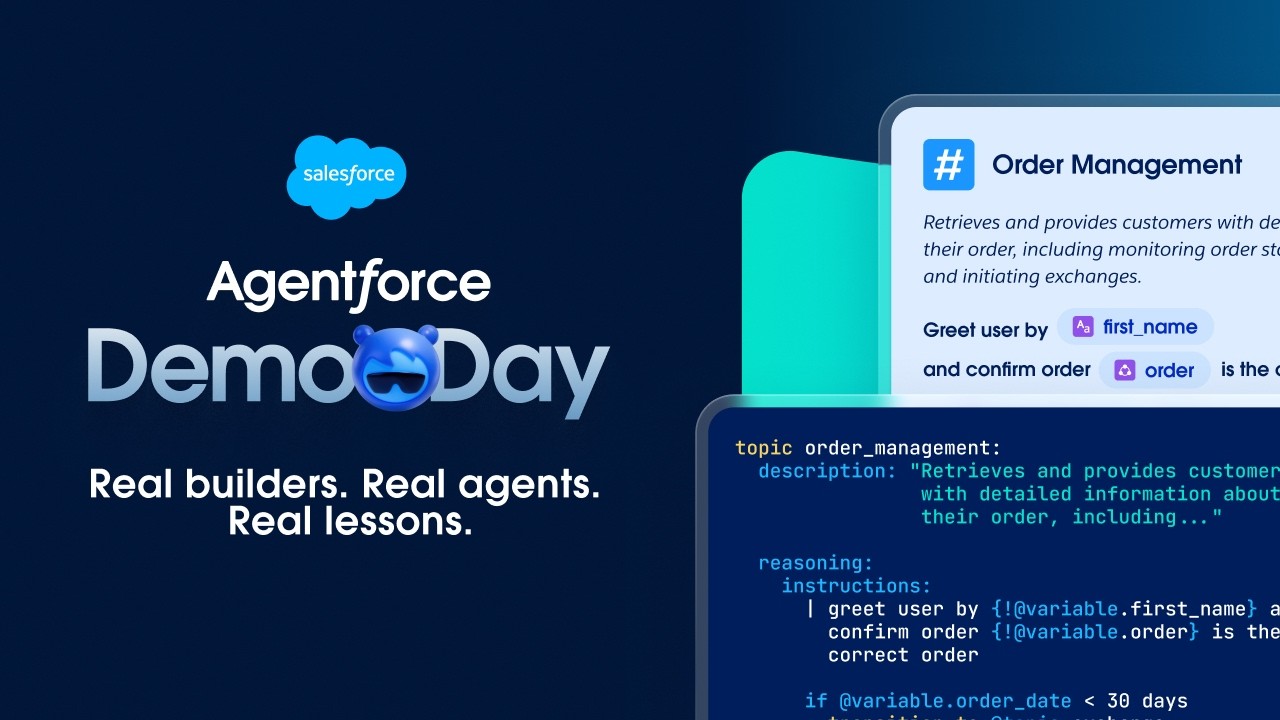
There is a moment, somewhere in the middle of Agentforce Demo Day, when the whole premise of enterprise artificial intelligence flips inside out. For years the pitch has been about machines that reason — systems clever enough to improvise, to interpret, to surprise you. But on this stage, broadcasting live from Salesforce headquarters in San Francisco, the most impressive thing anyone demonstrates is an agent that knows when not to. An agent that follows a straight line. An agent that does exactly what it is told, every single time, precisely because a human decided that this particular moment was too important to leave to improvisation.
"This AI world is moving fast," host Leah McGowen-Hare tells the audience at the top of the show, "and the best thing we can all do is learn from each other. No gatekeeping." What follows is a rare thing in the tech industry: three companies — Indeed, LIV Golf, and SharkNinja — opening their build files and their metrics, warts and all, to show precisely how they turned the abstract promise of "agentic AI" into working software that talks to real customers thousands of times a day.
01 / THE MISSIONThirty-one hires a minute
Oliver Bodden, a Senior Technical Product Manager at Indeed, begins where every good engineer begins — with the problem. "Our mission is very simple," he says. "We help people get jobs." Behind that plain sentence sits a marketplace of staggering scale: millions of job seekers, a firehose of employers, and a single north-star metric that Indeed obsesses over.
"We just announced a big metric where we're doing 31 hires every minute globally," Bodden says. Every agent his team builds is judged against a single question: does it move that number? Indeed's ecosystem, he explains, splits into internal-facing "employee agents" for IT and go-to-market teams, and external-facing agents — an SDR agent and the service agent he came to demo — all sitting on the Salesforce platform, pulling flexibly from Data Cloud or reaching straight to the source through MuleSoft when a freshly posted job needs a status in five seconds flat.
But the real revelation is in how Indeed now builds. "Without realizing it, we started using coding agents," Bodden says. His team found themselves copy-pasting context into tools like Cursor until they leaned into Salesforce's reusable "skills" to give those coding agents more autonomy. The problem they were solving is almost comically specific — and instantly recognizable to anyone who has shipped an AI feature.
When an employer asked "why is my job flagged?", the service agent was supposed to check the account, then investigate the job. Instead, three-quarters of the time, it found the account active, cheerfully announced "your account is active," and simply stopped. "It wouldn't even go to the next level," Bodden recalls. "There was a lot of frustration." The flagged job — the actual thing the customer cared about — went uninspected.
02 / THE FIXWrite the machine a playbook
The cure, it turns out, is a scripting language. Bodden opens Cursor and, in plain English, tells his coding agent to fix the misbehaving flow. Behind the scenes, Salesforce's orchestration skills kick in — and here is where he shares the single best practice of the whole broadcast. Coding agents fail, he explains, when they "start drifting, they don't understand the context, and then they start building quickly before understanding, which is very common with AI."
The antidote is a playbook: a markdown file, distilled from past conversations (and written, fittingly, with the help of AI), that the coding agent reads to re-ground itself. "When it's drifting, it goes to the playbook and we see it self-correct," Bodden says. The catch is organizational, not technical: every developer must use the same playbook. "You have to treat it like a new agent that you're maintaining."
The output is Agent Script, and the fix adds two variables — employer status active and employer status inactive — that add determinism so the agent can no longer get stuck on the account when it should be examining the job. Re-run the same question, and the agent now flows past the account, inspects the job, and, crucially, offers recommended next steps. "Not just answering questions," McGowen-Hare notes, "but taking actions."
Testing scales the same way. Rather than a human hand-checking thousands of daily conversations, Bodden asks his coding agent to "bulk test the job status agent, make sure you cover the scenarios of account being active and inactive" — and it generates the test cases itself, running Testing Center behind the scenes. "I remember when you would have to, as a developer, come up with every single test case and it would take weeks," McGowen-Hare marvels. Layer in human-in-the-loop logging — recording where a person had to correct the agent — and you get what both keep calling a "self-healing process."
03 / THE BLUEPRINTHeadless by design
Nathan Price, a Senior Director of Product Management at Salesforce, steps to a whiteboard to name the thing everyone has been circling. The agent development lifecycle, he explains, has four moves: build, test, deploy, observe — and then feed what you learn back into the loop.
What ties it together is Headless 360 — a platform Price describes as "open and extensible." The same skills work whether you build in your favorite coding agent, in Slack, or in the new Agentforce Builder, and the learning transfers between them. The bedrock beneath it all is Agent Script, which Salesforce has "just recently open sourced," now generally available on voice as well as text. Even the observability APIs are open standards, so teams can pull insights into any existing workflow. "The insights from the output of one skill can feed into the input of another," Price says — the whole lifecycle bridged into a single self-learning system.
04 / THE FANSA caddie for everyone
If Indeed shows the plumbing, LIV Golf shows the poetry. Imran Rahman, a Salesforce Technical Architect at the global golf league — now in its fourth season — explains the metaphor behind his agent. "We have a caddie, and a caddie essentially supports our players across the course. And so we want to try and replicate that for our fans. Hence, Fan Caddie."
Fan Caddie is genuinely capable: event details, ticket help, leaderboards, scores, stats — it will even surface a video of who scored the last hole-in-one. Under the hood, Rahman reveals an architecture of 14 different sub-agents, each a specialist. On his phone, live, he asks where to buy merchandise before the next event in Korea; the merchandise sub-agent fires and returns a link to the online store.
Then comes the twist. Using variables like in venue mode and an in-venue tournament ID, the agent's answer transforms: "Since you're already at the LIV Golf event in Korea, why don't you go visit one of the stands or tents nearby." The same question, a different answer, driven not by the LLM's guesswork but by deterministic logic that "reinforces" which sub-agent to use — and, via a "before reasoning" step, preloads data to slash latency.
LIV Golf — Fan Caddie Performance
The latest version of Fan Caddie using Agent Script has come back with a 94% accuracy rating.
— IMRAN RAHMAN, SALESFORCE TECHNICAL ARCHITECT, LIV GOLF
Bodden nods along — Indeed hit the same wall from the opposite direction. His team once tried to distinguish small-business from enterprise customers "through reasoning," but "it wasn't deterministic," and frustrated users got routed to the wrong human. The temporary fix was to collapse everyone into a single group; the real fix was Agent Script, pulling segment data into a variable "independent from reasoning" so "no matter how the conversation goes, we're always going to escalate to the right business segment."
05 / THE UNBOXINGMeeting the customer in the first moment
Carolin Duerkop, a Technology Transformation Partner at SharkNinja, arrives bearing gifts — a Cafe Lux espresso machine for the host — and a genuinely fresh use case. SharkNinja, maker of everything from Shark vacuums to Ninja air fryers, spans 39 product categories and launches roughly 25 new products a year. Every launch means new pre-purchase questions, new setup journeys, new troubleshooting flows — and customers who experience all of it "in unified waves."
So SharkNinja built an unboxing agent triggered by a QR code inside the instruction booklet. Scan it and the agent already knows the exact product — the model number is passed through — greeting you not generically but by machine. It walks you through the steps that stand between you and a decent espresso: flush the machine, run calibration, dial in the grind. Ask a stray question mid-setup ("what's the difference between the espresso strength options?") and the context persists; you scroll back up and pick your guided journey right where you left it.
Behind it sits Agent Script — "really new territory for us," Duerkop admits — with sub-agents for the personalized greeting and the guided setup, toggling between a low-code canvas view and a precise script view for developers. The guided steps demand strict determinism ("they have to happen in a very specific sequence"), while natural questions let the LLM's flexibility "kick in."
The subtlest breakthrough is how SharkNinja feeds the machine. Its product knowledge lives in dense PDFs "with so many images, diagrams, lots of information" — historically a nightmare for AI, which would scrape raw text and lose the diagrams, the sequencing, the context. The answer is a feature called Intelligent Context: an LLM reads and understands each PDF, then chunks the understanding rather than the raw text. Reviewers can click into the exact passages behind any answer and tweak an interpretation that reads a little off. "That transparency is so important for a brand like SharkNinja," Duerkop says.
06 / THE HUMANSDeterminism, all the way down
Price returns for one last whiteboard pass to define the word doing all the heavy lifting: hybrid reasoning. It is the mentality of moving between "the deterministic logic of code — if this, then that — and the agentic way of thinking," leveraging the LLM's ability to reason. In regulated worlds like financial services and health care, he warns, "a wrong answer isn't just a bad experience, it's a compliance risk." Agent Script lets a returns flow gather order context before an LLM is ever in the loop, branch on whether an order is under 30 days, and — if it isn't — escalate straight to a human being for a high-touch approach.
That human handoff is where the customer-experience stakes land hardest. At Indeed, Bodden notes, "our service channel is also a revenue channel." When an employer who just lost a team member gets stuck, the agent captures sentiment deterministically and, sensing frustration, escalates rather than forcing an unwanted experience. The human agent inherits the full conversation plus an AI-written summary — no playing catch-up. "Everything they need is right there at their fingertips," Bodden says, protecting both customer satisfaction and average handle time.
The proof is in the numbers, and the guests offer them without flinching. Salesforce cites Grupo Falabella, answering 60% of WhatsApp inquiries autonomously, and manufacturer JPW resolving cases 40% faster. Indeed's own service agent lifted its containment rate from a shaky 4% at launch to 25% — "over six times" — while CSAT climbed from 1.8 to 4. LIV Golf's Fan Caddie hit 94% accuracy with latency down nearly 60%. SharkNinja crossed a quarter-million chats and is expanding its unboxing agent from two products to its full platinum lineup.
We weren't handed a handbook. We all started from scratch. It's almost like we're all pioneers in this.
— OLIVER BODDEN, SENIOR TECHNICAL PRODUCT MANAGER, INDEED
Asked what they are proudest of, none of the builders names a metric first. Rahman points to how Fan Caddie was built — "not your typical Salesforce project built by Salesforce specialists," but a whole tech team, some of whom "never even touched Salesforce before," collaborating as builders. Bodden celebrates the "flexibility to change" as the technology advances, being "proactive and not reactive." Duerkop lingers on that 250,000-chat milestone — "some confetti," McGowen-Hare agrees — because every conversation is a fresh lesson.
That, finally, is the thesis buried under the hoodies and the confetti and the free espresso machine. The hard part of enterprise AI was never the pilot that works once on stage. It is the leap from pilot to production — from a clever demo to a system that behaves correctly on the ten-thousandth try, and learns something from every one. The Agent Blazers didn't get there by making their machines think harder. They got there by teaching them, at exactly the right moments, to think in straight lines.
Indeed
The leading job marketplace, matching 31 hires a minute. Built a service agent using coding agents, playbooks, and deterministic escalation.
LIV Golf
Global golf league behind "Fan Caddie" — 14 sub-agents, location-aware personalization, 94% accuracy, ~60% lower latency.
SharkNinja
Home-appliance maker across 39 categories. QR-code unboxing agent powered by Agent Script and Intelligent Context; 250,000 chats logged.