The Agents That Read the Bill of Lading So You Don't Have To
Pallet's Agent Platform encodes a company's operating knowledge and turns it loose on the freight desk - capturing orders, moving shipments, answering customers, and closing the books, from quote to cash.
In most of the economy, an order is a row in a database. In freight, an order is a PDF. Sometimes it's a fax. Often it's a voice call, an email thread with four people cc'd, or an EDI message that nobody has looked at directly since 1998. Before a single truck moves, someone has to read all of it and re-type it into six different systems. Pallet built the thing that does the reading and the typing.
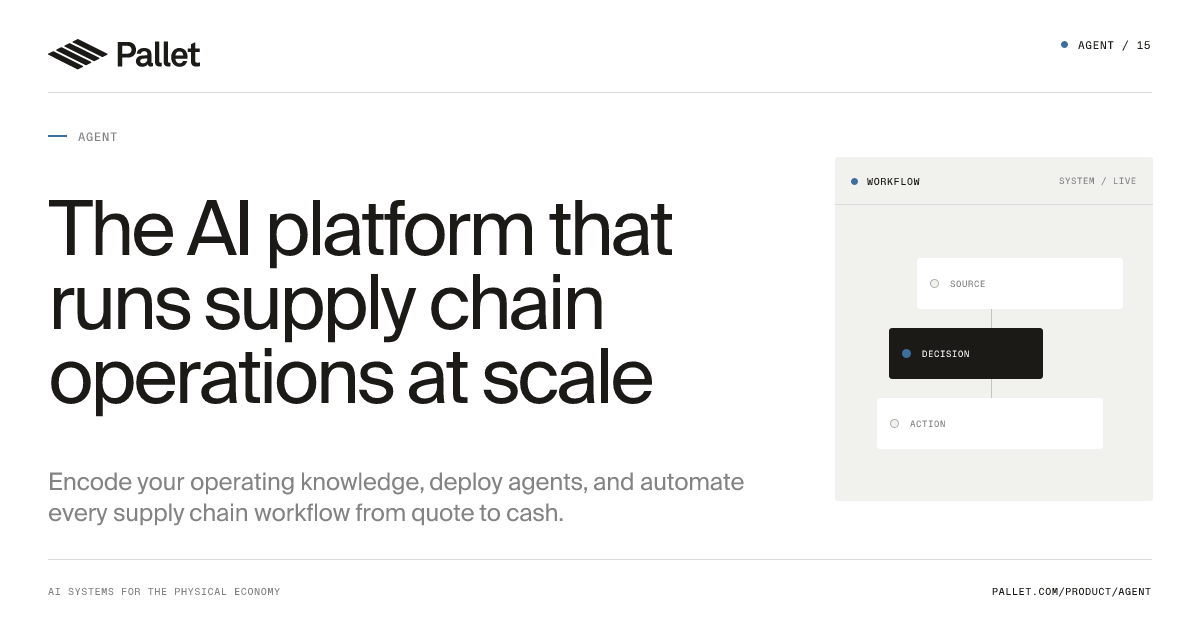
The Pallet Agent Platform describes itself plainly: "The AI platform that runs supply chain operations at scale." Encode your operating knowledge, deploy agents, automate every workflow from quote to cash. The word that matters in that sentence is "runs." Not assists, not suggests, not summarizes. Runs.
01 / WHAT IT ACTUALLY DOESFrom the first quote to the last invoice
The platform's agents capture and validate orders across every channel, execute and track shipments, answer customers instantly over email, voice, and chat, run billing, invoicing, and reconciliation, and file compliant customs paperwork without a human keying data. Each of those is a job someone currently does at a desk, at 4:40 on a Friday, with three browser tabs and a headset.
02 / WHERE THEY WORKNo clean API? Fine.
The reason most software never reached the freight desk is that the freight desk doesn't hand you a tidy API. Pallet's answer was to build agents that meet logistics where it lives. They operate across email, voice, documents, APIs, EDI, browsers, and remote desktop, and they connect to the platforms brokers and forwarders already run.
03 / HOW IT GETS SMARTThe knowledge in your best operator's head
Every deployment starts with custom models trained on the client's own data. An Enterprise Memory layer stores the institutional knowledge and standard operating procedures, so a new agent doesn't start from zero - it starts with the context a twenty-year veteran carries around and never writes down. Before anything touches production, Pallet runs thousands of simulations to validate accuracy, and a human-in-the-loop system keeps the agents learning after they go live.
How an agent gets deployed
04 / THE SPEED CLAIMSix weeks against six months
Pallet's pitch on time-to-value is blunt, and it's the kind of claim that's easy to check because customers say it out loud. The industry standard for standing up this kind of automation runs about six months. Pallet targets six weeks. Eassons Transportation Group went live in 40 days. The math on the difference isn't subtle.
05 / WHO OWNS THE BRAINSovereignty over your intelligence
There's a line Pallet uses that reads less like marketing and more like a promise: "Sovereignty over your intelligence." The custom models built from a client's data stay client-owned. No vendor lock-in over the intelligence a company spends months building. The platform is certified for GDPR, SOC 2 Type II, and CCPA - the unglamorous credentials that let the glamorous agents run in a regulated business.
06 / THE BILLPay for the work, not the seats
Software has trained everyone to pay per seat and per license, whether or not anyone logs in. Pallet flipped the invoice: you pay for delivered agent value, not for chairs. It's a pricing model that only works if the agents actually do the work - which is a useful thing for a vendor to bet its revenue on.
Behind the product is a company with backing to match the ambition. Pallet raised a $27 million Series B led by General Catalyst, bringing total funding to roughly $50 million, with Bain Capital Ventures, Activant Capital, and Bessemer Venture Partners along for the round. The money is aimed at one narrow, stubborn, enormous target: the desk where freight still moves at the speed of typing.