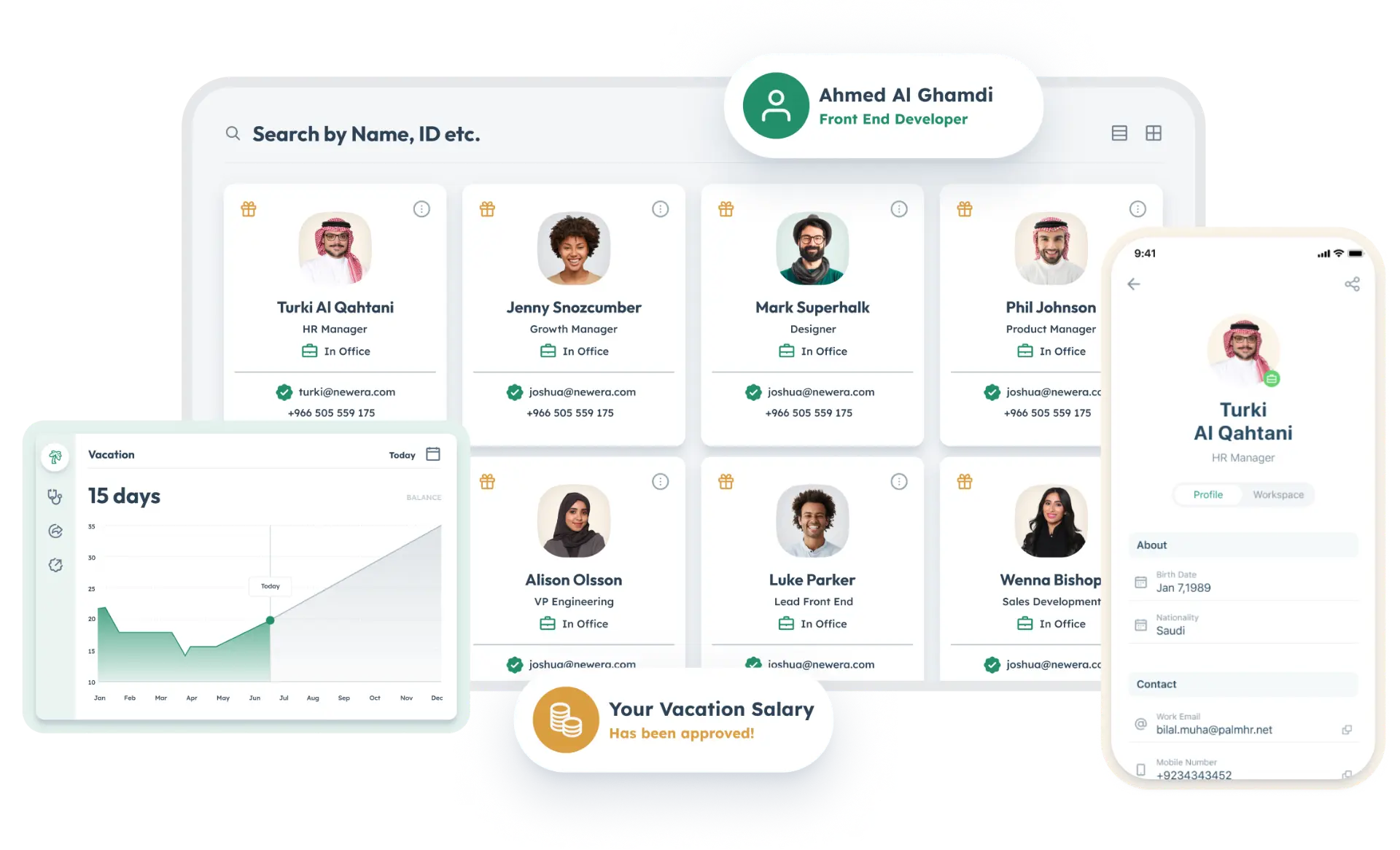
The cloud HR and payroll platform born in Riyadh - built so companies across Saudi Arabia and the GCC can run people operations that are compliant with local law by default.
Most human-resources software is written for one country and sold everywhere else, its regional edges sanded down after the fact. palm.hr was built the other way around. Founded in Riyadh in 2019, it began with the part every imported product tends to bolt on last: compliance with Saudi and Gulf labor law. Payroll that files through the Wage Protection System. Contributions that reconcile with GOSI. Salary disbursement that runs through Mudad. End-of-service pay, calculated the way the law actually prescribes.
The pitch is unglamorous and, in the region, exactly the point. For a small or mid-sized company operating in Saudi Arabia or the wider GCC, HR administration is less a productivity problem than a regulatory one. A missed contribution or a mis-timed filing is not an inconvenience; it is exposure. palm.hr's founders - Richard Schrems, Christoph Czichna and Dragan Nikolic - built the platform around that reality, treating government integrations as the product rather than the footnotes.
What customers get is an all-in-one system that consolidates the sprawl of spreadsheets, WhatsApp approvals and manual filings that many regional SMEs still run on. Employee records, time and attendance, payroll and internal requests live in one place, on the web and in a mobile app. The company describes itself plainly as "the modern full-service all-in-one HR software built for SMEs in the Middle East" - a description that resists the temptation to oversell.
That restraint is part of the story. palm.hr is not trying to be a global platform that happens to work in Riyadh. It is trying to be the platform that understands Riyadh - and Jeddah, and Dubai, and the specific paperwork that a company there has to produce - better than anyone importing a template from abroad. In a market where the alternative is often a foreign giant or a spreadsheet, that focus is the wedge.
palm.hr organizes the work of an HR department into a handful of connected modules. Each one removes a manual step; together they form a single record of who works at a company, when they worked, and what they were paid.
Digital profiles, a searchable directory and org chart, document management, benefits, and onboarding/offboarding workflows - one source of truth for everyone on the payroll.
Mobile check-in and check-out, absence and vacation tracking, custom work schedules, remote-work support and timesheet approvals - the raw data that feeds payroll.
Automated, WPS-compliant payroll with GOSI compliance, compensation management, expense claims, multi-currency and multi-country support, and end-of-service calculations.
Announcements, team celebrations, HR and time requests, custom approval workflows, and feedback and surveys - the softer side of keeping a workforce in sync.
Connectors to Zoho, QuickBooks, Xero, NetSuite, Odoo and Dynamics, regional tools like Qoyod, Wafeq and Tally, biometric hardware via ZKTeco and CAMS, plus GOSI and Mudad.
For teams that want the software plus people to run it: certified professionals handling payroll, compliance, onboarding and government filings as a managed service.
palm.hr's customers are small and mid-sized businesses through to growing enterprises operating in Saudi Arabia and the GCC. Named users include the ride-hailing brand Hala, the media company Thmanyah, the AI firm Mozn, and the Saudi Venture Capital Company, alongside names like Jeepy and Rabbit. The common thread is a company large enough to feel HR pain but not large enough to want a heavyweight global suite.
The problem palm.hr solves is specific: the fragile, error-prone process of running people operations by hand. The spreadsheet only one person can open. The salary calculation that has to account for allowances, deductions and end-of-service. The government filings that carry real penalties if they slip. By pulling attendance, compensation and compliance into one system, palm.hr aims to make that machinery invisible - and correct.
For an HR manager, the payoff is fewer manual reconciliations and a payroll run that files itself. For an employee, it is a self-service portal and a mobile app for requests, check-ins and payslips. For a founder, it is the confidence that the company is compliant without needing to become an expert in labor law.
2023 round co-led by Speedinvest and RAED Ventures, with Wamda Capital participating. 2021 bridge led by Nama Ventures. Bar for the 2021 round is illustrative - the amount was not disclosed.
Sources: TechCrunch, Wamda, Zawya, RAED Ventures, Tracxn.
The HR software market palm.hr competes in is not empty. Global platforms like Workday, Rippling, Gusto, Deel, Factorial and Employment Hero all have GCC ambitions, and regional players such as Bayzat, ZenHR and Jisr address the same buyers. palm.hr's argument is not that it does more, but that it does the regional part natively - GOSI, Mudad, WPS, Emirates ID and end-of-service handled inside the product rather than approximated by a localization layer.
That is the wedge. A foreign suite can be configured for Saudi Arabia; palm.hr was designed for it. For an SME weighing an imported enterprise tool against a spreadsheet, a home-grown platform that already speaks the local systems - and offers a human team to run them - occupies a useful middle ground.
It also fits a larger regional moment. Saudi Arabia's push to digitize and formalize its private sector, and the GCC's broader startup boom, are creating exactly the kind of fast-growing SMEs that outgrow manual HR. palm.hr's $5M pre-Series A in 2023, co-led by Speedinvest and RAED Ventures, was a bet that these companies will increasingly want to build their systems of record locally rather than rent them from abroad.
Richard Schrems, Christoph Czichna and Dragan Nikolic launch an HRMS built specifically for Saudi and GCC labor requirements.
An undisclosed bridge round from Nama Ventures and Saudi angel investors funds product development.
The company broadens beyond core software with outsourced HR services and a growing set of accounting and government integrations.
A round co-led by Speedinvest and RAED Ventures, with Wamda Capital, funds expansion across the MENA region.
palm.hr is a cloud-based, all-in-one HR and payroll platform built for small and mid-sized businesses in Saudi Arabia and the GCC, covering people data, time and attendance, WPS-compliant payroll and employee engagement.
It was founded in 2019 and is headquartered in Riyadh, Saudi Arabia, with a presence in the UAE.
It is built compliance-first for the region, with native integrations to Saudi government systems like GOSI and Mudad and support for WPS payroll and end-of-service calculations, rather than localizing a foreign product.
palm.hr raised a $5M pre-Series A in February 2023, co-led by Speedinvest and RAED Ventures with Wamda Capital participating, following an earlier bridge round led by Nama Ventures.
SMEs through to enterprises across the GCC, including named customers such as Hala, Thmanyah, Mozn and Saudi Venture Capital Company.
Profile compiled from public sources including palmhr.net, TechCrunch, Wamda, Zawya, RAED Ventures, Tracxn and Dealroom. Figures such as revenue are third-party estimates and approximate; funding and dates reflect publicly reported rounds. Founder roles and the 2019 founding date follow the most consistent public reporting.