YesPress Profile - Company File No. 0421
Guidde.
A Belmont-headquartered, Tel Aviv-built AI company that turns the boring corporate how-to video into a 90-second reflex.
A Belmont-headquartered, Tel Aviv-built AI company that turns the boring corporate how-to video into a 90-second reflex.
It is being replaced, sentence by sentence, by a video that records itself.
The video in question was not produced by a studio. It was produced by an employee who clicked through a software workflow once, then walked away. By the time she returned with coffee, a finished how-to existed - narrated, captioned, branded, ready to ship. That is Guidde. Today the company sits on $80 million in total funding, 4,500 paying customers, and a partnership scroll that includes KPMG and Deloitte. None of that is an accident. Every line of it is the result of a small, contrarian bet placed five years ago.
The bet was that nobody really wants to read the manual. Not even the people who write the manuals.
If you have ever joined a new company and watched a senior teammate share their screen while saying "you'll figure it out, it's mostly intuitive," you have met Guidde's target market. The product attacks that exact moment - the friction between someone who knows and someone who does not - and removes the assumption that this friction is solvable with more PDFs.
The 2020s gave every department a software stack the size of a small airline. Average mid-market knowledge workers now navigate dozens of SaaS tools. Each tool ships features weekly. Each feature ships with documentation that nobody updates. Internal trainers, IT teams and customer success managers spend their lives writing screenshots into Confluence pages that go stale before the next sprint.
The conventional answer was "make better docs." This produced an industry of writing tools, a smaller industry of screenshot annotators, and a smaller industry still of digital adoption platforms that overlay tooltips on top of every application. None of it scaled. Tooltips have the half-life of a wall poster. Screenshots are out of date before they are uploaded. PDFs do not record themselves.
Co-founders Yoav Einav and Dan Sahar saw the same thing from two different angles. Both had spent careers running product at companies where data, AI and operational tooling mattered - Qwilt, Iguazio - and both had watched perfectly good software get adopted at half-speed because nobody could explain how to use it. The bottleneck was not the software. The bottleneck was the explainer.
In 2020, Einav and Sahar started Guidde on a thesis that sounded, at the time, mildly heretical: the best documentation is video, and the only way to make video documentation cheap enough to be ubiquitous is to remove the human editor.
That meant building three things at once. A browser extension that watches what a user clicks. A generative model that turns those clicks into narrated steps. A polish layer that adds branding, voice, captions and motion without anyone asking. None of those were straightforward in 2020. By 2023, when TechCrunch first wrote about the company, Guidde was already shipping all three.
The name is a portmanteau of "guide" with an additional D. Officially, the extra D stands for nothing. Unofficially, it is the kind of small irreverence that signals a company built by people who do not want to be a Slack channel.
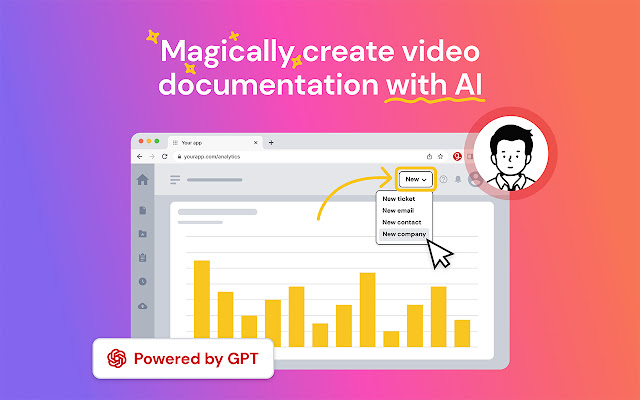
Open the Chrome extension. Click record. Walk through whatever workflow needs documenting - a Salesforce report, a new HR policy, a checkout flow, a Kubernetes deployment. Click stop. Three to four minutes later, Guidde returns a finished artifact: a narrated video with subtitles, a step-by-step text guide, screenshots with auto-zoom, a brand-stamped intro and outro, and a shareable link.
Behind the scenes, the system is doing the unglamorous work that human editors used to bill for: identifying clickable elements, summarizing intent into language, generating voiceover in any of dozens of voices and languages, dropping in transitions, suggesting titles. None of this is visible to the person who pressed record. Which is, mathematically, the entire point.
Browser extension - captures any workflow as a structured recording.
AI video generator - turns clicks into narrated, branded video in minutes.
Multi-language voiceover - synthetic voices in dozens of languages, no booth required.
Embedded knowledge layer - serves the right video inside the right app at the right moment.
Analytics - shows which guides get watched, which ones rot, and what employees still cannot find.
Above: the unglamorous list of features that, taken together, replace an entire docs team.
By February 2026, Guidde was reporting more than 4,500 paying customers, including names that do not sign up for unproven software: Nasdaq, Yahoo, Bayer, Anheuser-Busch, SentinelOne, Fortinet. Revenue had grown roughly threefold each year for three consecutive years. Customer retention sat above 90 percent. PSG Equity, a firm that tends to write checks once a business has graduated from interesting to inevitable, led the Series B.
Source: PR Newswire, Calcalist, FinSmes. The Series B was reportedly oversubscribed - the polite way to say investors wanted more in than the company let them put in.
The Series B announcement landed alongside two non-obvious bits of news. The first: Monday.com joined as a strategic investor, which says something about how horizontal Guidde's pitch has become. The second: KPMG and Deloitte signed on as implementation partners. That second fact, more than the cash, signals what stage Guidde is now playing in. Big consulting firms do not partner with screen recording tools. They partner with platforms.
Einav frames the next phase with a sentence he has now said in at least four interviews: train humans on AI, and AI on humans. The first half is the original product - faster onboarding, faster training, faster everything. The second half is newer and stranger. Guidde's research team has been publishing on what they call visual imitation learning, the idea that AI agents can be trained on expert human video rather than written documentation.
The implication is significant. If models can learn workflows by watching, the most valuable form of corporate documentation stops being prose and starts being recordings. Companies sitting on libraries of Guidde videos do not just have training assets. They have AI training data.
It is a tidy thesis and, like all tidy theses, it will get messier on contact with reality. But it is the kind of thesis that makes a $50M Series B a down payment rather than a finish line.
Two macro trends keep pointing at the same Guidde-shaped hole. The first is the sprawl of enterprise software. Every department will keep adopting more tools, faster, with less institutional patience for traditional documentation. The second is the rise of AI agents that need clean, behavioral examples to learn from. Both trends reward the same artifact: a high-fidelity recording of a human doing the thing.
That puts Guidde in an unusual position. The company started as a productivity tool and is becoming something closer to infrastructure - a layer where workflows are captured once and then consumed by humans, AI agents and analytics dashboards alike.
Guidde uses Guidde to onboard new employees at Guidde. Most of their internal documentation is, in fact, Guidde recordings of senior staff. The dogfooding is not a marketing line. It is the company.
Whether Guidde becomes the category leader or eventually shares that title with a Loom, a Scribe or a Tango is less interesting than the underlying observation: the way companies remember what they know is being rebuilt, and Guidde is building a lot of it.
The 40-page PDF is gone. In its place, a folder of short videos, each one made by someone who used to dread making them.
The new hire watches three of them before lunch. The Slack thread of "hey, where can I find the doc for-" has thinned by half. Somewhere, an internal trainer who used to spend Fridays writing screenshots is now spending Fridays designing curricula. Somewhere else, an AI agent is being fine-tuned on the same library of videos to handle the next round of customer questions.
That is the Guidde bet, fully drawn. Recording, once. Consumed by everyone, forever. Coffee, optional.