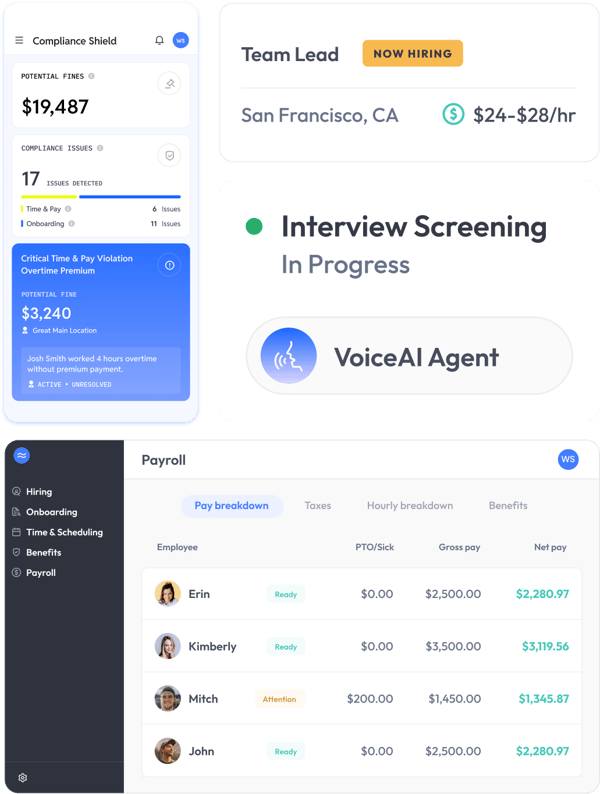
It's 6:47 a.m. at a Wingstop in Phoenix. The general manager is short two cashiers, the morning rush starts at eleven, and the only candidate from yesterday's job post just texted back: "u still hiring?" She taps a button. Ten minutes later he's confirmed for a 9 a.m. interview. By Friday he'll be in uniform. None of this happens through a careers portal. All of it happens through Workstream.
This is the work hiding behind every order of fries, every car wash, every late-night gas station coffee in America. It is also the work that, until recently, software had almost entirely ignored.
Who they are now
Workstream is a 280-person company in San Francisco that runs the hiring, onboarding, payroll and scheduling for roughly 10,000 hourly workplaces. The brands you'd recognize - Burger King, Jimmy John's, Dairy Queen, Wingstop, plus a sprawl of Chick-fil-A operators - all push their applicants into the same set of Ruby on Rails and React screens that 280 people in SoMa have spent eight years sharpening.
The pitch is simple enough to fit on a coaster. Texting beats email. Voice AI beats voicemail. A QR code on a counter beats a careers page no one visits. By gluing those three ideas to a payroll engine, Workstream cuts time-to-hire by about 70%.
The problem they saw
Roughly 80 million Americans work hourly. They are the country's largest single labor cohort. They are also the most poorly served by software. The big HRIS suites - Workday, Oracle, SAP SuccessFactors - assume an org chart with reporting lines, performance reviews and stock grants. They assume an inbox.
Hourly workers, in the main, do not have an inbox. They have a phone and a schedule that flips every two weeks. They apply through Indeed, get a confirmation email they never open, miss a phone call from a number they don't recognize, and ghost. From a manager's seat, hiring an hourly worker has historically been less a workflow than a slow leak.
Field Notes
The industry's own data was the giveaway. Quick-service restaurants run annual turnover north of 130%. A franchise group with 40 stores might hire 1,500 people a year - more than the headquarters of the chain itself. Yet most of them were still using PDFs.
The founders' bet
Desmond Lim was an unlikely person to fix this. He'd grown up in Singapore, run a Thai restaurant in college to pay tuition, then pinballed through WeChat as a product manager and through Harvard's Kennedy School as a master's student. He'd seen, from both sides of the counter, how the supply chain of labor actually worked.
In 2017 he co-founded the company with Max Wang and Lei Xu. All three were immigrants. None had a deep restaurant industry pedigree, which, in retrospect, was useful - they didn't know enough about hospitality HR to be intimidated by it. Their first product, depending on how charitable you feel, was either a chatbot or a glorified group text. It took job seekers' phone numbers and replied to them. That was the whole feature set.
It also worked. Operators started paying. Founders Fund cut the seed check. Then Coatue, then BOND, then GGV, then - in a turn that still raises eyebrows at HR tech conferences - Jay-Z's Marcy Venture Partners. Mark Cuban came along too, because of course he did.
The product, eight years in
Today Workstream is decidedly not a chatbot. It is six products glued together by a shared employee record, sold mostly to multi-location operators who need all of them.
Hiring & ATS
Text-first applicant tracking. Job posts syndicate to Indeed, ZipRecruiter, Google for Jobs.
Voice AI
An AI that calls candidates back in English or Spanish, screens, schedules, chases no-shows.
Onboarding
I-9, W-4 and direct deposit, signed from a phone in the breakroom.
Payroll
Full-service, multi-EIN payroll with tax filing for franchise operators.
Time & Scheduling
Geofenced clock-ins, AI-built shift schedules, overtime flagging.
Compliance & Benefits
Labor law, ACA and predictive scheduling alerts. ACA filings included.
The Voice AI is the piece that wins conference demos. A candidate misses an interview, the AI calls back within minutes, offers a reschedule, and - depending on the brand's script - either books them in or politely closes the file. It will switch from English to Spanish mid-call if it hears the candidate prefer it. The audio is recorded, transcribed and stored as part of the audit trail, which matters less for marketing and more for the EEOC.
Milestones
Founded in San Francisco by Lim, Wang and Xu.
Founders Fund leads seed. Product is mostly text messages.
$10M Series A. Restaurants pile in during COVID hiring crunch.
$48M Series B led by BOND and Coatue.
$60M Series B extension led by GGV. Total round: $108M.
Revenue crosses $38.5M. Payroll product ships.
~$59.2M revenue. Stevie Gold for customer service.
Bilingual Voice AI, French and Spanish onboarding.
The proof, in numbers
Skepticism is the appropriate response to any HR vendor's marketing site, so look at the disclosed numbers instead. Revenue has grown roughly 1.5x year-over-year through 2024. Customer satisfaction sits at 96.4% - a figure verified by the 2024 Gold Stevie Award and the kind of number rarely seen outside of self-serve consumer apps. Around 170 of the top quick-service restaurant brands now use the platform somewhere in their footprint.
Workstream revenue, 2021 - 2024
The mission, stated plainly
Workstream's stated mission - "help local businesses hire, retain and pay hourly workers" - is the kind of thing that sounds like a slide-deck filler until you watch a shift manager use the app. The mission is the product. You are either making hiring less painful for someone whose calf hurts from standing for nine hours, or you are not.
Internally, the team uses the word "deskless" the way other startups use "AI-native." It's both a description of the customer and a constant reminder of what to keep out of the product: long forms, dense dashboards, anything that requires a quiet office to fill out. The Workstream app is, by design, usable with one hand on a chipped iPhone while the other hand is holding a tray.
Tech Stack, Spotted In The Wild
Ruby on Rails. React + Next.js. PostgreSQL, Redis, DynamoDB. Kubernetes on AWS. LangGraph and Pinecone running the Voice AI. Anthropic Claude and OpenAI both in the model rotation. Sidekiq Pro doing the unglamorous work.
Why it matters tomorrow
The deskless workforce isn't shrinking. Demographics, restaurant expansion and the slow death of cashier-less retail (RIP, allegedly) all push the line up. Every year, more of the U.S. economy depends on people whose job cannot be done from a laptop. Until 2017 the software industry treated them as an afterthought. By 2026, Workstream is one of a small handful of companies treating them as the whole market.
There are competitors - Fountain, Harri, 7shifts, Paradox - and Workstream's bet is essentially that owning the entire stack from "candidate clicks apply" through "direct deposit lands" produces a moat that point solutions cannot match. The early evidence, including the unusually steep retention curve their investors quietly cite, suggests they're right. The later evidence will be whether the company can move beyond QSR into the rest of hourly America: gyms, car washes, salons, light manufacturing.
Back at the Wingstop in Phoenix, the new cashier has clocked in. His geofenced punch lands in a Workstream database in Virginia. His I-9 is countersigned, his direct deposit is queued, and his shift schedule for next week is already on his phone. The general manager has gone back to counting wings. None of this is glamorous. All of it is, finally, working. That is what an eight-year-old San Francisco startup, founded by three immigrants who used to work hourly themselves, has actually done. Less software for software's sake. More 6:47 a.m. shifts that start on time.