Tagged: geospatial
30 results
Koltiva
Koltiva is a Swiss-Indonesian agritech and climate-tech company that makes agricultural supply chains traceable, inclusive, and climate-smart. Through its KoltiTrace software platform and KoltiSkills field services, it connects smallholder producers to global brands with seed-to-table traceability, farm mapping, deforestation and EUDR compliance, carbon assessments, and digital finance. Founded in 2013 and led by co-founder and CEO Manfred Borer, Koltiva reports work with over 2 million registered producers across dozens of commodities and more than 90 countries.

4M Analytics
4M Analytics is an AI-powered utility mapping company that compiles millions of scattered public utility records, satellite imagery, and legacy blueprints into a single continuously updated digital map of what lies above and below ground. Its Utility AI Platform gives civil engineers, contractors, and departments of transportation instant, verifiable subsurface data to plan safer, faster infrastructure projects and avoid costly excavation strikes.

Continuum Industries
Continuum Industries is an infrastructure-technology company behind Optioneer, an AI-powered platform that helps utilities, developers and engineers plan large linear infrastructure - power lines, cables, water networks and pipelines. Optioneer analyses geospatial data and tests millions of routing alternatives against environmental, social, cost and technical criteria, producing a shortlist of viable options in hours rather than months. Founded in 2018 and headquartered across Edinburgh, London and New York, the company raised a $10M Series A in 2023 to accelerate the build-out of grid and water infrastructure needed for the energy transition.

Nrby, Inc.
Nrby is a New Hampshire-based AI software company that turns raw network telemetry and location data into proactive action for broadband and telecom operators. Its platform - built around SmartPins, VisionAI, and the Link AI framework - shifts network operations from reactive repair to predictive prevention, guiding field technicians to the exact location of a fault and validating that work is done right the first time. Founded in 2015 by telecom veteran Kurt Dobbins, Nrby serves Tier One wireless, fiber, and broadband providers across North and South America.

Terradepth
Terradepth is an Austin-area ocean-data and subsea-intelligence company founded in 2018 by former U.S. Navy SEALs Joe Wolfel and Judson Kauffman. It pairs autonomous underwater vehicles that collect seabed data with Absolute Ocean, a cloud-native, government-grade platform for storing, visualizing, sharing and analyzing that data. Marketed as Ocean-Data-as-a-Service (ODaaS), Terradepth serves defense, offshore energy and maritime customers who need to map, understand and protect the roughly three-quarters of the planet that lies underwater.

Itzik Malka
Itzik Malka is the co-founder and CEO of 4M Analytics, an Austin- and Israel-based company building what he calls the Google Maps of the underground. Drawing on a decade in an elite Israeli combat-engineering unit clearing buried explosives, he now leads a 130-person team that fuses AI, satellite imagery and public utility records to map the hidden network of pipes, cables and conduits beneath America before crews dig. 4M has raised roughly $119 million to date, including a Series C, and counts firms like AECOM and Stantec and multiple state DOTs among its customers.

Luke Fischer
Luke Fischer is the co-founder and CEO of SkyFi, an Austin-based Earth intelligence platform that lets businesses and governments order satellite imagery and analytics on demand, the way you'd hail an Uber. A former U.S. Army Special Operations aviator with 16 years on active duty, Fischer went on to lead flight operations at Uber and government operations at Joby Aviation before becoming an entrepreneur-in-residence at Shield Capital. He teamed up with investor Bill Perkins, who was frustrated that buying satellite imagery could take three to six months, and together they built a marketplace connecting more than 50 imagery providers. In January 2026 SkyFi raised an oversubscribed $12.7 million Series A to push deeper into AI-driven analytics.
iMerit Technology
iMerit is a global AI data solutions company that supplies the labeled, enriched and expert-refined data used to train, fine-tune and evaluate machine learning and generative AI models. Founded in 2012 by Radha Basu, it pairs a specialized human workforce with its Ango Hub annotation platform and its Scholars network of domain experts to serve Fortune 500 clients across autonomous vehicles, healthcare, geospatial and financial services. In June 2026, enterprise-AI firm EXL agreed to acquire iMerit for up to $310 million.
Array Labs
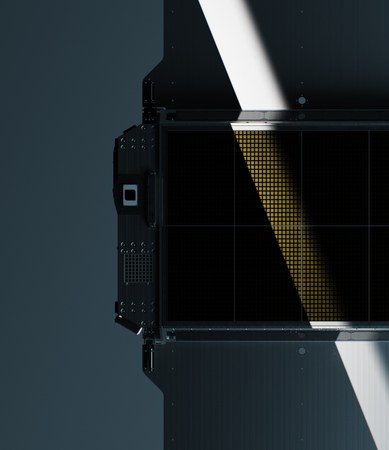
Array Labs designs, builds, and operates radar satellites that fly in coordinated clusters to image the same place on Earth from many angles at once. By distributing the radar across many small, mass-manufacturable satellites instead of one large bespoke spacecraft, the company aims to produce continuously refreshed, high-resolution 3D maps of the planet - a form of space-based radar it likens to what SpaceX did for launch. Founded in 2021 and based in Redwood City, California, Array Labs raised a $20M Series A in January 2026 to scale radar manufacturing and prepare to launch the world's first formation-flying radar satellite cluster.

GeoX
GeoX is an Israeli-founded geospatial AI company that turns aerial imagery, satellite data and ground-level images into detailed 3D models of individual buildings. Insurers, reinsurers, banks and public agencies use its property database - covering roughly 160 million US properties and expanding across Europe, Japan and Australia - to assess roof condition, elevation and exposure to fires, floods and storms without sending anyone into the field. The company raised a $19M Series A in 2024 (led by Flashpoint), bringing total funding to $23M.
Skycatch
Skycatch is a San Francisco drone-data company that turns aerial imagery into centimeter-accurate 3D and 4D models of mines, construction sites, and energy facilities. Founded in 2013 by Christian Sanz and Christopher Bumgardner, it pairs custom DJI-built drones and on-site edge computers with a cloud photogrammetry engine and AI to give industrial operators near-real-time maps of the physical world. Backed by Google Ventures, Komatsu, Autodesk, and others, Skycatch was acquired by Caterpillar in July 2026 to strengthen its data-driven mining technology portfolio.

Michael Mazur
Michael Mazur is co-founder and CEO of AI Clearing, an Austin-based platform that ingests drone imagery, BIM designs, schedules and ground data to produce autonomous progress tracking and quality control for large infrastructure builds. A former PwC partner who ran the firm's global Drone Powered Solutions unit, Mazur left in 2020 with co-founder Adam Wisniewski to spin the idea out as an independent company; in October 2023 the company closed a $14M Series A led by Prudence, on the back of 15x revenue growth.

Rema Matevosyan
Rema (Hripsime) Matevosyan is the co-founder and CEO of Near Space Labs, a Brooklyn-based company that flies helium-lifted robotic aircraft called Swift into the stratosphere to photograph the Earth at 7-centimeter resolution. Born and educated in Armenia, trained as an applied mathematician in Moscow, she left a PhD program two weeks into an entrepreneurship class to build what she calls her own little space program. In April 2025 the company closed a $20M Series B led by Bold Capital Partners, bringing total funding above $40M, with insurance carriers as anchor customers using the imagery to model wildfire and hurricane damage.

CivilGrid
CivilGrid is a San Francisco construction-intelligence company that centralizes utility, environmental, geotechnical and land-rights data into a single collaborative platform - often called 'Google Maps for pre-construction.' Founded in 2021 by Wharton classmates Josh Mackanic and Brandon Cohen, it partners with utilities and agencies to pull current GIS datasets so engineers and construction teams can scope, plan and de-risk projects before anyone breaks ground, cutting pre-construction research time by up to 90%.

Geolava
Geolava is a San Francisco startup building a world model for the built world - a spatial intelligence layer that fuses satellite, LiDAR, aerial, street-level and government data into a foundation model you can query in plain language. It lets real estate owners, investors, lenders, insurers and operators analyze, underwrite, monitor and forecast physical assets, turning slow, manual property surveying into predictive property intelligence.

Josh Mackanic
Josh Mackanic is the founder and CEO of CivilGrid, a San Francisco construction intelligence platform that stitches together utility, environmental, and geotechnical site data so engineers stop discovering surprises with a backhoe. A licensed mechanical engineer with a decade inside PG&E and an MBA from Wharton, he has shepherded north of half a billion dollars of gas, electric, and renewable infrastructure into the ground.

Atlas AI
Atlas AI is a Palo Alto-based Public Benefit Corporation building GeoAI software that turns planetary-scale satellite imagery, ground-truth surveys, and predictive models into decision-support tools for enterprises, governments, and development institutions investing in emerging markets.

Bifrost AI
Bifrost AI builds simulation and evaluation infrastructure for physical AI. Its platform generates photorealistic 3D synthetic data and stress-tests robotics and computer-vision systems across thousands of simulated scenarios - weather, sensor noise, rare edge cases - so teams can train and validate models in minutes instead of months. Used across maritime, geospatial, aerial, off-road, industrial, and off-world domains, with collaborators including NASA JPL and the U.S. Air Force. Founded in 2020 and backed by an $8M Series A led by Carbide Ventures with participation from Airbus Ventures and Peak XV's Surge.

Blumen Systems
Blumen Systems is a San Francisco software company building an AI-powered operating system for infrastructure permitting and environmental diligence. It fuses 2,000+ geospatial datasets, a nationwide database of local zoning and permitting rules across 3,200+ jurisdictions, and a decade of historic permit outcomes to flag fatal flaws and regulatory risk on energy and infrastructure sites in days instead of months. In 2025 its tools were used to evaluate roughly 60 GW of solar, battery, gas, and data-center projects.

Shovels
Shovels is an AI-powered building-permit intelligence platform that turns fragmented local-government data into a queryable source of truth on construction activity, covering more than 130 million permits across 1,800+ US jurisdictions.

Ali Khaloo
Ali Khaloo is a structural engineer turned AI founder who builds software that reads the health of bridges, dams, runways and cooling towers the way a doctor reads an X-ray. As CEO and founder of Aren, the New York company he spun out of Cornell Tech's Runway Startup program, he fuses computer vision, machine learning and civil engineering into an AI-powered digital twin platform that turns drone images, laser scans and sensor data into 3D condition maps and predictive maintenance plans. He holds a PhD in structural engineering, has authored more than 20 peer-reviewed papers cited over 1,000 times, and owns several patents for AI analysis of large infrastructure systems.

Delos Insurance Solutions
Delos Insurance Solutions is a San Francisco insurtech and managing general agent that uses satellite imagery, fire science, and machine learning to insure California homeowners in wildfire-prone areas that traditional carriers have abandoned. Founded by two aerospace engineers, Delos models wildfire risk at the individual-property level using NASA Earth-observation data, climate science, and hundreds of risk parameters, allowing it to write coverage on homes the rest of the market deems uninsurable.

Noam Ben-Zvi
Noam Ben-Zvi is the co-founder and CEO of Placer.ai, the location intelligence platform that turns anonymized phone movement into hard numbers for retailers, landlords, and city planners. He sold his first company, BlueTail, to Salesforce in 2012, then started Placer in 2016. By 2024 the company crossed $100M ARR and raised at a $1.5B valuation.

Erez Cohen
Erez Cohen is the Co-Founder and Co-CEO of August Health, a San Francisco-based healthtech company building the modern EHR platform for senior living communities. A serial founder and former Apple engineering leader, Cohen sold his first company, Mapsense, to Apple for approximately $25-30 million in 2015. He founded August Health in 2020 after meeting physician co-founder Dr. Justin Schram at a San Francisco playground - both pushing their two-year-olds on the swings - and the company has since raised $44 million in total funding, with a $29 million Series B led by Base10 Partners in August 2025.

Point One Navigation
Point One Navigation builds the precision-location stack behind autonomous vehicles, drones, robots and survey-grade tools. Its Polaris RTK network, Atlas inertial sensors and FusionEngine software fuse GNSS, inertial data and computer vision to deliver centimeter-level positioning across the US, Europe, UK, Australia, New Zealand and South Korea.

Raptor Maps
Raptor Maps builds the operating system for utility-scale solar. Its cloud platform combines drone thermography, digital twins, AI anomaly detection, and asset-performance analytics so solar owners, operators, and OEMs can find faults, plan maintenance, and squeeze more energy out of every panel across hundreds of sites.

Ready
Ready (ready.net) is a San Francisco software company that builds the platform state broadband offices use to run the federal BEAD program - from application intake and challenge processes to milestone tracking, reimbursements, and NTIA-ready reporting. Founded by Jase Wilson and Mike Faloon, the company turns a paperwork avalanche into structured, auditable workflows so $42B in public money actually reaches the unserved homes it was meant for.

Hannes Boehning
Hannes Boehning is the CEO and founder of Blumen Systems, a San Francisco-based AI company building environmental intelligence software that converts complex regulatory documents and geospatial datasets into permitting matrices, site layouts, and engineering documents for energy infrastructure developers. A Stanford-trained engineer and former Division I athlete, Boehning left roles at Rothschild & Co and Fortress Investment Group to found Blumen in 2023, raising $6.39M from Climate Capital to tackle one of the biggest bottlenecks in the clean energy transition: the permitting process.

Regina Clewlow
Regina Clewlow is a transportation scientist turned CEO who co-founded Populus, the urban curb and mobility management platform that became the operating system for city streets - helping over 100 cities worldwide manage the explosive growth of scooters, bikes, delivery fleets, and autonomous vehicles. Armed with a PhD from MIT and deep research roots at Stanford and UC Berkeley, Clewlow bridged academia and industry to turn GPS data and curb regulations into digital intelligence for cities. Populus was acquired by IPS Group in November 2025, cementing its place as the infrastructure layer between cities and the mobility economy.

Ryan Buckley
Ryan Buckley is the Co-Founder and CEO of Shovels, a Lafayette, California-based startup that turns fragmented government building permit records into a searchable intelligence layer for the construction and climate tech industries. Armed with degrees from UC Berkeley, MIT Sloan, and Harvard Kennedy School, Buckley spent years building parallel B2B ventures before co-founding Shovels in 2022 with Luka Kacil. The company now processes 180+ million building permits, covers 30 million US addresses, and raised a $5M seed round in June 2025 led by Base10 Partners. A prolific blogger, part-time college professor, and author of 'The Parallel Entrepreneur,' Buckley is building what he calls the 'Pitchbook for the construction industry.'