Test & improve physical AI in simulation - training machines on worlds that don't exist yet.
BIFROST AI. The rainbow bridge of Norse myth crossed worlds. This one crosses from simulation to the messy physical real - rendering the maritime, off-road, and off-world data nobody can safely collect.
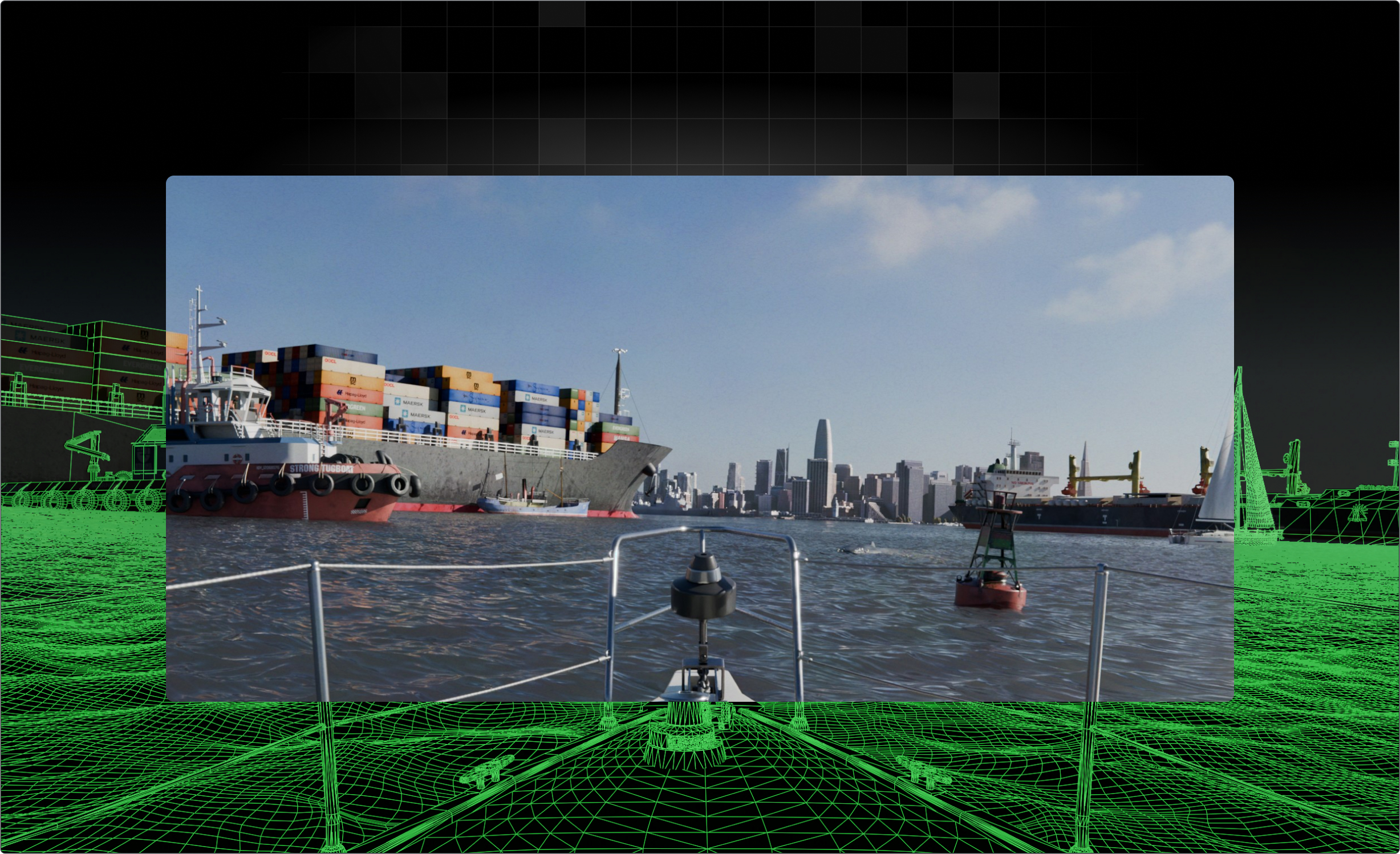
Somewhere in a data center, a cargo ship is on a collision course in a storm. Then it happens again, in fog. Then under a low sun that blinds the camera. Then ten thousand more times before the engineer finishes their coffee. None of these ships are real. None of these storms happened. And that is exactly the point.
This is Bifrost AI's daily business: manufacturing reality on demand. The company builds simulation and evaluation infrastructure for "physical AI" - the robots, vessels, and vision systems that have to work in the actual world, where mistakes are expensive and edge cases are lethal. The bottleneck for all of them is the same boring, enormous problem: data. You cannot teach a machine to handle a rare hazard if you have never captured one. So Bifrost stopped waiting for the world to cooperate and started generating it.
Its platform produces photorealistic, labelled 3D scenes - varying the objects, the weather, the lighting, the sensor noise - and runs them as continuous evaluations against a customer's model. Think of it as a CI/CD pipeline, but for robots instead of web apps. Push a new perception model, and Bifrost stress-tests it against thousands of synthetic scenarios overnight, flagging where it fails before anything fails on the water, the road, or the launchpad.
The pitch compresses cleanly: months become hours. Where a team might once have driven a fleet for a year to gather enough corner cases, Bifrost claims roughly a hundredfold speed-up - and the ability to conjure the scenarios a fleet would almost never stumble into.
The name is not an accident. In Norse mythology, Bifrost is the burning rainbow bridge connecting the realm of gods to the realm of mortals. The startup's version connects the perfect, controllable realm of simulation to the imperfect, unforgiving realm where machines actually operate. Cross that bridge correctly, and a robot trained entirely on invented data behaves correctly the first time it meets the real thing.
Co-founders Charles Wong and Aravind Kandiah did not arrive here by accident either. Wong worked on AI perception for self-driving cars at NuTonomy, the MIT spinout - close enough to autonomy's data problem to feel its weight. Kandiah had built medical AI to detect diabetic retinopathy, a field where a mislabelled pixel has consequences. Both had seen the same wall from different sides: models are only as good as the data behind them, and good data is the scarcest thing in the building.
CI/CD-style evaluations that continuously benchmark robotics and perception systems across thousands of simulated scenarios, catching failures before deployment.
Synthetic data generation using procedural 3D rendering and AI. Runs in the cloud or locally, outputs labelled 2D and 3D datasets across varied sensors, weather, and lighting.
Purpose-built generators for maritime, geospatial, aerial, off-road, industrial, and off-world scenes - including automated labelling and bias detection.
Most synthetic-data companies chase the obvious money: city streets and warehouse floors. Bifrost leans the other way, toward the verticals everyone else finds inconvenient. Offshore maritime, where the sea never repeats itself. Off-road robotics, where the ground is a different problem every meter. And off-world - the Moon and Mars - where collecting real data is, generously, difficult.
That last one is not a metaphor. Bifrost has collaborated with NASA's Jet Propulsion Laboratory on data generation engines for lunar and Martian exploration. You cannot send a fleet of test rovers to Mars to gather training images. You can, however, render the terrain - the lighting, the dust, the long shadows - and train a landing or navigation system on terrain it will only ever see for real once.
In October 2024, Bifrost closed an $8M Series A led by Carbide Ventures, bringing total reported funding to roughly $13.7M.
"Bifrost AI will unlock exceptional value at the intersection of 3D generative AI, advanced simulation, and design."
"The Bifrost team is uniquely positioned to bridge the data gap, training systems an order of magnitude more efficiently."
Charles Wong and Aravind Kandiah found Bifrost AI to attack the training-data bottleneck in physical AI.
Alchemy synthetic-data platform expands across maritime, geospatial, off-road, and off-world domains; collaboration with NASA JPL on Moon and Mars data.
$8M Series A led by Carbide Ventures, with Airbus Ventures and Peak XV's Surge. Total raised reaches ~$13.7M.
Repositions as simulation & evaluation infrastructure - CI/CD evals for physical AI, beyond pure data generation.
Bifrost is the Norse rainbow bridge between worlds - a fitting name for a company bridging simulation and reality.
Its engines have rendered Moon and Mars terrain - training systems for places no test fleet can reach.
CEO Charles Wong cut his teeth on self-driving perception at NuTonomy, an MIT spinout - and has been named to Forbes 30 Under 30.
CTO Aravind Kandiah previously built medical AI to detect diabetic retinopathy.
It deliberately specializes in the hard-to-reach: offshore maritime, off-road, and off-world.
Return to that cargo ship in the storm - the one that never sailed, in weather that never broke. By the time a real vessel meets a real hazard, the model steering it has already seen the situation ten thousand times, in fog and glare and dark. The rare event is no longer rare. The edge case has been rehearsed.
That is the quiet trick of what Bifrost is building. It does not promise to predict the future. It promises something more useful and more modest: to let machines practice the worst day they will ever have, before it arrives, in a world that costs nothing to break. The bridge holds. The ship corrects. And the storm, this time, was just data.