Aerospace, done by someone who does not run an aerospace company
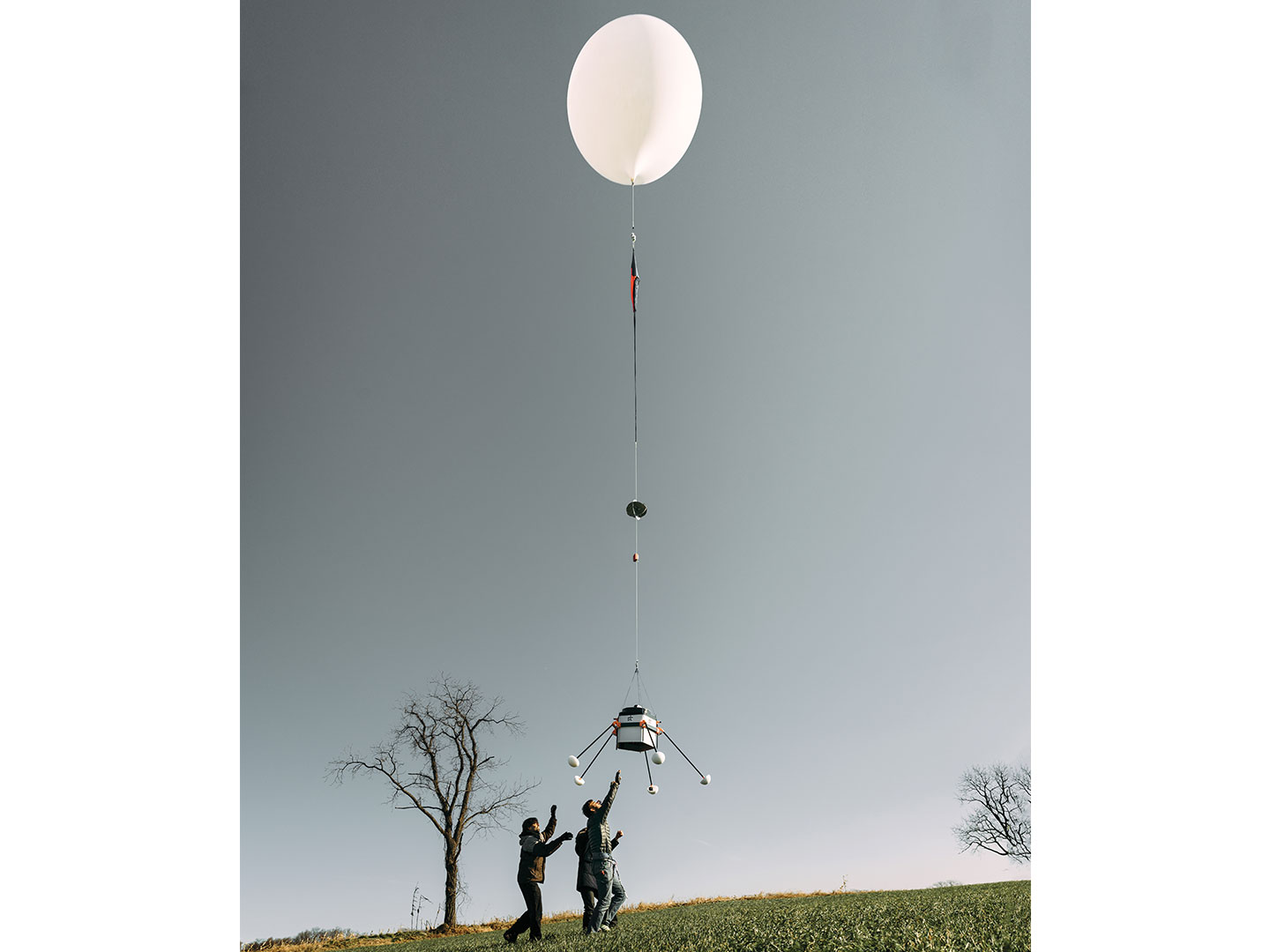
Rema Matevosyan runs Near Space Labs, which is technically an aerospace company and practically a data business that happens to fly. Her fleet of small helium-lifted aircraft, called Swift, climbs to the stratosphere, drifts on the wind, photographs whatever is under it at seven-centimeter resolution, and glides home. The company sells the pictures on subscription, mostly to insurance carriers who need to see hail damage the same week it happens and to utilities that need to see a hurricane's path before FEMA can.
The mechanics of Near Space Labs are fairly weird. A satellite costs a lot of money, orbits the planet on a schedule set by physics, and returns to the same patch of Brooklyn every few days at whatever resolution the optics permit. A drone can fly whenever you like, but only over a small area, and only if a pilot happens to be nearby with a license. Matevosyan's Swift robots do neither. They ride a balloon up, catch the winds, and come back with an imagery dataset that Matevosyan says would take five to ten satellites to match. The company told TechCrunch its fleet could accomplish in hours what would take 800,000 drones weeks. This is the kind of number a reporter writes down and a customer verifies with a purchase order.
The customer, mostly, is an insurance company. When a wildfire moves through a California suburb, an underwriter needs to know which roofs are gone and which are merely singed. When a hurricane rakes a stretch of the Gulf Coast, a reinsurer wants a defensible number for the total loss by the end of the week. Matevosyan built a company that hands them that number on a clock the satellite industry has trouble matching, using helium instead of kerosene, at a price that municipalities and utilities can also afford. It is climate resilience sold as a subscription.
The most crucial question for us is not whether we can build the biggest or heaviest balloon. It's who's going to pay for it and what are they really paying for? — Rema Matevosyan, Infinite Frontiers
The two-week PhD
Matevosyan was born and raised in Yerevan, Armenia. Her grandmother was a physicist, her grandfather an electronics engineer, her mother a computer scientist. She has told interviewers that the family kept a telescope, that the grandparents woke her at 3 a.m. to look through it, and that they taught her constellations before she could reliably distinguish between them. She went to Physmath, Armenia's flagship STEM secondary school, then to Yerevan State University for a bachelor's in applied mathematics. AGBU sponsored a scholarship that sent her to Moscow, where she completed a master's in control and applied mathematics at the Moscow Institute of Physics and Technology.
The pivot happened at the Skolkovo Institute of Science and Technology, an MIT-affiliated graduate program outside Moscow. Matevosyan enrolled in a systems engineering PhD focused on complex aerospace systems and set to work researching novel distributed space architectures for Earth observation. Two weeks in, she took an entrepreneurship class with a professor named Zeljko Tekic, who suggested that some of the research might be worth commercializing. She left the program. Her co-founders, Ignasi Lluch and Albert Caubet, went with her. They applied to New York's Urban-X accelerator, which is run out of a Mini Cooper facility in Brooklyn, and moved the company there in 2017. Matevosyan was 28 when she became CEO. Forbes put her on its 30 Under 30 list in Manufacturing and Industry the following year.
She has said, on the record, that she would have never thought she would become an entrepreneur. What Armenia lacks, and what she has cheerfully noted in interviews, is a national space program. Near Space Labs is, in a phrase she has used more than once, her own little space program. It is headquartered on Flushing Avenue in Brooklyn, has 75 employees, and reports about $7 million in annual revenue.
What Matevosyan tends to point out
She is unusually disciplined about the commercial question. Aerospace attracts a certain kind of founder who wants to build the largest possible thing; Matevosyan spends most of her airtime asking who is writing the check. In her Infinite Frontiers interview she describes the market with a bluntness that is rare in the sector. A drone-based crop monitoring service, she notes, "really didn't take off, because if a chunk of land is not healthy, that doesn't necessarily mean that the rest of the farm is unhealthy." Farmers need the whole picture. So do insurers. So does everyone she is trying to sell to. The company sells the whole picture.