Profile / The Subsurface
Itzik Malka
He spent a decade finding what was buried underground. Now he's mapping all of it - before anyone digs.
Co-Founder & CEO · 4M Analytics · Austin, Texas
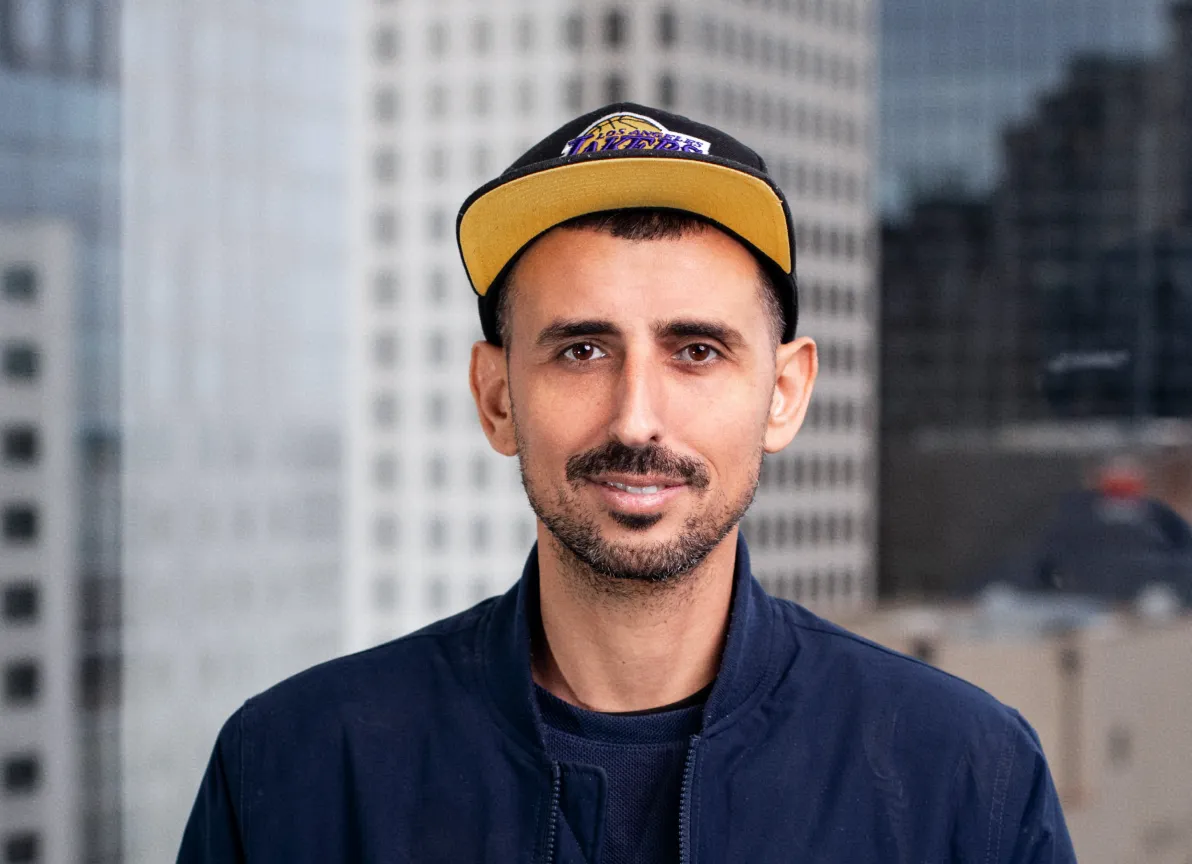 MAPPING THE UNDER-EARTH
He spent a decade finding what was buried underground. Now he's mapping all of it - before anyone digs.
Co-Founder & CEO · 4M Analytics · Austin, Texas
MAPPING THE UNDER-EARTH
Itzik Malka runs a company built around a strange fact: the most important data in construction is the data almost nobody has. Every road widening, every fiber run, every new pipeline starts with a question that is surprisingly hard to answer - what is already down there?
As co-founder and CEO of 4M Analytics, Malka has spent the past several years turning that question into a business. His company fuses satellite and aerial imagery, public utility records and computer vision into a single picture of the subsurface: the tangle of gas lines, water mains, electrical conduits and fiber-optic cables that sit invisibly beneath American streets. He describes the ambition in terms anyone can grasp. It is, he says, the Google Maps of the underground.
Today the company employs around 130 people, split between an engineering base in Israel and a headquarters at 919 Congress Avenue in Austin, Texas. It has mapped utility infrastructure across more than a dozen states and signed enterprise customers that include the engineering giants AECOM and Stantec, along with multiple state departments of transportation. Public records put total funding at roughly $119 million across several rounds, the most recent a Series C reported in late 2025. Malka's stated long-term target is characteristically large: he has talked publicly about building 4M into a $100 billion company.
To understand why investors and DOTs are paying attention, it helps to look at the numbers Malka repeats in interviews. There are roughly 42 million dig requests filed in the United States every year - the equivalent of about 169,000 construction projects starting every single day. Each of those projects typically requires coordination between 50 to 60 different entities just to figure out what utilities cross the site.
The financial drag is enormous. Malka points out that somewhere between 8 and 15 percent of a typical construction budget is set aside as contingency, much of it against a single category of risk: hitting something underground that nobody knew was there. Bricks & Bytes, a construction-tech newsletter that profiled him, framed it as a $42-million-a-day problem. 4M's pitch is that most of that guesswork is unnecessary, because the data to answer the question already exists - it is just scattered, inconsistent and unreadable in its raw form.
"I'm going to be building the Google Maps. I'm going to be the Google subsurface."
Malka's route into utility mapping did not run through a GIS lab. Born in Israel, he spent roughly a decade in the Israeli military's Yahalom unit - the combat-engineering group that specializes in locating and disposing of buried explosives, IEDs and landmines. His entire professional formation was built around one skill: knowing what lies beneath the surface without digging blindly into it.
That background is not a marketing flourish; it is the actual origin of the company. In 2016 he co-founded 4M Defense, working on landmine clearance and subsurface detection. The leap from clearing explosives to mapping utilities is smaller than it sounds. Both are exercises in reading the ground remotely, assembling fragmentary evidence into a confident picture of what is hidden. In 2019 he co-founded 4M Analytics with Yoav Cohen and Nir Cohen to apply that thinking to civilian infrastructure.
The result is a company Malka insists was "really, really AI native" - built from inception around machine learning rather than retrofitted with it later. Its approach is data fusion: combining satellite imagery, GIS databases, municipal records and surface features like manholes, poles and hydrants to predict where underground utilities run, even when no clean documentation exists. The system is designed to produce answers before a single crew reaches the site.
"Our vision is to create the first map product to access the world below us."
4M's growth has been geographic and methodical. The company launched its 4Map subscription product in 2022, moving over time from a pay-per-use model to project-based SaaS subscriptions that fit how engineering firms actually budget. It has since expanded its coverage across more than 14 states, with public plans to push toward 22 and beyond. Each new state adds another region of the country where an engineer can pull up buried infrastructure the way a driver pulls up traffic.
The company Malka has assembled around him signals how seriously the industry takes the idea. 4M's advisory board includes Carl Bass, the former CEO of Autodesk; Noam Bardin, the former CEO of Waze; and Jim Anspach, a pioneer of subsurface utility engineering. It is a deliberate mix - a design-software veteran, a mapping veteran, and the person who helped formalize the very discipline 4M is trying to automate.
For all the industrial ambition, Malka tends to describe himself in ordinary terms. In his own words on the company blog, life beyond the platform comes down to soccer, music and family - the counterweights to a company that wants to remap the ground beneath an entire country. He frames the work less as a technical project and more as a calling, writing that navigating the depths beneath our feet is "more than just a mission; it's a relentless passion."
That framing matters, because 4M is a long game. Mapping the subsurface of the United States is not a feature that ships in a quarter; it is a multi-year accumulation of data, coverage and trust. Malka's bet is that whoever assembles the definitive map of the underground will own a layer of infrastructure as fundamental as street maps became for navigation. Whether 4M becomes the $100 billion company he describes is unknowable today. What is clear is that he has spent his whole career, in uniform and out of it, answering the same question - and he is not planning to stop.
"Our game plan is to one day be a $100 billion company."
There's an entire system of power grids, oil and gas pipelines, and fiber optic cables underground.
We are really, really AI native.
Navigating the depths beneath our feet is more than just a mission; it's a relentless passion.
OFFICIAL PROFILES / NEWS / INTERVIEWS