Breaking
PASTEL ships agentic AI for banking operations Nigerian banks lost N52.26bn to fraud in 2024, up 196% Flagship platform SIGMA handles fraud, AML & onboarding Seed round: $5.5M led by TLcom Capital Founders met as Stanford grad students Africa loses $50bn/yr to illicit financial flows PASTEL ships agentic AI for banking operations Nigerian banks lost N52.26bn to fraud in 2024, up 196% Flagship platform SIGMA handles fraud, AML & onboarding Seed round: $5.5M led by TLcom Capital Founders met as Stanford grad students Africa loses $50bn/yr to illicit financial flows
Company Dossier // Fintech & AI

Pastel

The agentic AI startup betting that the banks everyone else skips are exactly where compliance software matters most.

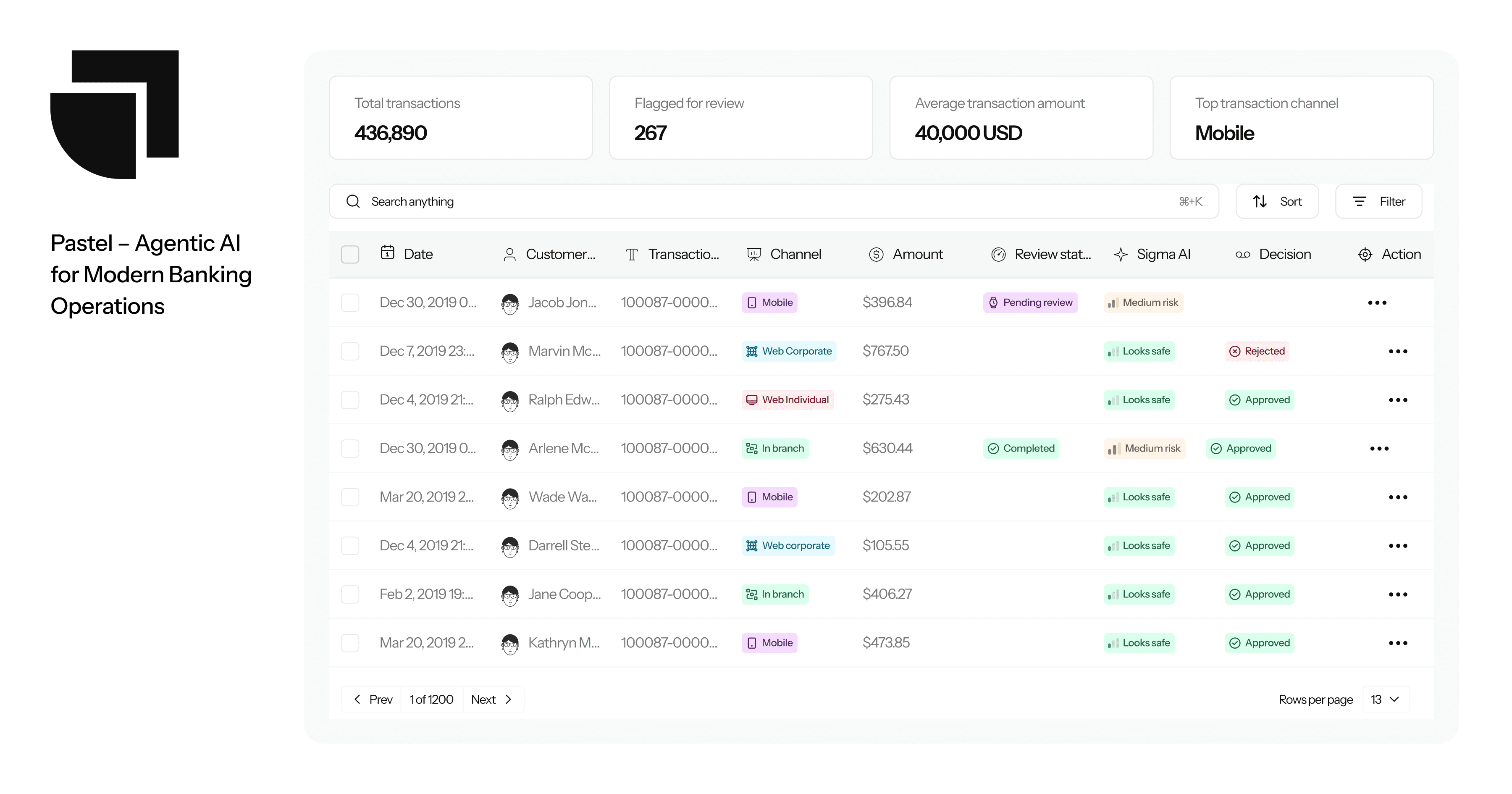
Pastel brand mark and product visual
Pastel, in its own colors. A company that started life as a bookkeeping app for Lagos merchants and grew into compliance plumbing for banks. The logo is calm; the problem it fights - fraud, at scale, in real time - is not.

A bet that AI is going to the wrong places first

Most fintech innovation flows to the biggest banks. Pastel is walking it the other direction.

Here is a thing about financial technology that is both obvious and, apparently, easy to forget: the institutions that most need better tools are often the last ones to get them. The very large banks have compliance departments, vendor budgets, and consultants. The regional, mid-tier, and community banks - the ones serving people who got their first bank account in the last decade - tend to have the same regulatory obligations and a fraction of the resources. Pastel's founding observation, which its CEO Abuzar Royesh states plainly, is that "AI is going to the wrong places first."

Pastel builds agentic AI for banking operations. In practice that means software agents that do the manual, box-checking parts of running a bank - customer onboarding, due diligence, fraud detection, anti-money-laundering monitoring, screening, and the endless generation of regulator-ready reports - so that the humans can spend their time on the part machines are bad at, which is judgment. This is a useful distinction, and Pastel leans on it hard. The AI acts inside policies and thresholds that people set. The person decides; the machine executes. If you have ever wondered what "human in the loop" is supposed to mean in a regulated industry, this is roughly it.

"Sigma is not a Western system retrofitted for Africa. It is purpose-built using African data, CBN standards, and risk models from across the continent." - Abuzar Royesh, Co-founder & CEO

The flagship product is called Sigma, which is a nice piece of naming for a compliance company - sigma being the symbol statisticians reach for when they are talking about deviation, risk, and how far a thing has strayed from normal. Sigma deploys specialized agents across the compliance stack and integrates with the systems a bank already runs. The pitch is not "rip out your infrastructure." The pitch is "we will sit on top of it and do the tedious work faster than your team can, and flag the suspicious things instantly instead of in next quarter's audit."

What makes this more than a generic AI-does-your-paperwork story is Pastel's insistence on local context. Fraud in Lagos does not look like fraud in London. Regulatory expectations from the Central Bank of Nigeria are not the expectations of the US Federal Reserve. A model trained on Western transaction data and pointed at an African bank will, Pastel argues, miss things and flag the wrong things. So Sigma is trained on African data, African regulations, and risk models drawn from across the continent. Royesh's line - that it is "not an imported fix" - is the whole thesis compressed into four words.

The numbers behind the pitch are not subtle. According to the 2024 NIBSS Fraud Report, Nigerian banks lost N52.26 billion to fraud in a single year - a 196 percent increase over the year before. Across the continent, an estimated $50 billion a year vanishes into illicit financial flows. Of the 24 countries on the FATF greylist, 12 are in Africa, which turns compliance from a back-office chore into an existential question about whether cross-border money can move at all. When your addressable market is defined by a problem growing at triple-digit percentages, you do not have to work hard to explain why the product exists.
N52bn
Nigerian bank fraud, 2024
196%
Year-over-year jump
$5.5M
Seed round
$50bn
Africa's annual illicit flows

From Sabi to Sigma

A bookkeeping app for merchants became compliance infrastructure for banks. That is not a small turn.

Pastel did not start here. It began, around 2021, as Sabi Cash - "sabi" being Nigerian Pidgin for knowing how to do something, being skilled at it. The original product, Sabi, was a digital bookkeeping app that let small businesses track transactions, manage the customers who owed them money, and understand their own cash flow. There were standalone tools bolted on over time: Quick Receipt for digital receipts, Pastel Financing to help merchants access capital. It was a classic emerging-markets SME play, and it worked well enough to raise money.

In August 2022 the company closed a $5.5 million seed round led by the pan-African VC firm TLcom Capital, with participation from Global Founders Capital, DFS Labs, Ulu Ventures, Plug and Play, Golden Palm Investments, and Soma Cap. That followed a $620,000 pre-seed the year before. The money was raised to scale bookkeeping and financing tools for Nigerian small businesses. That is worth stating clearly, because it is not what Pastel does now.

Somewhere between the seed round and today, the founders noticed the more valuable problem was upstream. The small businesses were one node in a financial system whose institutions - the banks and fintechs themselves - were buckling under compliance load and fraud they could not see fast enough. So Pastel pivoted, from selling tools to merchants to selling agentic AI to the banks. Pivots are easy to narrate in hindsight and brutal to live through. The tell that this one is real is that the company changed its entire product surface, its buyer, and its go-to-market, and kept the name.

Agents, not checklists

Sigma breaks banking's most manual workflows into specialized AI agents. Here is the lineup.

Onboarding

Due Diligence

Agents run customer onboarding and KYC-style due diligence, compressing intake work that normally clogs compliance queues.

Real-time

Fraud Detection

Suspicious activity is flagged as it happens rather than surfacing in a later audit - the difference between catching fraud and reporting it.

AML

Money-Laundering Watch

Continuous anti-money-laundering monitoring tuned to local transaction behavior instead of imported assumptions.

Reporting

Regulator-Ready Reports

Generates the documentation regulators expect on demand, turning a multi-day scramble into a query.

Screening

Risk Assessment

Comprehensive customer risk scoring and screening that plugs into a bank's existing risk framework.

Leadership

Executive Insight

Bank-specific data rolled up into real-time insight for the people who have to answer for it.

The overlooked middle

Not the giants. The regional, mid-tier, and community banks - in Lagos, and increasingly beyond it.

Pastel's customers are the institutions its thesis is built around: regional, mid-tier, and community banks, plus fintechs and payment and infrastructure providers, starting in African markets and centered on Nigeria. The company has been careful, as most B2B compliance vendors are, about naming specific customers - compliance is not a thing banks love to advertise buying. But Pastel has convened the ecosystem publicly. In 2025 it put Sigma at the center of an executive breakfast in Lagos, held with the industry body FintechNGR, that drew stakeholders from traditional banks, payment platforms, and infrastructure providers. Executives from institutions including Optimus Bank, Coronation Merchant Bank, Interswitch, and Katsu Network were in the room for the conversation.

The interesting move is what comes next. Pastel's argument is that the problem it solves is not uniquely African. A mid-tier bank in the Gulf or a community bank in the United States faces the same structural squeeze: full regulatory obligations, thin resources, and fraud that moves faster than a human compliance team. If that is true, then "built for Africa" is not a ceiling on the market - it is a proof of concept for the hardest version of the problem, portable to easier ones. That is the bet. It is not proven yet, and Pastel is honest enough to frame it as a bet rather than a fact.

"It's not an imported fix. It's a purpose-built platform trained on African data, CBN regulations, and local transaction behavior." - Abuzar Royesh, Co-founder & CEO

There is also a competitive reality to name. Compliance and fraud software is a crowded field - ComplyAdvantage, Sardine, Feedzai, Unit21, and identity players like Smile ID all circle the same money, alongside legacy screening vendors and the in-house teams that many banks still trust more than any vendor. Pastel's differentiator is not that it does fraud detection; plenty of companies do. It is the claim that context-native models, trained where the fraud actually happens, beat generic ones retrofitted from elsewhere. Whether banks will pay for that distinction at scale is the question the next few years will answer.

"AI should go where it creates the greatest impact - not just the largest markets."

Pastel's operating philosophy

How it happened

2021

Founded as Sabi Cash by Abuzar Royesh, Olamide Oladeji, and Izunna Okonkwo - Stanford grad students building for SMEs in emerging markets. Raises $620K pre-seed.

Aug 2022

Closes $5.5M seed round led by TLcom Capital to scale bookkeeping and financing tools for Nigerian small businesses.

2023-2024

Pivots from SME tools toward agentic AI for banking operations, reorienting product, buyer, and market around compliance.

Jul 2025

Puts Sigma at the center of a Lagos industry gathering with FintechNGR; broad press coverage frames it as emerging compliance infrastructure as Nigerian fraud losses top N52bn.