financial-crime
(41)
Elliptic follows the money. Banks are following Elliptic.
The bitcoin-vault startup became a business built around an awkward question: where did this money come from? Now a $120 million funding round is backing its next push into crypto compliance.

Facctum Wants Banks to Stop Chasing the Wrong Names
A familiar name can send a payment into a compliance queue. Facctum is tackling the data, screening and review work that decides whether it belongs there.

The Rules Never Stop. Wolters Kluwer Sells the Machinery to Keep Up.
Banks do not buy OneSumX because compliance is delightful. They buy it because a missed filing, stale loan form or unexplained number can be ruinously expensive - and Wolters Kluwer has spent decades turning that anxiety into recurring software revenue.

Annalisa Camarillo Learned the Machines. Then She Taught Them to Mean Something.
Her career began in an engineering department and grew through psychology, publishing and enterprise software. At Quantifind, Annalisa Camarillo turns the hidden machinery of risk intelligence into a story that people can act on.

Jonathan Daly Bet on Behavior Before Banking Had a Better Answer
The BioCatch CMO has spent a career naming hard-to-see threats. His latest argument is disarmingly human: the way people type, tap and swipe may tell banks more than another password ever could.

The $2.4 Billion Bet That Your Swipe Knows a Scam Before Your Bank Does
BioCatch turned hesitation, scrolling and a crooked swipe into a fraud alarm for 350-plus financial institutions. Now Visa is paying $2.4 billion for the chance to catch crime before money moves.

The Software That Turns Financial Crime Investigators Into Case-Closing Machines
Anti-money-laundering work is where good design goes to die. Hummingbird bet the opposite - that compliance investigators deserve tools as sharp as the criminals they chase.

The Startup Teaching Governments to Read the $20 Trillion They Can't See
Most financial crime hides in plain sight, scattered across the open web. IVIX built an AI platform that reads all of it at once - and hands governments a map.

Mozn
Mozn is a Riyadh-based enterprise AI company founded in 2017 that builds AI for high-stakes decisions in the Arabic-speaking world. Its flagship platform, FOCAL, unifies fraud prevention and anti-money-laundering (AML) compliance for banks, fintechs and governments, while its OSOS platform delivers Arabic natural-language understanding and enterprise knowledge intelligence. Backed by a $10M Series A, Mozn has served more than 100 organizations and, in 2025, became one of only ten vendors worldwide named a Category Leader by Chartis Research in both AML transaction monitoring and KYC solutions.

Will Lawrence
Will Lawrence is the co-founder and CEO of Bretton AI, the San Francisco company formerly known as Greenlite AI that builds AI agents for financial crime and compliance operations. After leading anti-money laundering product work at Facebook/Meta and building compliance infrastructure at Paxos, he started the company in 2023 to automate the slow, manual investigative work behind KYC, AML and sanctions checks. In February 2026 the company rebranded to Bretton AI and raised a $75 million Series B led by Sapphire Ventures, bringing total funding to roughly $90 million, with customers including Robinhood, Mercury, Ramp, Gusto and a set of OCC-, FDIC- and Federal Reserve-regulated banks.

Craig Costigan
Craig Costigan is the CEO of NICE Actimize, the financial crime and compliance software division of NICE, a role he has held since 2018. He leads market strategy, product, R&D, sales and marketing for a business that helps banks and other financial institutions fight money laundering, fraud and market abuse. A founding partner of a securities finance software firm in the early 1990s, he built a three-decade career in capital markets technology at K-Tek International, SunGard and FIS before taking the top job at NICE Actimize, where he has pushed the company toward generative and agentic AI.

Elementus
Elementus is a New York-based blockchain intelligence company that adds an identity layer to raw on-chain data, letting banks, regulators, government agencies and investigators trace crypto transactions, score risk, detect sanctions exposure and follow the money across multiple chains. Founded in 2018 by data scientist Max Galka, the company pairs proprietary attribution data with forensic algorithms and became widely known for mapping the flow of funds in the Celsius and BlockFi bankruptcies.
NICE Actimize
NICE Actimize is the financial-crime, risk and compliance division of NICE Ltd. and one of the largest providers of anti-money laundering, fraud prevention and trading-surveillance software to banks, regulators and financial institutions worldwide. Its AI-driven X-Sight platform, ActOne case management and SURVEIL-X surveillance suite help more than a thousand institutions detect suspicious activity, screen against sanctions lists, manage regulatory reporting and investigate financial crime - increasingly using agentic AI to cut investigation time.
Feedzai
Feedzai is an AI-native platform that helps banks and financial institutions detect and prevent fraud and financial crime in real time. Founded in Portugal in 2011, its RiskOps platform unifies fraud detection, anti-money laundering, transaction monitoring, identity verification and scam prevention across the customer lifecycle. Feedzai screens transactions for institutions such as Citi and Lloyds Banking Group, and in 2025 was selected by the European Central Bank to help safeguard the forthcoming digital euro. The company reached a $2 billion valuation in October 2025.

Bretton AI
Bretton AI, formerly Greenlite AI, builds an AI-native platform for the financial back office - deploying audit-ready AI agents that run compliance, risk and fraud operations for OCC-, FDIC- and Federal Reserve-regulated banks and fintechs. The agents ingest alerts and policies, consolidate evidence across systems, auto-resolve low-risk cases and escalate complex matters with cited, traceable narratives. Founded in 2023 by Will Lawrence and Alex Jin, the company rebranded from Greenlite to Bretton in February 2026 alongside a $75M Series B led by Sapphire Ventures.

Flagright
Flagright is an AI-native financial crime compliance platform that gives fintechs, banks, and crypto firms a single system for transaction monitoring, sanctions and watchlist screening, dynamic risk scoring, case management, and regulatory filing. Founded in 2022 by Baran Ozkan and Madhu G. Nadig after Baran spent roughly 18 months failing to find a real-time monitoring vendor he liked, the company sells what it calls an 'AI operating system for compliance' - including an agentic investigation engine, AI Forensics, that runs alert investigations end to end. It serves 100+ financial institutions across 35+ countries and raised a $12.5M Series A in June 2026.

Variance
Variance builds investigative AI agents that automate risk and compliance work for banks, fintechs, and Fortune 500 platforms - handling KYC, KYB, AML, transaction monitoring, and fraud investigations that would otherwise take teams of analysts days to complete. Founded in 2023 by ex-Apple fraud engineers Karine Mellata and Michael Lin (originally as the trust-and-safety startup Intrinsic), the company raised a $21.5M Series A in March 2026 led by Ten Eleven Ventures.

Martin Markiewicz
Martin Markiewicz is the co-founder and CEO of Silent Eight, a Singapore-headquartered regtech that builds AI models banks use to screen names, transactions and alerts for money-laundering, sanctions and terrorist-financing risk. A mathematician by training with roots in Poland's tech scene, he has spent the last decade convincing tier-one banks to let algorithms make the first call on suspicious activity.

Consilient
Consilient is a New York- and Washington, D.C.-based financial technology company that applies federated machine learning to anti-money laundering and financial crime detection. Its models learn from behavioral patterns across multiple banks and share the algorithms - not the underlying customer data - so institutions can collaborate on catching illicit activity while preserving privacy. Founded in 2020 as a joint venture between K2 Integrity and Giant Oak, the company's Dozer platform has demonstrated in bank trials that it can sharply cut false positives while improving true-positive detection.
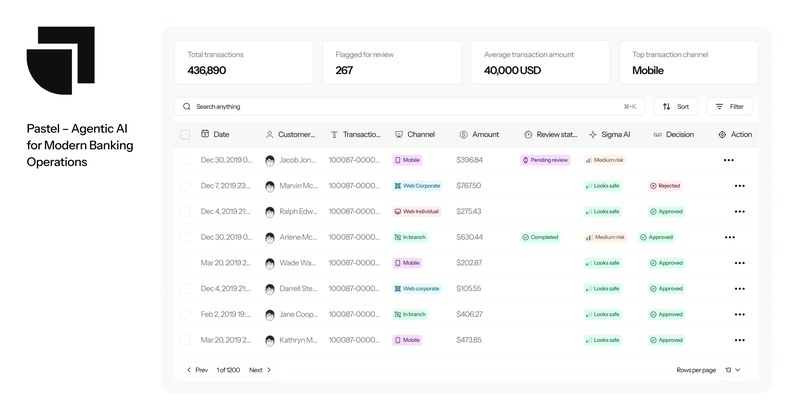
Pastel
Pastel builds agentic AI for banking operations, aimed at the regional, mid-tier, and community banks that most fintech innovation skips over. Its flagship platform, Sigma, deploys AI agents across customer onboarding, due diligence, fraud detection, anti-money laundering, screening, and executive reporting - trained on local data and regulations rather than retrofitted Western systems. Founded by Stanford graduate students and rooted in African markets, Pastel started as a small-business bookkeeping tool called Sabi before pivoting into compliance infrastructure for financial institutions.

Roe AI
Roe AI builds agentic AI that investigates fraud, disputes, and anti-money-laundering (AML) cases end to end - reading documents, images, websites, and structured data to produce cited evidence and audit-ready dispositions. Founded in 2024 by ex-Snowflake and ex-Meta engineers and backed by Gradient Ventures and Y Combinator, the company started as an AI-powered data warehouse for querying unstructured data with SQL and sharpened into a financial-crime investigation platform used by teams at Affirm, eBay, and a Global Systemically Important Bank.

Sphinx
Sphinx builds browser-native AI agents that do the work of a human compliance analyst - running AML, KYC, KYB and enhanced due diligence reviews inside the case-management tools banks and fintechs already use. Every decision is logged and explainable, producing a regulator-ready audit trail. Founded in 2024 by Alexandre Berkovic and Chrisjan Wust and backed by Y Combinator, Sphinx raised a $7.1M seed round in early 2026 and now runs in production across banks, fintechs, crypto platforms and public companies in eight countries.

Evan Kohlmann
Evan Kohlmann spent two decades tracking terrorists through their own chatrooms, earning the nickname 'the Terrorist Search Engine.' He built cyberintelligence firm Flashpoint from his bedroom, wrote its original code, and served as NBC News' terrorism analyst for nearly 18 years. Today he is founder and CEO of Cloudburst Technologies, a New York company that maps the off-chain human networks behind crypto fraud - the pump-and-dumps, pig-butchering rings, and market manipulation that live in forums and chatrooms rather than on the blockchain. Cloudburst raised a $7M Series A in 2025 backed by Coinbase Ventures, CoinFund, and In-Q-Tel.

Ajit Tharaken
Ajit Tharaken is the CEO of Consilient, a Washington, D.C. fintech building federated-learning AI to catch financial crime without ever moving a bank's data. A Columbia-trained computer scientist, he previously ran Opus Global (Alacra) through its sale to NICE Actimize, then led NICE Actimize's Data Intelligence business. He pitches a blunt thesis: the global anti-money-laundering system is outdated, and the fix is letting institutions train AI models locally and share the intelligence, not the data.

Alexandre Berkovic
Alexandre Berkovic is the co-founder and CEO of Sphinx (YC F24), a San Francisco company building browser-native AI agents that do the grunt work of financial compliance - the KYC, AML and KYB checks that banks and fintechs run millions of times a year. He trained as a Design Engineer at Imperial College London and studied machine learning at MIT, did research on multi-modal generative AI, and co-founded and exited an audio-generation startup, Adorno AI, before pivoting into compliance with co-founder Chrisjan Wust. In February 2026 Sphinx raised a $7.1M seed led by Cherry Ventures.

ComplyAdvantage
ComplyAdvantage is a London-founded RegTech company that uses AI and machine learning to help banks, fintechs and other regulated businesses detect and prevent financial crime. Its flagship Mesh platform combines a proprietary, real-time database of sanctions, watchlists, politically exposed persons (PEPs) and adverse media with customer screening, transaction monitoring, payment screening and fraud detection - automating the heavy, error-prone work of anti-money-laundering (AML) and know-your-customer (KYC) compliance for more than 3,000 enterprises across roughly 75 countries.

Cloudburst Technologies
Cloudburst Technologies is a New York-based crypto threat intelligence company that gathers off-chain data at scale from the deep and dark web, chatrooms, and other online hubs of fraud to detect cryptocurrency crime before it lands on the blockchain and to identify the people behind it. Founded in 2022 by former Flashpoint founder Evan Kohlmann, the company pairs OSINT collection with AI-driven enrichment and entity resolution to serve exchanges, regulators, law enforcement, and U.S. government agencies.
Castellum.AI
Castellum.AI is a New York-based regulatory technology company that automates anti-money-laundering and know-your-customer compliance for banks, credit unions, fintechs and crypto firms. Its platform pairs in-house risk data drawn from 200,000+ global sources with explainable AI agents that screen for sanctions, politically exposed persons and adverse media, cutting alert volume by 94% and review time by 83% out of the box. Founded by a former U.S. Treasury sanctions officer, the company raised an $8.5M Series A in July 2025 led by Curql.

Vatsa Narasimha
Vatsa Narasimha is the CEO of ComplyAdvantage, the London-based regtech building AI-native tools to detect and disrupt financial crime. A ceramics engineer turned consultant turned operator, he ran foreign-exchange platform OANDA before joining ComplyAdvantage as COO/CFO in 2018, then taking the top job in 2022. He has pushed the company past $100M in funding, 3,000+ enterprise customers, and a billion-plus searches a year, while reframing compliance as an asymmetric fight that only AI-native systems can win.
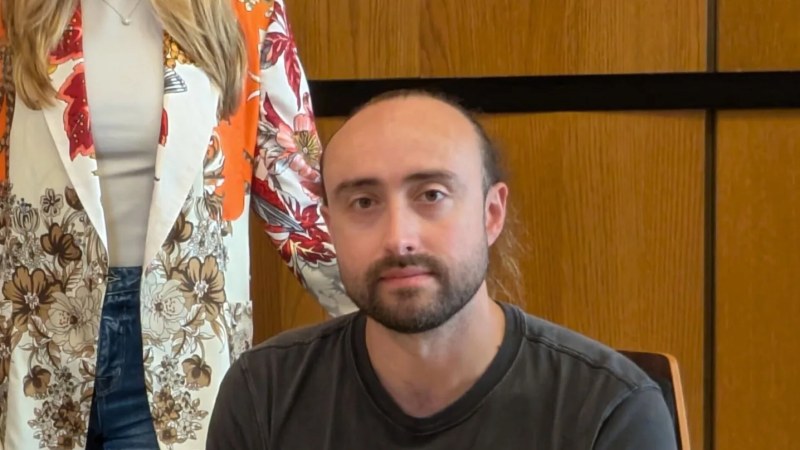
Peter Piatetsky
Peter Piatetsky is the co-founder and CEO of Castellum.AI, a New York compliance-technology company that automates AML/KYC screening for banks, credit unions, fintechs and crypto firms. A former US Treasury sanctions officer who once fined banks and froze illicit assets, he started Castellum after a month of staring at 38,000 compliance alerts that surfaced exactly one real threat. The company builds its own financial-crime data pipeline, refreshes it every five minutes, and routinely corrects errors in government sanctions lists. In July 2025 Castellum raised an oversubscribed $8.5M Series A led by credit-union and bank-backed funds.