BREAKING  Foundry Robotics unveils "The Everything Factory" Seed round led by Khosla Ventures & Garuda Ventures VLA foundation models meet the assembly floor Founder Adarsh Kulkarni: ex-Ghost Robotics, ex-Scale AI Targets: drones, robot dogs, battery packs, satellites Dual-use - commercial + Department of Defense Mission: rebuild American manufacturing BREAKING  Foundry Robotics unveils "The Everything Factory" Seed round led by Khosla Ventures & Garuda Ventures VLA foundation models meet the assembly floor Founder Adarsh Kulkarni: ex-Ghost Robotics, ex-Scale AI Targets: drones, robot dogs, battery packs, satellites Dual-use - commercial + Department of Defense Mission: rebuild American manufacturing
SAN FRANCISCO · FOUNDED 2025 ROBOTICS & AI DESK
Company Profile

Foundry
Robotics.

The startup that wants to make retooling obsolete - one AI-driven robotic cell that assembles anything, from drones to satellites.

~15Team
2025Founded
SeedKhosla-led
SFHQ
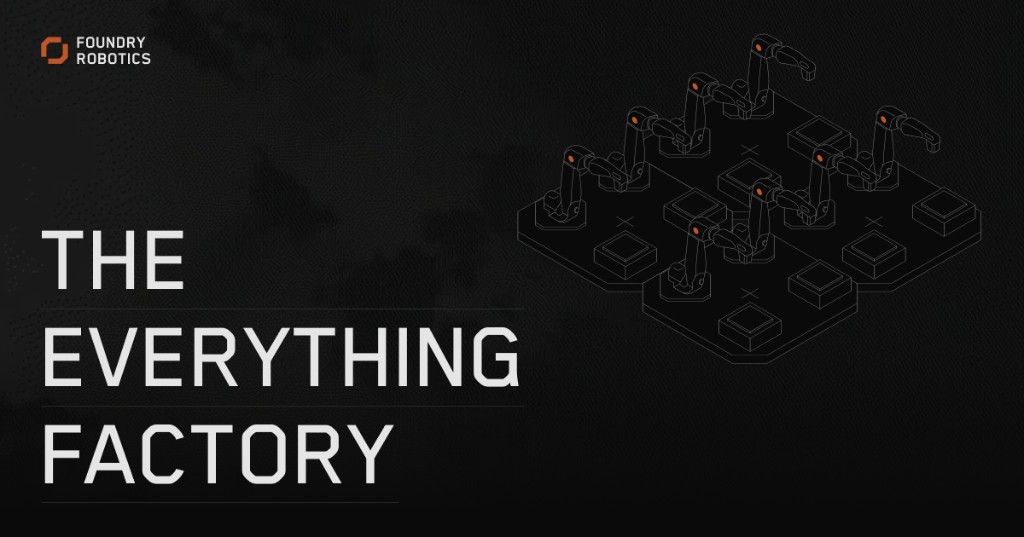
Foundry Robotics - The Everything Factory brand image with robotic assembly cells

Foundry Robotics' calling card: rows of robotic arms over an isometric grid of workcells, captioned "The Everything Factory." A tidy drawing for an untidy ambition - a plant that rebuilds itself for whatever ships next.

Share this profile LinkedIn Twitter / X Facebook Instagram
The Story

A factory that changes its mind

There is a boring, expensive fact at the center of how physical things get made, and Foundry Robotics has decided to build a company around it. The fact is retooling. When a factory that makes one thing wants to make a slightly different thing, it stops. Engineers swap fixtures, reprogram machines, and rebuild the line, and for a while nobody makes anything. This is fine if you are stamping out ten million identical widgets. It is agony if you want to make a few thousand drones this quarter and a few thousand battery packs the next.

Foundry's pitch - and it is genuinely a pitch, the company is young and much of this is still ambition - is that retooling does not have to be a physical event. If a robot is general enough, and the software driving it is smart enough, then switching products becomes closer to a software update than a construction project. The company calls the result "The Everything Factory," which is the kind of name that is either going to look prophetic or adorable in five years. Possibly both.

The mechanism they are betting on is a class of AI models with an unwieldy name: Vision-Language-Action models, or VLA. The short version is that these models take in what a robot sees and a description of what it should do, and output the motions to do it. It is the same broad idea that has made large language models useful, pointed at the physical world instead of a text box. Foundry's wager is that VLA models, plus modern robotics hardware, plus a lot of unglamorous manufacturing software, add up to robots that can assemble products they were not specifically programmed to assemble.

"An AI+robotics-first, assembly-focused, dual-use contract manufacturer."

— How Foundry describes itself

The un-obvious part of the plan

Here is the detail that makes Foundry more interesting than a robotics-arms vendor: the company does not primarily want to sell you robots. It wants to be the factory. Foundry is set up as a contract manufacturer - you bring the product, they assemble it - which means the robots and the VLA models are the means, not the merchandise. This is a slower, more capital-intensive path than shipping robot arms to other people's plants. It is also a more defensible one, because the hard-won knowledge of how to actually assemble complicated things at low-to-mid volume stays inside the company and compounds.

The products they are aiming at are telling: drones, robot dogs, battery packs, satellite components. These are complex, relatively low-volume, high-mix items - exactly the category where traditional automation is too rigid and human labor is expensive or scarce. They are also, not coincidentally, things that are frequently made abroad and that both companies and the U.S. government would prefer to make closer to home. Foundry describes its initial targets as products in high demand from both commercial customers and the Department of Defense, which brings us to the word doing a lot of work in the company's self-description: dual-use.

Dual-use, meant literally

"Dual-use" in defense circles usually means a technology that could serve civilian or military ends. Foundry means it more concretely: the same robotic assembly cells that build a commercial product can build a defense one. One factory, two demand curves, and a supply chain that does not run through an ocean. In June 2026 the company registered a federal lobbying representative, which is the sort of paperwork that tells you a startup is taking the government-customer half of its thesis seriously rather than as a footnote.

Whether all of this works is genuinely unknown, and worth saying plainly. Generalized robotic assembly is hard in the way that hardware is always hard - reality does not grade on a curve, and a robot that assembles something 95% correctly has assembled nothing. Foundry is a small team taking on a problem that much larger and better-funded companies have circled for years. But the shape of the bet is clear, and the people making it have done adjacent versions of it before.
1Factory to rule them all
VLAVision-Language-Action core
Commercial + Defense demand
$400MFounder's prior exit (Ghost Robotics)
What They Build

Three pieces, one bet

01

The Everything Factory

An assembly-focused contract manufacturing operation built on modular robotic cells that switch between products without the usual retooling downtime.

02

VLA-driven assembly

Vision-Language-Action foundation models fused with traditional controls, so robots can generalize across products rather than being hand-programmed for one.

03

Dual-use manufacturing

The same cells assemble complex, low-to-mid volume products - drones, robot dogs, battery packs, satellite parts - for commercial and defense customers alike.

#robotics#vla#reshoring #contract-manufacturing#defense-tech#ai
The Founder

Who is building it

AK

Adarsh Kulkarni

Founder & CEO

Kulkarni studied robotics at the University of Pennsylvania's GRASP Lab, then joined Ghost Robotics as an early employee - a company later acquired for a reported $400M - where he worked as a core autonomy engineer deploying robots alongside the Department of Defense. He went on to Scale AI, rising to Head of Robotics. Foundry is the synthesis of those chapters: field-tested autonomy, defense deployment experience, and a front-row seat to how foundation models get built and trained.

Background compiled from public profiles - Penn GRASP Lab, Ghost Robotics, Scale AI, and Foundry Robotics.

The Money

Who's backing the bet

Foundry raised a seed round to build the Everything Factory, led by Khosla Ventures and Garuda Ventures. Reported seed figures vary across public sources (roughly $13.5M to $19M), reflecting how early and fast-moving the company is.

Khosla Ventures · lead Garuda Ventures · lead Red Glass Ventures Embark Ventures Zero Shot Fund Recall Capital Hanabi Capital E14 Fund

Figures and investor lists per Crunchbase, PitchBook, Dealroom, and Garuda's published announcement. Amounts approximate.

Latest Updates

Recent moves

2025

Foundry Robotics founded in San Francisco around the "Everything Factory" thesis - generalized robotic assembly for American manufacturing.

MARCH 2026

Announced seed funding to build the Everything Factory, led by Khosla Ventures and Garuda Ventures, with a syndicate of robotics- and defense-minded investors.

JUNE 2026

Registered Aquia Group LLC as its federal lobbying representative - a signal that the defense/dual-use half of the strategy is being pursued in earnest.

ONGOING

Hiring robotics, AI, and software engineers in San Francisco to move learned control from the lab onto real production floors.

Watch & Follow

Demos & interviews

Search these channels for Foundry Robotics product demos, founder talks, and robotics interviews.

Worth Knowing

Details that stick

The name is the pitch

The company's own tagline is, unironically, "The Everything Factory." Rarely does a mission statement fit on a badge.

Same cells, wild range

Drones, robot dogs, battery packs, satellite components - all intended to run on the same robotic assembly cells.

Factory, not vendor

Foundry wants to be the manufacturer, not sell you robots - so its hard-won assembly know-how compounds internally.