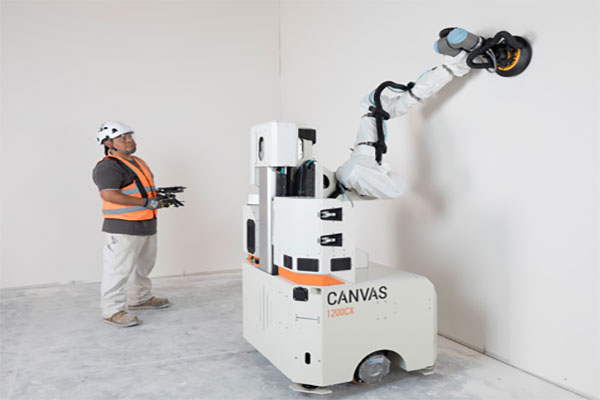
An empty floor on Folsom Street.
It is a Tuesday on a high-rise jobsite in San Francisco. A boxy machine the size of a small refrigerator hums down a freshly framed corridor, all-wheel steering itself into place against a wall of unfinished gypsum. An arm extends. Joint compound goes on in one even pass, then again, then again, until 12 feet of wall has been mudded without anyone climbing a ladder. The pilot is a union drywaller in a hi-vis vest, holding a tablet, drinking coffee. He pushes a button. The robot starts sanding. The dust, almost all of it, disappears into the machine.
This is what Canvas looks like in 2026 - not a demo, not a render, not a pitch deck. A worker-operated robot, on a paying job, doing work that for half a century has been done by ladders, trowels, and very tired backs.
Construction forgot how to get better.
Manufacturing productivity has roughly doubled since 1970. Construction productivity, depending on which McKinsey chart you trust, has gone sideways or backwards. The reasons are unglamorous: every project is a one-off, every site is outdoors, every trade is hand-tooled, and every drywall finisher in America is older this year than they were last year.
Drywall finishing is a particularly miserable subspecies of this problem. It is dusty. It is repetitive. The work happens on stilts or scaffolding. Apprenticeship rolls have been shrinking for years. The union halls that used to overflow on Monday mornings now post help-wanted signs.
The polite version of this is "labor shortage." The honest version is that the work, as currently designed, is not a job many young people want.
Two roboticists walk into a union hall.
Kevin Albert spent years at Boston Dynamics, the place that taught quadrupeds to dance. Maria Telleria came out of MIT and Otherlab. In 2017 they founded Canvas with a premise that sounded almost suspiciously old-fashioned for a Bay Area startup: before they would build anything, they were going to sit down with the people who would have to use it.
What followed was three years of stealth. Not the cool kind of stealth with leaked screenshots - the boring kind, where engineers spend their weeks on actual construction sites, then drive back to Alameda to argue about end effectors. Canvas worked with District Council 16 of the International Union of Painters and Allied Trades. They co-designed the machine with the people who would operate it. They wrote the training program with the union, not at it.
This is, depending on your priors, either common sense or a small revolution. In Silicon Valley it is usually a small revolution.
The cap table, briefly
Innovation Endeavors. Obvious Ventures. Brick & Mortar. Grit. Then Menlo Ventures led a $24M Series B in April 2021 with strategic investment from Suffolk Construction - one of the country's largest general contractors, which began deploying the robot on its own jobs.
An investor who is also a customer is a useful tell. It usually means the product is working.
What the machine actually does.
The Canvas system - originally a larger first-generation unit, and as of mid-2024 the compact 1200CX - is a self-driving, battery-powered platform with a robotic arm that performs the two slowest steps in drywall finishing: mud application and sanding. It maps the wall, sprays joint compound to a Level 4 or Level 5 finish in a single pass, waits for the mud to dry, swaps an end effector, then sands the surface while a vacuum captures, by Canvas's measurement, 99.9% of the dust.
The 1200CX is 30 by 34.5 inches and weighs 1,200 pounds. It steers all four wheels independently. It runs all day on a single battery charge. It finishes walls up to 12 feet tall, which covers most multi-family and tower interiors. The pilot is always a trained drywaller. The robot does not take the worker out of the loop; it takes the ladder out.
The numbers vary by project, but the directional claim is consistent: about 60% off the schedule, about 40% off the labor.
Drywall, the old way vs. the Canvas way
A milestone timeline, briefly annotated
It is not a demo anymore.
The Canvas robots have, by the company's own count, finished close to one million square feet of drywall - on hospitals, office buildouts, multi-family projects, towers. Suffolk Construction deploys them. General contractors who would not return a startup's cold email three years ago now schedule pilot runs.
The validation that mattered most arrived in 2025. JLG Industries - the access-equipment giant best known for its yellow lifts on every American construction site - acquired Canvas's core robotics technology and engineering team. JLG is part of Oshkosh Corporation, which is part of the Fortune 500. Translating: a drywall-finishing robot, designed by a small startup in Alameda, is now part of the equipment portfolio that shows up on virtually every commercial jobsite in the country.
The recognition shelf, briefly
Forbes AI 50. Fortune startup lists. The Pro Tools Innovation Award in Technology / Robotics. ENR coverage. Universal Robots case study. The construction press, traditionally hard to impress, has been impressed.
Tools, not replacements.
The temptation, in any conversation about robots and labor, is to slide toward the dystopia. Canvas slides the other way. Its language - in press kits, in interviews, in the painters' union training materials - is consistent: the robot is a tool, the operator is a tradesperson, and the goal is to make the work less brutal so more people will want to do it.
This is not a marketing line. It is the engineering brief. The 1200CX is built to be moved through a tight stairwell, plugged into a standard 110-volt charger, and operated by a drywaller with a few days of training. Everything difficult about the machine is hidden behind a tablet interface designed by people who have run drywall jobs.
The next ten years of construction.
Drywall is the wedge. Behind it sits framing, painting, MEP rough-in, exterior cladding, every other trade that has not had a productivity revolution since the cordless drill. Canvas spent six years proving that a worker-operated robot can survive on a real jobsite, satisfy a union, and ship a finish at spec. Now that the technology lives inside JLG, it has access to the dealer network and service infrastructure required to scale.
If the bet works, the next decade of US construction looks less like the last one. Buildings get finished faster. Trades crews work less brutally. Apprenticeship becomes recruitable again because the job stops being about dust and ladders. The chronic under-supply of new housing - currently a political and economic emergency - eases a little, not because policy fixed it, but because the work got easier.
None of that is guaranteed. Robotics startups are famously good at promising "the iPhone moment for X" and famously bad at delivering it. But Canvas is not a startup anymore. It is a product line inside a public-company manufacturer with a thousand dealers. That is a different kind of bet.
Back to Folsom Street.
The pilot finishes his coffee. The robot finishes the wall. He checks the surface with a hand-held light - the test for a Level 5 finish, the one that used to take three skim coats and a long afternoon. The wall is smooth. He moves the machine to the next bay, plugs in for a top-up, and goes to lunch.
The job used to take a week. It will be done by Friday. The dust is in a sealed bag in the corner. The drywaller still has a job - probably, for the first time in years, more job security than he had before. The wall does not care which century finished it.
This is what Canvas wanted in 2017. It took six years, three rounds of capital, one union, one acquisition, and a refrigerator-sized robot. It is, on a quiet Tuesday on Folsom Street, actually happening.