npu
(6)
Cactus
Cactus is a cross-platform, open-source AI inference engine built in C/C++ to run language, speech, and vision models directly on smartphones, laptops, wearables, and other low-power edge hardware. It gives mobile developers Flutter, React Native, Kotlin, and Swift SDKs to deploy quantized models on-device - cutting latency to under 100ms, keeping data private, working offline, and avoiding cloud API bills - with automatic cloud fallback for heavier tasks. A YC Summer 2025 company, Cactus already powers production apps serving 500,000+ weekly inference tasks.

General Instinct
General Instinct is a Y Combinator (Spring 2026) startup building inference infrastructure for physical AI. Its software distills, quantizes, and deploys large frontier models onto resource-constrained edge hardware - drones, robots, IoT devices, and old PCs - fully offline. The flagship product, Instinct Edge, takes a model, a target device, and a latency budget and returns an optimized offline runtime that hits that budget on hardware like Jetson, mobile NPUs, ARM CPUs, and Apple Neural Engine. The company also ships an open-source compression toolkit, InstinctRazor.
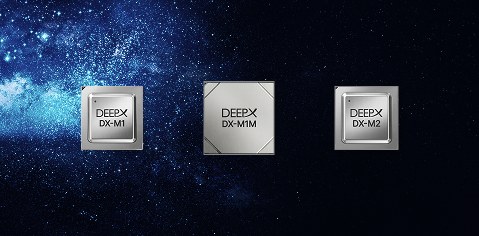
DEEPX
DEEPX is a South Korean fabless semiconductor startup building ultra-low-power neural processing units (NPUs) for on-device and edge AI. Founded in 2018 by former Apple chip designer Lokwon Kim, the company designs AI accelerators - led by its 25 TOPS DX-M1 chip - that run vision and generative AI models at under 5 watts, aiming to move intelligence out of the data center and into robots, cameras, factories, mobility and everyday devices. It raised an $80.5M Series C in 2024 at a $529M valuation and positions itself as a 'Physical AI infrastructure company.'

ESWIN Computing
ESWIN Computing is a Beijing-based chip company building system-on-chip products around the open RISC-V architecture. It designs edge-computing and AI SoCs - most notably the EIC77 series - pairs them with its own NPU and software stack, and sells them as chips and developer boards for smart home, automotive, industrial, and PC-class computing. It is the IC-and-solutions arm of the larger Beijing ESWIN Technology Group founded by former BOE chairman Wang Dongsheng.

Quadric
Quadric is a semiconductor IP company that licenses the Chimera family of general-purpose neural processing units (GPNPUs) - a single, fully C++ programmable processor core that runs machine learning inference alongside classic DSP and control code in one unified architecture. Founded in 2016 by three engineers who previously built bitcoin computing hardware, Quadric aims to fix the fragmentation of on-device AI silicon: instead of a fixed-function neural accelerator that breaks whenever a new model appears, its cores scale from 1 to 864 TOPS and can adopt new networks - including large language models up to 30 billion parameters - through a software port rather than a chip respin.

OpenInfer
OpenInfer is a San Mateo-based AI infrastructure startup building an 'Inference OS for the agentic era' - software that runs large AI models and agents directly on the CPUs, GPUs and NPUs enterprises already own, from edge devices to private data centers, without cloud lock-in. Founded by ex-Meta and Roblox systems engineers Behnam Bastani and Reza Nourai, its OpenInfer Engine claims 2-3x faster inference than Llama.cpp and Ollama on distilled DeepSeek models and works as a drop-in replacement for existing endpoints. The company raised an $8M seed round in February 2025 and has since shipped Jean, a private email-native agentic AI system, and orchestration layers for heterogeneous compute.