Here is a fact about artificial intelligence that everyone knows and nobody quite likes: it is enormously expensive to run, and most of that expense is electricity. The dominant business model of the AI era is, roughly, "buy the most powerful graphics processors you can find, put thousands of them in a warehouse, cool them aggressively, and hope the answers are worth the power bill." This works. It also means intelligence is centralized in a handful of very hot buildings, and everything else - your camera, your robot vacuum, the drone, the factory sensor - has to phone that building for permission to be smart.
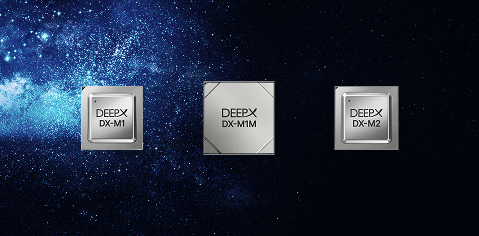
DEEPX, a semiconductor company in Seongnam, South Korea, thinks this is backwards, or at least incomplete. Its argument is narrow and technical and, if you squint, a little philosophical. The narrow version: a lot of AI work - recognizing a face, spotting a defect, seeing an obstacle - does not need a warehouse. It needs a small, cheap, cool chip sitting inside the device itself, doing the inference locally, instantly, without a round trip to the cloud. DEEPX designs those chips. They are called NPUs, neural processing units, and the company's flagship, the DX-M1, does about 25 trillion operations per second while drawing between two and five watts. That is less than a phone charger.
The comparison DEEPX likes to make is against GPUs, the graphics chips that power most AI today. For this specific job - running an already-trained model at the edge - DEEPX claims its silicon is more than ten times more power-efficient. You should treat vendor efficiency numbers the way you treat a restaurant describing its own portions: directionally useful, precisely suspect. But the direction is real, and it is the entire company. If AI's constraint is power, then the company that makes AI cheap to run has found a genuinely good place to stand.
DEEPX was founded in 2018 by Lokwon Kim, who has the kind of resume that makes a chip startup fundable before it ships anything. He designed application processors at Apple - the actual brains of iPhones - and did stints at Broadcom, Cisco, and IBM's T.J. Watson Research Center. Then he went home to Korea to build his own. This is a recognizable Silicon Valley story played in reverse: the expat engineer who returns with the credential and the conviction. The conviction, in Kim's telling, is unusually grand. He has said the root of human suffering is a lack of intelligence, knowledge, and wisdom, and that centralizing access to AI just widens the gap between who has it and who does not. The fix, apparently, is to make the intelligence cheap enough to put everywhere. This is a lot of weight to place on a chip. It is also, as founding myths go, more coherent than most.
The company's slogan - "AI for Everyone & Everywhere" - is the marketing-department version of that idea. The product roadmap is the engineering version. DEEPX ships what it once called an "All-in-4" lineup: the DX-V1 and DX-V3, small vision chips for appliances, cameras, and drones; the DX-M1, the 5-nanometer workhorse; and the DX-H1, a higher-end computing card for AI boxes and smart factories. Around the silicon sits DXNN, a software kit that lets developers take a model built in PyTorch, ONNX, or TensorFlow and compile it down to run on a DEEPX chip. The hardware is the moat; the software is what stops the moat from being a nuisance.
What makes the DX-M1 interesting is not any single specification but its ordinariness of form. It comes as an M.2 module - the same little card format as a laptop SSD - and slots into a Raspberry Pi 5, a $60 hobbyist board. Plug it in and the Pi becomes a 25-TOPS AI machine. There is something quietly subversive about that. The frontier of AI is supposed to be gated behind billion-dollar clusters; DEEPX is selling a piece of it that fits in a component you can buy with pocket change. "Democratizing AI" is a phrase every company says. DEEPX has the unusual property of a product where the phrase is literally true.
The market has noticed, in the way markets notice: with money. In May 2024 DEEPX closed an $80.5 million Series C, led by SkyLake Equity Partners - the private-equity firm of a former Samsung executive - with BNW Investments, AJU IB, and existing backer TimeFolio. That round valued the company at $529 million, roughly eight times its Series B valuation from three years earlier. An 8x markup in a chip startup during an AI boom is not itself a miracle; the AI boom marks up almost everything. What is notable is who wrote the checks. Korean semiconductor insiders - people who know exactly how hard it is to actually manufacture a chip - decided this one was worth it. That is a more informed vote than a generic venture markup.
They had reason to be careful, because they had reason to be reassured. Before mass production, DEEPX had its chips validated by more than 300 companies. This is the inverse of the usual startup posture, which is to ship first and find out later. DEEPX ran a large, slow, unglamorous validation program - including trials at Hyundai's robotics lab and POSCO DX - and only then moved to volume. In a business where a bad chip is a very expensive coaster, "300 companies tested it and did not run away" is close to the strongest signal available.
Then came the awards, which in the chip world function as a kind of public scorecard. At CES 2024, DEEPX won Innovation Awards in three separate categories - robotics, embedded technology, and hardware components - a sweep the company says no AI semiconductor firm had done before. At CES 2025 the Consumer Technology Association tagged it a "Must-See Company." At CES 2026 it won two more Innovation Awards, and - the detail that matters most - a partner's product built around the DX-M1, an edge gateway called the ALPON X5 from a US company named Sixfab, took the show's top "Best of Innovation" honor. That last one is the important kind of validation. It is one thing for your chip to win a prize. It is another for someone else's product, powered by your chip, to win the biggest prize in the room. That is the difference between a good component and an ecosystem.
Around CES 2026, DEEPX also did the thing growth-stage companies do when they want to sound like a category rather than a supplier: it rebranded. It now calls itself a "Physical AI infrastructure company." Physical AI is the industry's phrase-of-the-year for intelligence embedded in machines that move and act - robots, vehicles, factory equipment - as opposed to chatbots that generate text on a screen. It is a real distinction and a convenient one, because it happens to describe precisely the market where a low-power, always-on, no-cloud-required inference chip is most useful. Naming a category you already fit inside is a time-honored move. It works when the category is real, and this one appears to be.
None of this means DEEPX has won anything. The edge-AI chip market is crowded with well-funded names - Hailo, Kneron, EdgeCortix, Axelera, Sima.ai - plus the edge lines of giants like Nvidia, Qualcomm, and Google. Being ten times more efficient than a GPU is a great pitch, but competitors are making similar pitches, and customers are famously slow to rip out working systems for a better spec sheet. DEEPX's answer is speed and roadmap: it moved from 5nm mass production to signing a contract for 2nm sample chips inside a single year, and it is developing a second-generation part - internally, "Project LAIN" - meant to run large language models on-device under five watts. If it delivers that, the pitch stops being "cheaper vision AI" and becomes "generative AI without the cloud," which is a much bigger room.
There is also, in the background, the exit. Reports in 2025 had DEEPX planning an IPO around 2027 and hiring Morgan Stanley for a fundraising round. IPO timelines from private chip companies are aspirational documents, subject to revision the moment the market sneezes. But the direction of travel is clear enough: a company that spent its early years quietly stacking patents - more than 400 filed, 130-plus granted - and validating silicon is now positioning to be a public, durable player rather than an acquisition footnote.
Which returns us to the founder's slightly outsized thesis. It is easy to be cynical about a chip company invoking human suffering in its origin story; mission statements are cheap and semiconductors are not. But DEEPX has the rare quality of a mission that maps cleanly onto a product decision. If you actually believe intelligence should be distributed rather than hoarded in warehouses, you would build small, cheap, low-power chips that go inside everyday devices. That is what DEEPX builds. The philosophy and the bill of materials point the same direction. Whether the world buys enough of them is the open question - but the company is, at minimum, honest about what it is trying to do.
What DEEPX Actually Sells
DX-M1
The flagship: a 5nm edge processor delivering up to 25 TOPS at 2-5W. Ships as an M.2 module that drops into a Raspberry Pi 5 or x86/ARM hosts.
DX-M1M
A compact variant of the DX-M1 for space-constrained edge devices - same idea, smaller footprint.
DX-V1 / DX-V3
Small "AI enabler" vision chips for home appliances, surveillance cameras, robot vision and drones.
DX-H1
A higher-end "Green AI" computing card for AI boxes, servers and smart factories.
DXNN® SDK
The software layer. Compiles PyTorch, ONNX and TensorFlow models down to run on DEEPX NPUs.
Project LAIN
In development: a second-generation NPU built to run large language models on-device, under five watts.
Funding & Backers
| Round | Amount | Date | Lead / Investors |
|---|---|---|---|
| Series B | ~$15M | 2021 | TimeFolio Asset Management |
| Series C | $80.5M (KRW 110B) | May 2024 | SkyLake Equity Partners (lead), BNW Investments, AJU IB, TimeFolio |
Valuation
$529M (KRW 723B) at Series C - up roughly 8x from Series B.
Reported Next Step
Plans for a 2027 IPO; Morgan Stanley reportedly engaged for a fundraising round (2025).
Timeline
- 2018
DEEPX is founded
Ex-Apple application-processor designer Lokwon Kim starts the company in Seongnam, South Korea.
- 2019
IP development begins
The company starts building its NPU intellectual-property portfolio in earnest.
- 2021
Series B
Raises about $15M, led by TimeFolio Asset Management.
- 2023
Real-world validation
Chips validated by Hyundai Robotics Lab and POSCO DX in robotics and industrial settings.
- 2024
Series C & a CES triple crown
Closes $80.5M at a $529M valuation; wins CES 2024 awards in robotics, embedded and hardware.
- 2025
Mass production & global rollout
5nm volume production begins, distributor deals span the US, China, Taiwan and Europe, and a 2nm sample-chip contract is signed.
- 2026
Physical AI infrastructure company
Rebrands at CES 2026; the DX-M1 powers Sixfab's ALPON X5, the show's "Best of Innovation" winner.
The Details That Amuse & Inform
Who Uses It
OEMs and integrators building edge-AI products: security and surveillance cameras, robots, drones, smart factories, mobility, IoT gateways and AI computing boxes. Sold through Macnica, Avnet Silica, WPI/WPG and Radxa.
The Competition
Hailo, Kneron, EdgeCortix, Axelera AI, Sima.ai, Ambarella - plus edge lines from Nvidia (Jetson), Qualcomm and Google (Coral).
Culture, In Their Words
"Think Deeply." "Best Ideas Over Titles." "Own Your Work." Decisions run through an internal MVBRP framework - Mission, Value, Beneficiary, Result, Planning.
Fun Facts
- The DX-M1 draws about as much power as a phone charger.
- You can bolt it onto a $60 Raspberry Pi.
- Valuation jumped ~8x between Series B and C.
- 400+ patents filed since 2019.
Video & Demos
DEEPX on YouTube
youtube.com/@DEEPX_AI - product demos, keynotes and the DX-M1 in action.
CES 2026 Keynote
"Unstoppable Rise of Physical AI" - DEEPX's CES 2026 session on the physical-AI thesis.
Frequently Asked
What does DEEPX make?
Neural processing units (NPUs) - AI accelerator chips and modules that run AI inference on-device at the edge instead of in the cloud. Its flagship DX-M1 does up to 25 TOPS at 2-5 watts.
Who founded DEEPX and when?
Lokwon Kim founded it in 2018. He previously designed application processors at Apple and worked at Broadcom, Cisco and IBM.
How much has DEEPX raised?
Roughly $126M total, including an $80.5M Series C in 2024 that valued the company at $529M.
How is it different from Nvidia?
Nvidia's GPUs dominate data-center AI; DEEPX focuses on ultra-low-power edge inference, claiming 10x-plus the power efficiency of a GPU for on-device AI at under 5 watts.
Where can you buy DEEPX chips?
Through global distributors - Macnica, Avnet Silica, WPI/WPG - and the DX-M1 M.2 module works with platforms like the Raspberry Pi 5 and various x86/ARM hosts.