3d-modeling
(18)
West Woods and the value of a rough first draft
A coupon app, a solar boat, and a design agency with an unusually broad toolkit. West Woods makes more sense when you look at what its designers learned before the polished version.

Womp wants your next design to leave the screen
An artist’s frustration became a browser-based 3D tool. Now Womp is following its users into the less forgiving business of making things you can hold.
Vectorworks Bet Designers Wanted Freedom - Now Architects Must Decide What That Freedom Is Worth
A 40-year-old Mac CAD pioneer built one flexible modeler for buildings, gardens and stadium shows. Its real trick is keeping the idea alive from first sketch to final drawing - if a team can stomach the switch and the subscription.

Konstantina Psoma Turned a Cathedral-Sized Headache Into Kaedim
A crashed laptop, a stubborn student project and six Y Combinator applications led from Athens to San Francisco. Her more useful lesson was simpler: when the AI fell short, put an artist in the loop.

Aurorin CAD
Aurorin CAD is building professional mechanical design software from scratch, replacing the 1980s-era geometry kernels inside tools like SolidWorks with a purpose-built, AI-native B-Rep kernel. The result: parts that take an experienced SolidWorks user 20 minutes to model can be created in seconds, either through a fast modern interface or by describing them in natural language to an integrated AI agent. Founded in the Y Combinator Winter 2026 batch by Michael Baron, a former 3x SpaceX intern and Apple GPU driver engineer, Aurorin positions itself as 'Claude Code for mechanical engineers.'

SiteSee
SiteSee is a Brisbane-founded software company that builds AI-powered digital twins of telecommunications infrastructure. By combining drone capture, photogrammetry and machine-learning audit engines, it turns survey-grade imagery of cell towers and rooftops into interactive 3D models that tower companies and mobile network operators can inspect, measure and upgrade from a desk - cutting site visits, speeding colocation approvals and helping owners get more value from their assets.

Scanifly
Scanifly is a New Jersey-based B2B software company that helps solar contractors design and survey photovoltaic systems using drone imagery, photogrammetry, and AI. Its cloud platform turns a five-minute drone flight or remote satellite/LiDAR data into a to-scale 3D model accurate to within 1-3 inches, then generates layouts, shading reports, and permit-ready plan sets. Contractors use it from pre-sale proposals through post-sale final design to cut survey and design time by as much as 90% and reduce costly change orders on install day.

Snaptrude
Snaptrude is a cloud-based, AI-native design platform for architecture, engineering and construction (AEC) teams. It lets architects move from a brief to a BIM-ready model inside one connected, browser-based workspace - handling site analysis, space programming, massing, BIM modeling and presentation while staying interoperable with legacy tools like Revit, Rhino and Archicad. Founded in 2017 by Altaf Ganihar and backed by Foundamental and Accel, Snaptrude positions itself as a modern, collaborative alternative to design software largely built in the late 1990s.

Jason Steinberg
Jason Steinberg is the CEO of Scanifly, a drone-based software platform that lets solar companies survey rooftops, build 3D models, run shading analysis, and produce permit-ready designs without repeated site visits or dangerous roof climbs. A CFA charterholder who once installed solar panels on New Jersey rooftops, he spent years financing renewable energy projects at Bloomberg New Energy Finance and CohnReznick Capital before taking the helm at Scanifly in 2018. He hosts the podcast 'When Life Gives You Lumens,' where he digs into how the solar industry can scale through better technology, safety, and workforce development.

Kaedim
Kaedim is a San Francisco- and London-based AI company that turns 2D images and concept art into production-ready 3D models. Founded in 2020 by Konstantina Psoma and Roman Bromidge out of the University of Bristol, it pairs machine-learning tools with an in-house team of artists - a 'human-in-the-loop' approach - to deliver game-ready assets faster and cheaper than traditional outsourcing. Kaedim serves 250+ enterprise studios and thousands of creators, and raised a $15M Series A led by a16z Games in March 2024.

Vizcom
Vizcom is a San Francisco AI design platform that turns rough sketches into full-fidelity, photorealistic renders in seconds. Founded in 2021 by former Honda and NVIDIA designer Jordan Taylor and CTO Kaelan Richards, it is built for industrial, automotive, footwear and consumer-product designers who want to move from idea to visualization without leaving one tool. The company preserves original line work, proportions and intent while layering on materials, lighting and depth - positioning itself as the 'Figma for the physical world.' Backed by $52M in venture funding and used by more than 700,000 designers and 150+ companies including Ford, New Balance, Dell and Estee Lauder.
Aren
Aren is a New York-based AI company that helps owners of bridges, tunnels, and other large civil infrastructure figure out what is quietly falling apart before it becomes a headline. Its platform ingests source-agnostic data - smartphone photos, drone video, laser scans, infrared, and sensors - and turns it into 3D digital twins that detect and quantify damage, track deterioration over time, and produce maintenance and capital-allocation plans. Founded by structural engineer Ali Khaloo out of Cornell Tech, Aren pairs computer vision and deep learning with decades of structural mechanics to give asset owners a quantitative, repeatable way to decide where to spend limited repair dollars.
Leo AI
Leo AI is a Cambridge, Massachusetts company building what it calls the world's first AI purpose-built for mechanical engineering. Its engineering design co-pilot, powered by a proprietary Large Mechanical Model (LMM) trained on millions of real-world products and engineering standards, turns text, sketches and specifications into production-ready 3D CAD models. Leo integrates with CAD and PDM systems to answer technical questions, source parts, run mechanical calculations and generate design concepts, and says it helps teams cut engineering time by up to 70%.
RIIICO
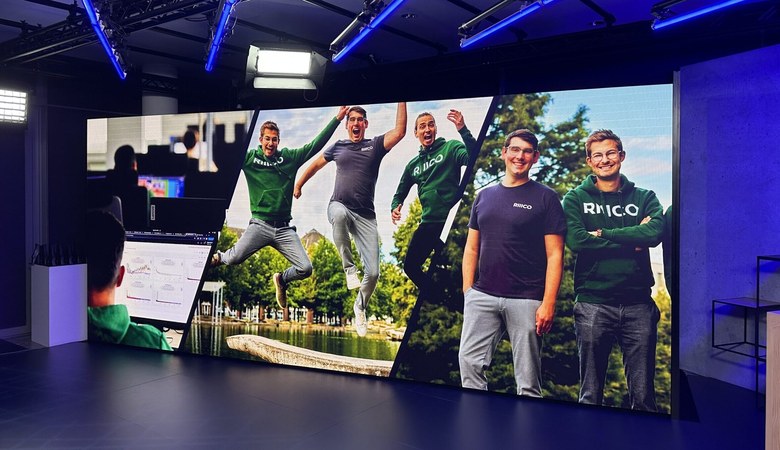
RIIICO is a Düsseldorf-based deeptech startup turning LiDAR scans of real factories into intelligent, editable 3D models. Its AI segments and classifies every object on the shop floor, exports it as OpenUSD, and plugs into NVIDIA Omniverse and Siemens Tecnomatix so planners can redesign brownfield plants in a fraction of the usual time.

Backflip AI
Backflip AI is a San Francisco-based generative AI company building 3D design tools for the physical world. Founded by the Markforged co-founders Greg Mark and David Benhaim, it turns text prompts, sketches and photos into editable 3D meshes (Idea to Mesh) and converts 3D scan data into fully parametric CAD models in one click (Scan-to-CAD / Mesh-to-CAD), with native Onshape and SOLIDWORKS integration. The company raised a $30M Series A co-led by NEA and Andreessen Horowitz and trained its model on a synthetic dataset of over 100 million 3D geometries.
Hover
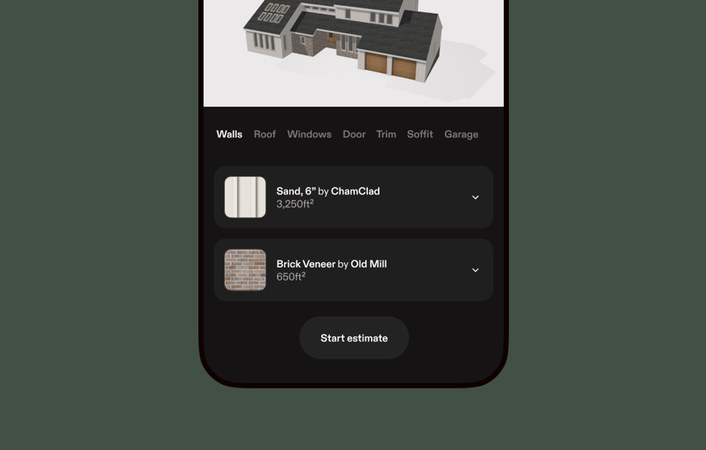
Hover is a San Francisco-based AI and computer vision company that turns smartphone photos into accurate, interactive 3D models of properties — complete with measurements, material takeoffs, and design visualization. Serving 300,000+ construction and insurance professionals, and trusted by 9 of the top 10 U.S. insurance carriers, Hover has digitally reconstructed over 22 billion square feet of property. Its platform compresses what used to be hours of manual estimation into minutes, enabling faster insurance claims, more accurate contractor bids, and immersive homeowner design experiences.

AJ Altman
AJ Altman is the founder and CEO of Hover, a San Francisco-based proptech company that turns smartphone photos into precise 3D models of homes - used by contractors, insurers, and homeowners to measure, design, and estimate renovation projects. A U.S. Marine Corps veteran and computer engineer by training, Altman left Intel at 29 to serve as an infantry officer before channeling military-grade geospatial mapping technology into a commercial platform that has raised over $146M and reached a $490M post-money valuation. Hover's platform now replaces five separate contractor apps and is backed by some of the country's largest insurance carriers.

Felix Fink
Felix Fink is the co-founder and CEO of RIIICO, a German deeptech startup building AI-powered 3D factory digital twins using LiDAR point cloud data. Founded in 2021 out of RWTH Aachen University, RIIICO transforms physical factory floors into collaborative, predictive digital environments in a fraction of the time traditional modeling takes. The company raised a $5M seed round in 2025 led by Pi Labs, won the Siemens Inventors of the Year 2024 award in the Open Innovation category, and counts Volvo, Porsche, Volkswagen, and Schaeffler among its customers. Fink drives product strategy with a philosophy of combining startup agility with deep industrial knowledge.