The chair took two days. It was only a chair, destined for a digital cathedral that Konstantina Psoma had volunteered to model while studying at the University of Bristol. Her professor had asked whether she was sure about the cathedral. Psoma, then a computer science student with a taste for projects that produced something visible, had answered in the spirit of every ambitious beginner: how hard could it be? The software answered first. Her laptop crashed. The interface offered a parliament of buttons. YouTube tutorials disagreed with one another. Two months later, she understood the assignment with an intimacy the assignment had not requested.
The irritation was productive. A video game may contain thousands of characters, props, buildings and bits of scenery, each constructed as a three-dimensional object. A skilled artist often shapes them through software that asks a flat screen to behave like a sculpture studio. Psoma could see the finished image in her mind and could also see the long queue of repetitive decisions between idea and object. Somewhere inside that queue was a company.
She grew up in Petralona, Athens, in a household where technology and making things arrived by different doors. Her father had built a B2B software company and completed doctoral work involving artificial intelligence. Her mother, a preschool teacher with an artistic streak, painted and cut her own puzzles, laminated the pieces and carried them to class. One parent supplied an example of enterprise; the other made physical imagination look ordinary. Psoma took longer to notice the combination than a profile writer might prefer. Life is inconsiderate about tidy origin stories.
The degree with a twist
At school, she loved mathematics and physics. When Greece's 2015 financial crisis unsettled her family, she looked abroad and chose Bristol because its computer science course included innovation. The distinction mattered. Students could build, test and pitch rather than treating code only as an academic object. She gravitated toward computer graphics, computer vision, character design and animation - classes where an algorithm eventually appeared on screen wearing a shape.
In her final year, the university offered a choice for the capstone: research or a simulated startup. Psoma chose the startup. With fellow student Roman Bromidge, she developed the idea that became Kaedim. They registered the company in February 2020 for £12. That May, it won the university's New Enterprise Competition, bringing £10,000 and a year at the SETsquared Bristol incubator. Psoma later recalled looking at the money and briefly imagining it could support two people for two years. This was optimistic arithmetic, but excellent founder morale.
Early believers made the idea less imaginary. Aardman Animations and Rebellion tested prototypes and provided feedback. Chris Kingsley, Rebellion's co-founder and CTO, backed an early round and joined the board. The company grew to five people by early 2021. Then came the verdict that every technical founder requests in theory and dislikes in practice: the product was not useful enough.
Eleven versions of no
Eleven companies piloted the early system. All eleven rejected its output for professional work. The machine could turn a two-dimensional image into a rough 3D form, but roughness is an expensive gift when the customer needs a model ready for a production pipeline. Psoma faced a choice between waiting for research to advance or changing how the result was made.
She chose the people her product was supposed to help. Kaedim hired 3D artists to examine, correct and finish the machine's output. The AI produced a starting point; an artist supplied judgment, craft and accountability. The phrase for this pattern is human in the loop. Kaedim made it more specific: artist in the loop.
The useful loop / from visual reference to production asset
The adjustment was commercially useful and philosophically revealing. Psoma has repeatedly framed AI as an accelerator for creators rather than a substitute for them. “The goal is to augment and to accelerate them,” she said in a 2023 conversation. Her concern is time: remove a portion of repetitive production so artists can spend more of it on decisions where taste matters. Kaedim's funding announcement put the ambition neatly as “giving back time to artists to unleash their creativity.”
“The true creation is in the detail.”Konstantina Psoma
There was also a communications lesson. When Kaedim's work spread online, observers found job advertisements for artists and concluded that the AI claim was a disguise for manual labor. Psoma wrote in 2026 that the reality had always been a combination: algorithms built the base and artists refined it. The mistake, she argued, was silence about the humans. Transparency would have made the workflow less magical and more credible. Magic is a poor substitute for an accurate product description.
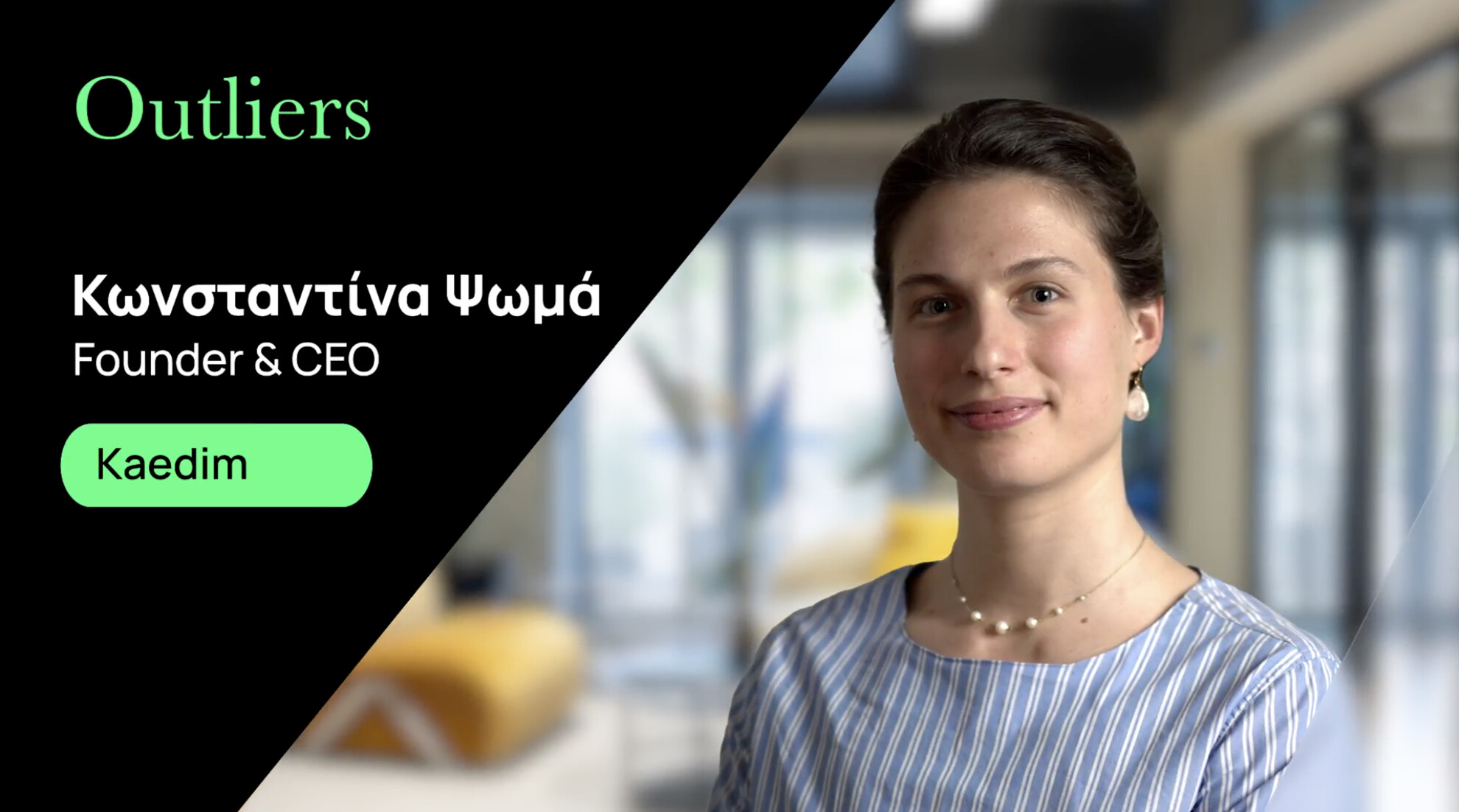
Selling the before and after
Once the artist-assisted workflow produced something studios could use, Psoma went looking for buyers. At a gaming conference in London, she carried an input image and its 3D result on her phone. The pitch was visual and wonderfully compact: this becomes that. The demonstration helped secure the company's first two clients.
Then came outbound messages to small and medium-sized game studios, companies large enough to feel the production pain but reachable by a young vendor without a famous logo. Within the following six to nine months, Kaedim brought roughly 40 to 50 studios aboard. Psoma wanted the company to be capable of supporting itself, even while using outside capital to expand. After an investor told her the business was too early, the team returned to selling and building. It crossed $1 million in annual recurring revenue within the next stretch of concentrated work.
Persistence converted into evidence
Her Y Combinator history provides the comic counter-rhythm. She began applying in 2021 and returned twice a year: rejection, rejection, an interview followed by rejection, then two more unsuccessful attempts. The sixth application arrived in 2024, after revenue had made the company difficult to dismiss. YC offered a place. Psoma declined. At Kaedim's stage, the accelerator's economics no longer made sense, and discussions with Andreessen Horowitz offered another route. Persistence had finally opened the door after the room behind it had ceased to be the destination.
In March 2024, Kaedim announced a $15 million Series A led by A16Z GAMES, with Pioneer Fund and a group of gaming and technology operators participating. Psoma's monthly investor updates had turned progress into a serial narrative: customer by customer, revenue line by revenue line. Fundraising was no lightning strike. It was correspondence with receipts.
Action before authority
Psoma's ideas about leadership began before the company. As a teenager at summer camp, she moved from camper to assistant leader, then took responsibility for a group when its leader could not continue. Eventually she coordinated team leaders responsible for about 100 children. Summer camp lacks cap tables, though it contains many of management's essential complications: limited attention, competing moods and people who can simply ignore you.
Her conclusion is plain: “No one will listen to you if you just talk and don't act.” That bias toward visible effort helps explain the phone demos, the repeated applications and her preference for being physically present with teams. In 2026 she described living out of her 15th apartment at age 27, with possessions scattered among London, San Francisco and Athens. She moved because Kaedim was being built in several places and she wanted to work beside the people doing it.
The company has described offices in San Francisco, London and Singapore, plus remote colleagues elsewhere. After bringing everyone together in San Francisco for an offsite, Psoma wrote about the quiet once they left. Distributed work permits a company to find people across continents. It does not abolish geography; it turns geography into a recurring invoice for airfare, calendars and absence.
A good founder story is rarely about being right early. It is about becoming less wrong without abandoning the problem.
Learning to leave fingerprints off
For five years, Psoma said, she had been involved in every product Kaedim shipped. In 2026, a team released one without her. She had given them the vision and the reason, then resisted prescribing the method. The engineers made decisions she would have made differently; some proved better. She called the launch her proudest product moment.
This may be the quieter achievement behind the fundraising and recognition. Forbes placed her on its 2023 30 Under 30 Europe Technology list, and the financing allowed Kaedim to hire and expand. Yet a founder who remains necessary to every decision has built a demanding job, not a durable organization. Stepping back converts personal intensity into institutional ability.
Psoma has said she wants to build a billion-dollar company that solves a substantial problem. The number is her stated destination, but the more distinctive ambition lives in the means: make 3D creation quicker and more accessible while retaining the artists whose detail turns geometry into a believable object. She also wants her example to matter to founders who lack obvious role models, especially women entering technical industries.
The cathedral remains a useful monument to the whole story. It began as an object too large for a student's tools, broke down into a chair that still took two days, and produced a question durable enough to survive multiple product versions. Kaedim did not erase the craft involved. It rearranged the labor around it. Psoma's practical message to other founders is shorter than any pitch deck: keep going. The fuller version is better. Keep going, keep listening, and when the machine gives you an inadequate answer, invite an artist into the room.