A customer once asked King Alandy Dy for an artificial intelligence system that would talk to clients and sell products. It sounded like an ambitious commission. After more conversation, the request shrank to something much more familiar: a series of questions that would help shoppers find the right curtains. Industrial or commercial? See-through or blackout? The customer needed a product selector. The developer had heard a moonshot.
Dy later described the episode while writing about running a software development business in Manila from Stanford. The misunderstanding had consequences. A project dragged on for fourteen months. Screens were approved, built, and then reconsidered. The lesson was expensive enough to remember and ordinary enough to be useful: before building what someone requests, find out what they mean.
That small comedy of translation offers a way into a career usually introduced with larger nouns: Stanford, artificial intelligence, venture capital, international freight. Dy co-founded Expedock to tackle shipping paperwork. He has since announced that he stepped away as CEO and started Akmon, a business supplying human data and evaluation for AI. Across those ventures, the question keeps returning. What job does the customer actually need finished?
Before the pitch deck, the shipping documents
Dy’s acquaintance with freight began in his family’s international import-export business. By sixteen, he was learning to run an operation spanning Southeast Asia, China, and the Philippines. Trade was already part of his working life before it became a market for a startup.
There is a useful distinction between knowing that goods cross borders and knowing the work that lets them cross. A container is visible. Its administrative life is less photogenic. Documents, amounts, references, approvals, and systems must agree sufficiently for people to act. A beautifully designed dashboard is little consolation if the information feeding it still requires someone to decipher an attachment.
Dy would bring that practical background to Stanford, where his individualized engineering major combined computer science and product design. His earlier work included machine learning at Shopee and product work on a machine learning team at Intuit. He also researched at Stanford’s Center for the Study of Language and Information, working on software for checking logical proofs.
These are different settings for a related problem: making information usable. Product design asks whether someone can operate a system. Machine learning asks what a system can recognize. Running a business adds an impatient third question: will the result arrive in time to matter? Dy’s career brought those questions into the same room.
His Stanford coursework also included a project classifying corporations from their descriptions to examine investment patterns across industries. The subject was far from shipping invoices, but the underlying task was recognizable. Written descriptions had to become categories that could support a decision. Text was raw material, rather than something to leave sitting politely in a document.
The classroom friendship that became Expedock
At Stanford, Rui Aguiar sat beside Dy in a computer science class. A moment of help grew into a friendship and eventually a company. Jeff Tan and Jig Young, friends from Dy’s high school years, joined the founding team. Tan brought freight operating experience from CNT Worldwide Transport. Young brought product experience from Kalibrr and First Circle.
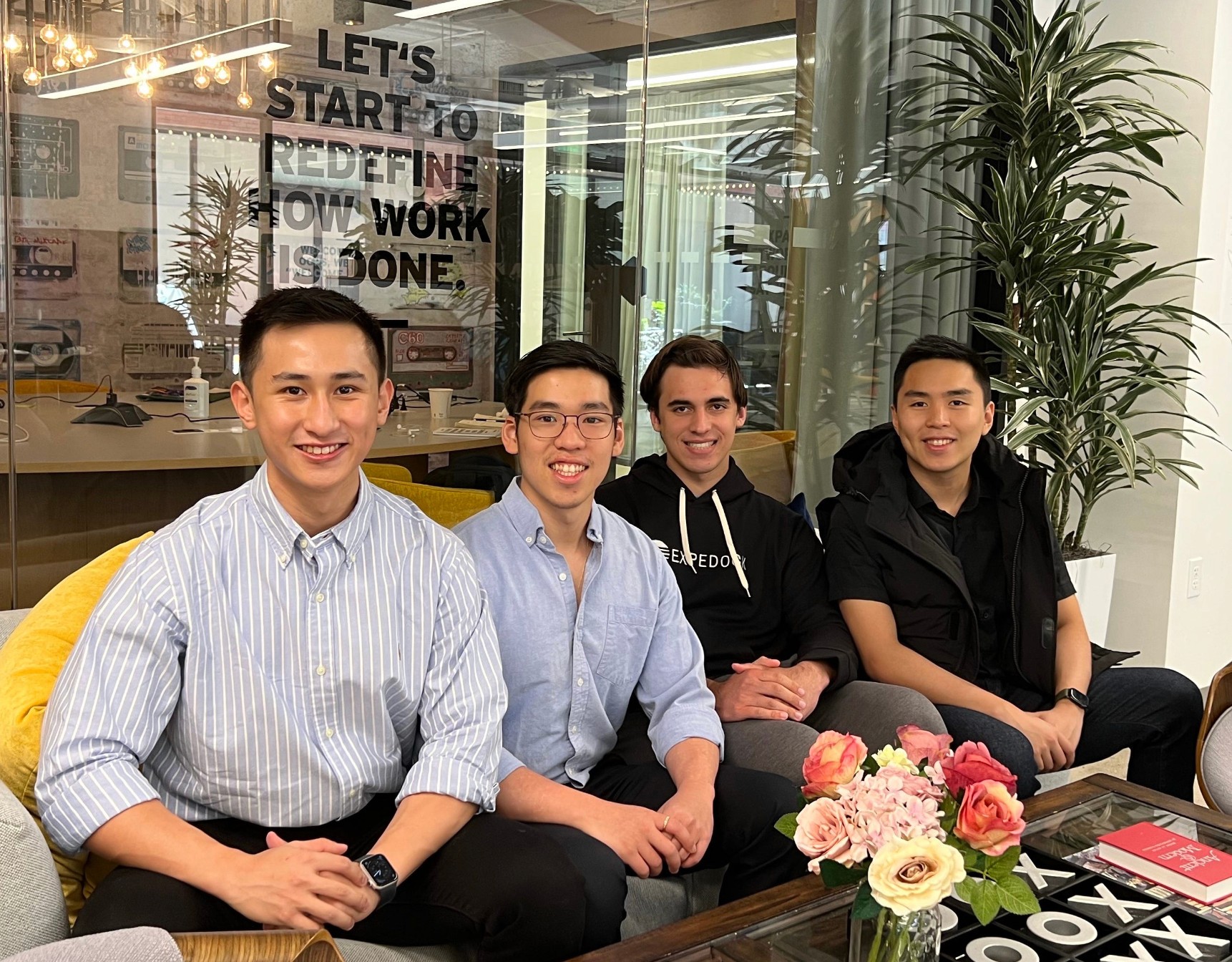
The photograph of the four together has a suitably ambitious instruction on the glass behind them: “LET’S START TO REDEFINE HOW WORK IS DONE.” Office walls are generous with advice. This particular team had a fairly concrete place to begin.
Expedock’s task was to turn freight documents into structured information that could move through existing business systems. That meant extracting invoices, checking them against shipment records, reconciling information, and getting usable data into transportation and enterprise software. The customer’s world already contained tools. Adding another tool only helped if the troublesome work between them became easier.
Consider the difference between displaying an invoice and processing it. A person may still need to identify the shipment, check the amount, compare records, resolve an exception, and create the right payable entry. Reading the page is one stage of a longer chain. The attraction of Expedock lay in connecting those stages to actual operations.
For Dy, the opportunity was rooted in experience rather than a newly discovered taste for containers. That background also made the founding team’s composition consequential. Software knowledge and freight knowledge could challenge each other before customers had to do all the challenging themselves.
What the money was supposed to buy
In August 2022, Expedock announced a $13.5 million Series A led by Insight Partners, following a $4 million seed round. The announcement put total funding at $17.5 million. Motion Ventures participated, alongside existing investors Pear and Neo and executives from several technology companies.
$17.5M total funding at that announcement
The purpose of the financing was specific: expand the team and help supply chain businesses make better use of their data. Capital could pay for more engineering capacity and more customer support. It could not excuse a product from understanding the paperwork it was meant to process.
That is an appealingly unglamorous measure of progress. An investor can celebrate a round in a morning. An operator must live with a workflow every afternoon. The useful question after the announcement is whether a person can stop copying the same information, whether an exception gets noticed, and whether a business can act on what it already knows.
Recognition followed. Tatler included Dy among its 2021 Gen.T Leaders of Tomorrow in the Philippines. Forbes featured Expedock and its four co-founders in its 2023 profile. The startup had become visible beyond the people handling its daily work.
But visibility has its own temptation: it turns a founder’s career into a procession of badges. Dy’s earlier writing offers something more revealing. He was willing to describe work that had gone badly, and to place his own management decisions inside the explanation. The most useful part of that record is its lack of ceremonial polish.
A manager’s education, with the mistakes left in
In 2018, Dy published a guide to running remote teams. He described a developer who repeatedly deferred a difficult assignment while completing easier ones. The team appeared busy. The project eventually slipped three months behind schedule. Other engineers had noticed, but their concerns did not reach him.
His proposed remedies included peer review, regular discussion of dependencies, and opportunities for every team member to suggest improvements. He also described a small meeting trick: a bot asked people to write down discussion points fifteen minutes before calls. Nobody had to read those notes for the preparation to help.
The detail is quietly funny. A bot can improve a meeting without contributing a single idea to it. Sometimes automation earns its keep by reminding people to arrive with theirs.
His team also played DotA and Overwatch with microphones on. Camaraderie had to be made across distance, just as coordination did. The games were one way of reminding colleagues that the other names on a screen belonged to people.
Read alongside the curtain-selector episode, these recollections suggest a founder attentive to the space between a declared process and what actually happens. A client can approve a design without understanding it. A team can report progress while avoiding the difficult task. A metric can look reassuring while the work waits.
There is no need to pretend these episodes prove a complete theory of leadership. Their value is smaller and more credible. They show Dy noticing particular failures and trying to change the surrounding arrangements. The fixes involve questions, reviews, preparation, and trust. None would make an especially dramatic product launch. All could decide whether a launch happens.
The humans stayed in the picture
By July 2026, Dy was describing an Expedock that had evolved beyond its original software proposition. In a podcast conversation, he explained that the team had encountered the limits of automation alone and adopted a human-in-the-loop approach. The business had around 400 staff at the time of the interview.
“What they want is the job done”King Alandy Dy, July 2026
That short statement carries a change in responsibility. Selling software asks a customer to use it. Delivering a completed process requires an organization to deal with what happens along the way. Someone must own the awkward cases, the checks, and the handoffs. A customer does not receive much comfort from learning that the easy part was automated perfectly.
Dy’s newer venture, Akmon, places human contribution directly inside AI development. Its services include data collection, annotation, labeling, and human evaluation. In announcing the move, he said that Expedock had become profitable and that leaving its CEO role had been difficult. The new opportunity, as he described it, was specialized human data that AI companies could not simply gather by scraping the internet.
There is continuity here, even as the customer changes. Freight software needs information that corresponds to the shipment. An AI developer needs information and judgments appropriate to the task. In both cases, the surrounding work matters: who supplied it, who checked it, and what a business can safely do with the result.
Dy has also been testing AI-generated videos of himself, joking about whether his digital clone might become more famous than he is. It is a fitting experiment for someone whose business concerns the relationship between machine output and human judgment. Even a founder’s public presence now presents another thing to test.
The curtain customer wanted shoppers to make a useful choice. The freight customer wanted work completed. The AI customer needs data and evaluation suited to a model. Dy’s businesses have grown more technically elaborate, but the opening conversation remains recognizable. Find the actual job. Ask enough questions to understand it. Then make sure someone is responsible for getting it done.
Follow the work
Read, listen, and keep up with King.
AkmonExpedockLinkedInInstagramXPersonal essays2026 podcast conversationHustleshare interviewStanford project presentation · YouTube2022 funding announcementForbes profile