David Ehrlich has a rather specific idea of a good day. It involves a ticket to Disneyland, preferably from the era when the rides came with letters. A tickets bought the gentler diversions. E tickets bought the roller coasters. Looking back over a career spent running technology companies, he reaches for the E ticket. This is a revealing choice for someone whose professional advice so often concerns the careful preservation of cash.
The co-founder and former CEO of Aktana likes a demanding ride. He also knows that a company needs enough money to remain open tomorrow. Put those two convictions together and a recognizable character emerges: an executive willing to spend years on an uncertain idea, with little patience for confusing enthusiasm with proof.
His career runs through consulting, network software, analytical databases and artificial intelligence. The connecting question is pleasingly ordinary: how do you help someone make a better decision? At Aktana, that meant putting useful suggestions into the working day. In a boardroom, it meant examining the business behind the presentation. For a founder, it might mean admitting that one delighted customer has yet to become a market.
A sociologist walks into a software company
Ehrlich studied sociology at Stanford, graduating with honors and distinction. He also earned a Stanford master's degree in industrial engineering and an MBA at Harvard Business School. People, systems, businesses: the academic combination almost supplies its own table of contents. It would be too tidy to claim that three degrees explain a career. They do, however, make an interesting introduction to his later work.
From 1993 to 1998, he worked at McKinsey & Company. His responsibilities included leadership in the firm's Asian telecommunications, electronics and media practice. Then came a succession of operating roles. At Visual Networks, between 1998 and 2002, he handled product management and strategic partnering. At NetIQ, from 2003 to 2006, he was senior vice president of marketing and chief strategy officer.
Those titles place him where product ambition meets the practical business of selling. Partnerships require other companies to agree. Marketing requires a customer to understand. Strategy eventually requires a decision. There are plenty of places in that sequence for an elegant plan to lose its shoes.
In March 2007, he became CEO of ParAccel, an analytical database company, serving until January 2010. An executive-in-residence position at Mohr Davidow Ventures followed before Aktana. The sequence gave him experience on several sides of technology's commercial bargain: advising a business, shaping its product, explaining its value and taking responsibility for the whole enterprise.
The suggestion had to survive Monday morning
Aktana's early proposition sounds modest beside the more theatrical promises of artificial intelligence. Give salespeople suggestions they can actually use. Put those suggestions where people already work. Learn from what happens next. There is an appealing lack of ceremony here. Nobody has to climb a mountain to consult the oracle.
By July 2012, the company said it had spent thousands of hours working with sales representatives on its design. The aim was to turn complicated analytics and broad commercial strategies into practical prompts that accommodated individual working styles. Co-founder Derek Choy described the design as centered on the sales representative. The person receiving the recommendation mattered as much as the machinery producing it.
That year, Aktana appeared on JMP Securities' list of privately held software companies to watch for a second consecutive year. Recognition supplied a useful public marker, but the product's more interesting test was still mundane. A suggestion had to arrive at a moment when someone could do something with it. Otherwise it joined the generous supply of information that working people already ignore.
The attention to everyday activity also appears in an Aktana patent application published in 2014. Ehrlich is listed among the inventors, alongside Choy, Clark Bernier, William Hunt, Robert Willson and John O'Holleran. Its subject is the relationship between organization-wide workflow strategy and an individual's workflow. The proposed system offers suggestions and refines them using feedback.
A patent application is no guarantee that a product will find buyers. It does provide a more detailed view of the problem this group had chosen. Management has plans. Individuals have calendars, habits and immediate obligations. Software has to connect the two without making the individual spend the day servicing the software.
“Keep the burn rate exceptionally low.”
David Ehrlich, on the search for product-market fit
When demand becomes an organizational problem
Ehrlich dates Aktana's struggle to establish product-market fit from 2011 through late 2014. In early 2015, he recalls, demand changed sharply enough that the company was hiring before it had the capital for those hires. That is a rather different business problem from persuading people to care in the first place.
His advice to founders is correspondingly strict: “Keep the burn rate exceptionally low.” A customer who loves a product is encouraging. Evidence of a repeatable market requires more. He describes a change in the CEO's responsibilities once demand takes hold, from solving the central product problem to building an organization capable of meeting it.
The public shape of that expansion was visible by February 2016. Aktana added Jin Huang as chief technology officer and senior vice president of engineering, and Eric Redline as vice president of customer engagement. One appointment addressed the product's construction; the other addressed the customer's experience from implementation through ongoing support.
Ehrlich pointed to demand for decision-support tools and to the effect of Veeva's CRM Suggestions initiative on Aktana's partnership. His explanation gave the two hires a clear job: turn that demand into something the company could deliver. Growth looks rather less abstract when it requires people who can get software installed and keep customers using it.
By December 2020, another pair of appointments extended that structure. Dmitri Daveynis took charge of technology strategy, product development and cloud operations. Manny Triggiano became senior vice president of professional services, with responsibilities spanning customer satisfaction, employee engagement, operational efficiency and cost effectiveness. The list has none of the glamour of a launch announcement. It describes much of the work required to make one worthwhile.
A surplus of data, a shortage of attention
In 2018, discussing Veeva's new commercial data warehouse, Ehrlich drew attention to an awkward consequence of progress. Greater access to data could produce useful customer insights. It could also overwhelm organizations that lacked the means to use it. Both outcomes could follow from the same increase in information.
That observation belongs near the center of his story. His work at an analytical database company concerned the infrastructure for examining information. Aktana concerned the point at which information becomes a recommendation. The distance between those two things can contain an entire business.
In a 2019 conversation with Daniel Levine, he explained Aktana's decision-support products and their integration with customer relationship management systems. Data from different places could be brought together to guide decisions about timing and approach. The integration matters: the recommendation could sit within an established routine, close to the decision it was intended to improve.
By November 2020, investor Safeguard Scientifics was arranging a public discussion between Ehrlich and Aktana board member Gary Kurtzman. The platform was described as combining AI with human insight and other technology. The inclusion of human judgment was part of the product's stated design, rather than an embarrassing footnote to the machine.
The implication is refreshingly practical. An organization can own plenty of data while its employees still wonder what to do next. Helping them answer that question requires choices about presentation, timing and context. A large spreadsheet, however conscientiously assembled, rarely offers to clear your afternoon.
The colleague's version of the chief executive
The other account of Ehrlich comes from someone who worked for him. In a public recommendation, Natsumi Komatani describes a leader who communicated openly, valued employees, cared about customers and made decisions ethically. Her compact verdict is that “he lives our values.” She also describes feeling able to share her thoughts freely.
It is one colleague's assessment, and its specificity gives it weight. A culture becomes tangible when someone can identify what it allowed them to do. In Komatani's account, that freedom included speaking candidly and contributing beyond the narrow boundaries of a role. For an enterprise built around better suggestions, making room for employees' suggestions seems a useful consistency.
Ehrlich's responsibilities also extended beyond the CEO's office. He joined Travelzoo's board in February 1999, and its 2013 disclosures identify him as audit committee chair. His biography includes other board and advisory work, along with service to the Brandeis School of San Francisco. His public profile lists volunteering with the San Francisco-Marin Food Bank.
Those activities add some perspective to the familiar executive biography. A board role asks someone to assess management from a little distance. Running a company asks that person to make decisions at close range. Ehrlich has spent time in both seats, where the same confident forecast can look rather different.
Another ticket, with a different job
In May 2024, Ehrlich joined Real Chemistry as president of analytics and insights, reporting to CEO Shankar Narayanan. The appointment drew on his experience building customer-focused technology and bringing machine-learning software into large organizations. It continued the commercial thread of his earlier work: understanding an audience, then helping a business act on that understanding.
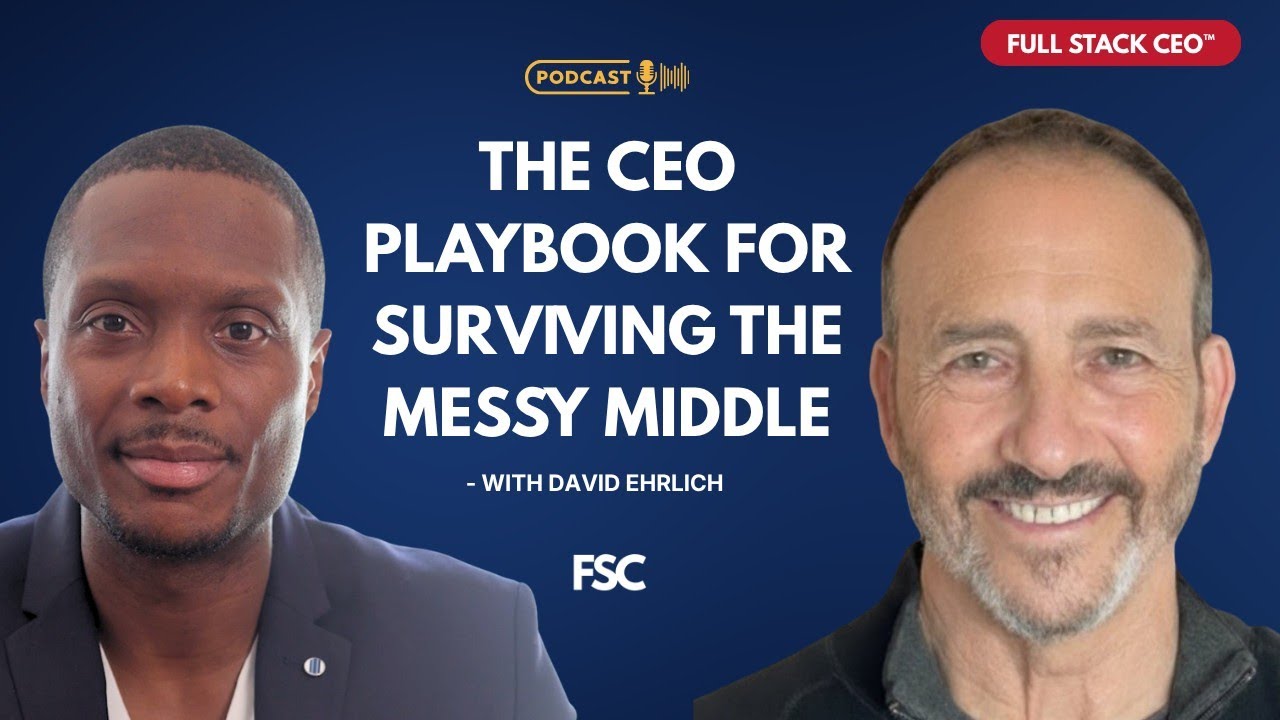
By June 2026, he had joined Full Stack CEO as an operator partner supporting software and AI founders. An August conversation with Mark Nelson turned to first sales hires, incentives and the difficult passage from founder-led selling to a larger sales organization. The topics are concrete enough to disappoint anyone hoping for a universal formula on a decorative mug.
This latest work returns him to decisions he has faced himself. When should a founder hire? Which responsibilities can move to someone else? What evidence justifies spending more? There is room here for ambition, but also for the patience to examine whether a business is ready for the next expense.
The Disneyland analogy survives that caution. Ehrlich's attraction to the E-ticket ride has never required the ride to be comfortable. His advice makes space for uncertainty while asking founders to pay attention to what is happening around them. The next ticket still needs buying. It helps to keep enough cash for it.