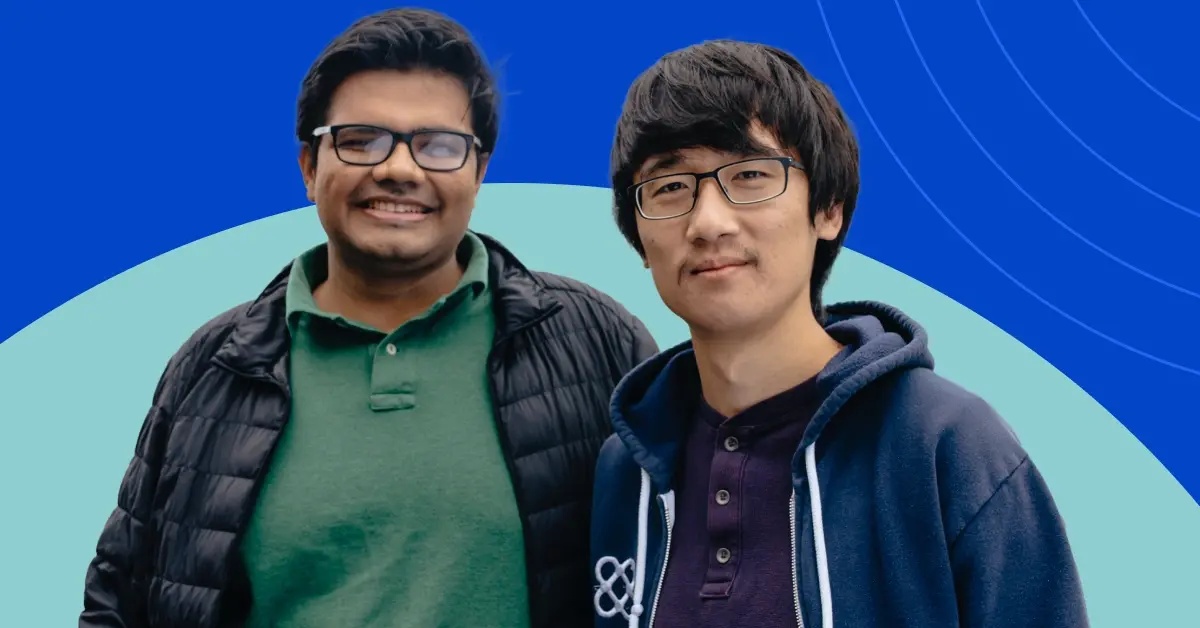
Before Shubham Goel and Ray Zhou built software for dealmakers, they built a website for making Harlem Shake videos. The premise was cheerfully undignified: a visitor could produce a dance video in three steps. The site, maketheharlemshake.com, is gone. The partnership survived. There are worse ways to audition a future business partner than finding out whether you can make something ridiculous together.
Goel and Zhou met at Stanford orientation, lived in the same dorm and took classes together. Building gave them another sort of education. They could observe how the other thought, how disagreements went, and whether an unsuccessful idea spoiled the pleasure of working together. Goel later described their partnership as “low ego, high trust.” A useful specification for software founders, though rather harder to test than a login button.
Affinity followed in 2015. Its subject was the professional relationship: who knows whom, how well, and whether that connection might help something happen. The company’s own founding relationship makes a fitting introduction. Long before Goel was selling the value of a network, he was discovering what a dependable person beside you could make possible.
Two engineers leave the familiar territory
Goel grew up in Delhi and studied computer science and artificial intelligence at Stanford. His training gave him the tools to build software. It did not automatically tell him what an investor, banker or business development professional needed from it. That gap became an invitation to ask questions, rather than a reason to pretend he already had the answers.
During a summer in Palo Alto, the two students joined other young builders through Pear’s entrepreneurial community. They interviewed more than 50 professionals across fields that included financial services, sales and nonprofits. Different job descriptions kept leading back to a similar responsibility: maintaining relationships with people. A deal, a donation and a new customer all depended on someone knowing whom to approach.
In their account of those early days, the founders described a summer of exploration becoming a sustained series of interviews. That is a less cinematic origin than an idea arriving fully formed at midnight. It is also easier to believe. People who work for a living tend to know quite a lot about what makes their working day unnecessarily difficult.
The difficulty they kept encountering was information. Professional contacts were scattered through correspondence and calendars, while customer relationship management systems expected people to enter the details themselves. Someone could have a busy working week and finish it with an impressively empty database. The work had happened. The record of the work was waiting for another piece of work.
The address book with a memory
The founders’ answer was to use the communications that already existed. Affinity integrates with team communications, calendars and other information to map business contacts and help identify possible introductions. The bet was that a useful account of a professional network could emerge from the ordinary traces of doing business, without asking everyone to become a conscientious archivist first.
That distinction matters in the industries Goel chose to serve. In a 2021 conversation, he described a strategy aimed at relationship-driven businesses, starting with financial services and extending into commercial real estate and professional services. These are places where a relationship can precede an opportunity by a long time. A conversation may have value well before anyone can put a price beside it.
In a discussion with Zhou about venture capital workflows, Goel pointed to the weakness of simply knowing that two people are connected. A meeting at a dinner party years ago and frequent current conversations are very different circumstances. A contact list tends to flatten both into the same tidy entry. The person seeking an introduction would quite reasonably like to know the difference.
Read that way, Affinity is concerned with context as much as contacts. The interesting question is how a connection fits into someone’s actual working life. Software cannot supply the goodwill required to make an introduction. It can help a team find the person who may already have it, and spare everyone a round of asking the office who remembers whom.
Conceptual diagram, not a measurement of relationship quality.
Earn the introduction
Goel’s own account of using the product makes the idea concrete. He assembled a list of 250 prospective customers, mostly investment firms, and used his investors’ and advisers’ networks to look for routes in. He reported finding more than 120 introduction paths. The exercise began with people he already knew, then asked what those relationships could reveal about people he wanted to meet.
His article described $600,000 of potential sales pipeline. That figure describes opportunity, rather than completed revenue. The useful detail is the method: a defined list of prospects, a network of trusted contacts, and a way to inspect connections that might otherwise remain invisible. The software gave him somewhere to begin a conversation. The conversation still had to happen.
Affinity’s early growth also depended on introductions, but Goel first had to give customers a reason to make them. He has described an onboarding routine built around a small number of agreed outcomes, checked every week. Customer feedback went back into the product. The team sought referrals after showing value, rather than treating a new customer as an immediate source of more names.
The numbers in his recollection are striking: ten beta customers became a hundred paying customers in six months. Yet the mechanism was deliberately small and repetitive. Agree on what matters. Check whether it is happening. Improve the experience. Then ask for an introduction. There is a certain comic inconvenience here for anyone hoping that growth might be purchased without the tedious business of being useful.
A founder has to learn a second job
By the time Goel talked about his responsibilities in 2021, they included marketing, finance and operations. He called himself an engineer by training, acknowledging how different that work was. Founding a software company had carried him into the territory he and Zhou originally explored through interviews. Now the unfamiliar job descriptions belonged to him.
The recognition came along the way. Goel and Zhou appeared on Forbes’ 2019 Under 30 list in Enterprise Technology. The company’s profile described a platform that used artificial intelligence and natural language to extend conventional CRM, with more than $13.5 million raised at that point. It was an external marker of progress for a partnership that had begun with dorm life and small projects.
Funding announcements create their own vocabulary of arrival. Goel’s public response to Affinity’s $26.5 million Series B had a more provisional tone. He wrote about the obstacles the company had already faced and the others still ahead. He also slipped in a joke about the team being fun, with the possible exception of himself and Zhou. The achievement came with room for self-mockery.
As the organisation grew, his explanation of the chief executive’s job grew more specific. Speaking in 2023, he placed the emphasis on assembling the people who would build the products and the business. That is a substantial shift in where a founder spends attention. The engineer can no longer personally solve every problem; the quality of the team becomes part of the solution.
“Your job is to build a team.”
Shubham Goel, discussing leadership after product-market fit
The statement is plain enough to sound obvious. In practice, it asks a founder to give up some of the immediate satisfaction of making the thing himself. A good hiring decision takes time to show its effects. A colleague’s judgement must be allowed to matter. For someone who began by finding a partner he trusted, that evolution has an understandable continuity.
The cookies are also part of the story
Ask Goel about a worthwhile small purchase and the scale changes pleasantly. On a business trip to New York, he bought Levain cookies to bring back to his team in San Francisco. He was enthusiastic about the bakery; colleagues were pleased with the delivery. A company that sells relationship software still has room for the old technology of arriving with something good to eat.
His account of how he works is similarly practical. He writes ideas down in detail, looks for gaps and asks other people for feedback. He also learned to protect time from meetings. The habits are modest, but they give the ambitious project a daily form: a document someone can question, a plan someone can improve, an afternoon with enough space to do the work.
There is no need to turn the cookies into a management doctrine. They are more interesting as a human detail. The same person explaining artificial intelligence and organisational networks had stopped to consider what colleagues might enjoy the next morning. It brings the scale of the story back within reach of an ordinary desk.
A relationship that travels both ways
Goel’s work with the Indian founder community offers another view of that impulse. Avinash Raghava recalled meeting him through an introduction from Rocketlane’s Srikrishnan Ganeshan. What stayed with Raghava was Goel’s understated manner. Their first conversation was about building in CRM, without a recital of the company’s size to establish the speaker’s importance.
Later, Goel hosted a session for founders in Bangalore and became a mentor through the community’s SGX programme. Raghava described a person willing to help other builders work through their questions. The pattern is familiar by now: one introduction leads to a conversation, and repeated involvement gives the relationship substance. In this case, the network is visible in what someone contributes.
Affinity has since announced Ken Fine as chief executive, with Goel and Zhou continuing as co-founders and board members. In that announcement, the company reported serving more than 3,200 firms across over 80 countries. The role has changed; the association continues. Goel’s public LinkedIn profile also describes him as building something new, leaving the next chapter open.
Return to the dormant dance-video site and the story acquires a pleasing sense of proportion. A throwaway project helped two students discover whether they liked building together. Their later company dealt with the value contained in such connections. For Goel, the first useful relationship in this particular business was close enough to share a dorm. Everything that followed required him to keep meeting people, and to keep being worth meeting.
Keep the conversation going
- Goel on LinkedIn
- Goel on X
- Goel’s writing on Medium
- Affinity
- The Stanford partnership, in Goel’s words
- The early growth conversation
- The IdeaMensch interview
- Relationships and CRM: a conversation
- The founder community portrait
- The CEO transition
- Listen: The Desi VC interview
- Watch: the private-capital Campfire panel