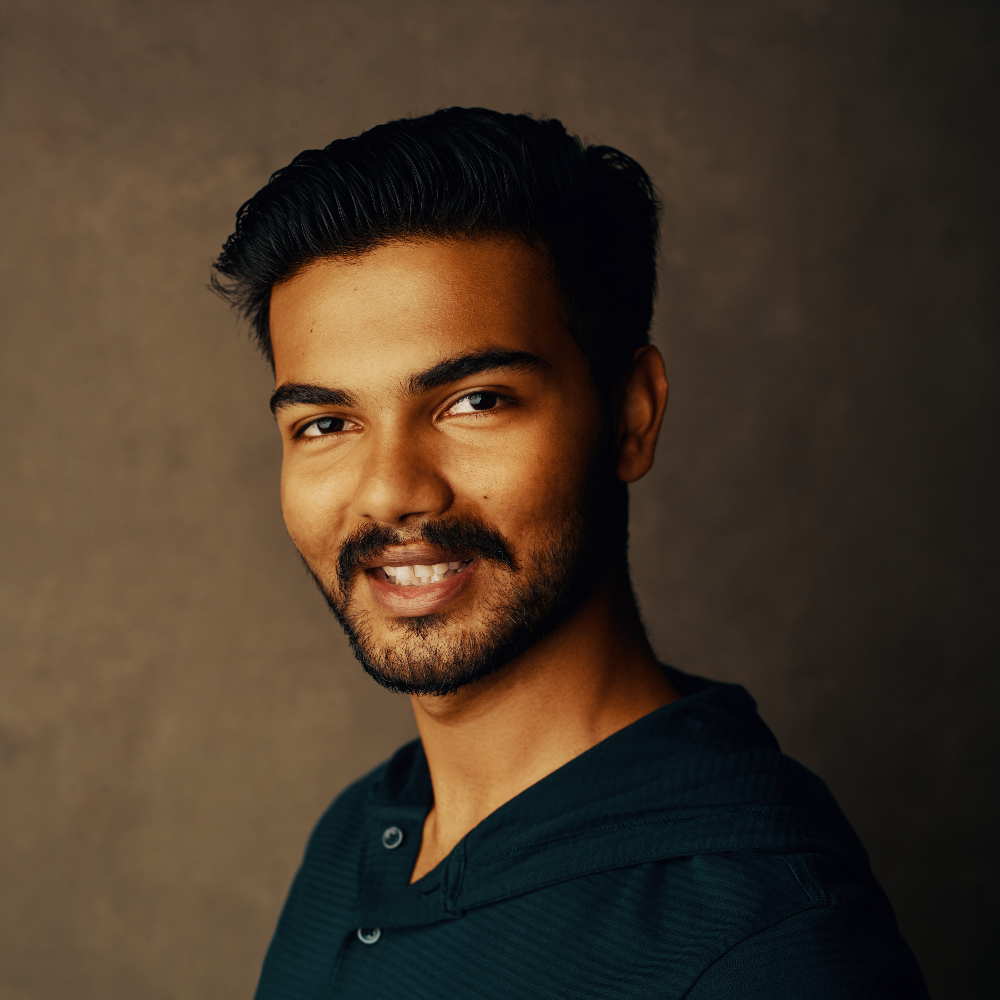
The Boy Who Stole His
Mother's Laptop
New Delhi, circa 2008. A nine-year-old named Tanay Kothari is awake past midnight, squinting at a laptop screen he was told he was "too young to understand." He'd watched Iron Man that year. The film had a specific effect on him: not the suit, but the assistant. Jarvis. A voice that listened, processed, and acted. Tanay Kothari has been building toward that moment ever since - and sixteen years later, Silicon Valley's venture capital elite use his product every morning before they check their email.
He taught himself to code from YouTube tutorials in those late-night sessions, quietly maintaining his school grades while building things his teachers couldn't have explained to him. By age eleven, he had built a viral voice assistant platform called Convert.cc that attracted 2.5 million monthly active users - with zero marketing, zero funding, zero adults involved. Google eventually shut it down for YouTube scraping violations. He rebuilt. He kept going. "I still don't tell my parents what I'm doing," he said years later, only half-joking.
"One of the hardest parts about interacting with computers is communicating what you want."
- Tanay KothariThe Stanford Chapter
He enrolled at Stanford in 2016 with a Computer Science degree in one hand and an AI specialization in the other. He didn't just attend - he ran the Venture Capital Club for three years as President, spent time at the Stanford AI in Medicine Imaging (AIMI) lab co-authoring a paper on detecting pulmonary embolism in CT scans (published in npj Digital Medicine), and became a teaching assistant for CS230, Andrew Ng's legendary Deep Learning course. He co-founded two startups while doing all of this. Stanford was a playground and he used all of it.
One of those Stanford-era ventures was FeatherX, an AI personalization startup for e-commerce stores that boosted conversion rates by 25%. Within a year of graduating, it was acquired by Cerebra Technologies. Kothari joined Cerebra as Head of Product, then Head of AI & Engineering - managing teams substantially older than himself, learning to lead through listening rather than authority. He also joined Luminous Computing as its fifth employee and AI team lead, working on photonic hardware designed to remove bottlenecks in large-scale AI systems.
Stanford Highlights
- BS Computer Science + MS Artificial Intelligence
- Teaching Assistant for CS230 (Deep Learning) alongside Prof. Andrew Ng
- Published medical AI research in npj Digital Medicine
- President, Stanford Venture Capital Club (3 years)
- Co-founded FeatherX during school; acquired by Cerebra Technologies
The Hardware Bet - and the Pivot
In August 2021, Kothari and his Stanford batchmate Sahaj Garg co-founded Wispr with $4.5 million from NEA and 8VC, with Warby Parker's CEO and Dropbox's CTO on the board. The original vision was audacious: a non-invasive wearable that would translate neurological signals into smartphone control - silent text entry from sub-vocalization. Thought to text. Jarvis, finally.
For three years, they built hardware. They studied brain signals, wearable form factors, the whole stack. Then they connected their prototype to the AI models of the moment - ChatGPT, Siri, Alexa. His assessment was blunt: "Turns out they all sucked." The hardware wasn't the problem. The software layer underneath was. The AI that was supposed to convert "rambles into something structured" didn't exist yet. So they built it themselves.
"The way I speak is very different from the way I write."
- Tanay KothariWhat started as an internal tool - Project Flow - went from five users to hundreds to thousands in two months. The pivot became the product. The company rebranded, and Wispr Flow was born. Unlike every dictation tool that came before it, Flow didn't just transcribe. It edited. It removed filler words, structured thoughts, applied context-aware formatting - optimizing not for word error rate but for "zero-edit messages." You speak like a human; Flow writes like a professional.
The 500-User Obsession
Most founders track DAUs and conversion funnels. Tanay Kothari opened Google Meet calls. He personally onboarded the first five hundred users of Wispr Flow one by one, watching their faces, tracking their mouse movements, cataloging their micro-expressions of confusion and delight. "Find the things that repeatedly create delight, make sure that never dies, and then find the other places where there's confusion and kind of take them out." It's not a growth strategy. It's a craft methodology.
The numbers that came back from that obsession are unusual. Wispr Flow achieved a 20% paid conversion rate in a market where 3-4% is considered good. Eighty percent of users remain active after six months. Users type 72% of their characters through Flow after half a year. Daily typing time drops by nearly 50%. The product grew 90% through word of mouth, with zero sales team. One hundred companies were signing up weekly without anyone asking them to.
The signal that convinced everyone? Users were purchasing MacBooks specifically to use Wispr Flow on macOS. That is product-market fit with receipts.
Product-Market Fit Signals (2025)
- 20% paid conversion rate vs. 3-4% industry standard
- 80% six-month active-user retention
- Users buying MacBooks specifically to run Wispr Flow
- 90% word-of-mouth growth with zero sales team
- 100 companies signing up per week organically
- Every tier-one VC in Silicon Valley using product daily
The Anti-Fragile Architecture
Here is how Kothari thinks about building in the AI era: "If you feel afraid of a new model launching, you're doing something wrong." Most AI-adjacent companies live in fear of GPT-5 making their moat irrelevant overnight. Wispr is built to benefit from every new model. Its infrastructure sits on top of the AI industry rather than competing within it. Better models mean better Flow. Every OpenAI announcement is a tailwind.
He eliminated SEO as a strategy because "no one is searching for voice dictation." He applies a ruthless 80/20 filter: identify the 20% of activities generating 80% of results, repeat. He explicitly targets the 95% of non-tech-savvy users - not because early adopters are bad, but because the mainstream is where durable businesses are built. "They're more loyal than early adopters."
The Funding Arc
By June 2025, every tier-one venture fund in Silicon Valley had their partners using Wispr Flow for daily memos, emails, and documents. The Series A pitch was unusually short: the investors were already customers. Menlo Ventures led a $30 million round with participation from NEA, 8VC, Pinterest founder Evan Sharp, Carta CEO Henry Ward, and Opal CEO Kenneth Schlenker. By November 2025, Notable Capital led a $25 million extension, bringing total funding to $81 million at a $700 million valuation.
The product had by then shipped a macOS app (October 2024), a Windows app (March 2025), and an iOS app (June 2025). 104 languages. 40% US users, 30% Europe, 30% everywhere else. Sixty percent of all dictations in non-English languages. Kothari built a global product from the start because he grew up speaking across languages himself.
"The most important thing nobody talks about with startups is the people and team you build. That comes before your product, before your marketing, before your market."
- Tanay KothariWhat Comes Next
Kothari has laid out three pillars for the version of Wispr he's building toward. First: you speak, the system writes for you. That part exists. Second: you speak, the system takes action - executing tasks, not just transcribing them. Third: the system anticipates, proactively. The full Jarvis. He gives himself five years to make keyboards vintage store items.
The Android app is in development. Enterprise solutions - with company-wide phrase context - are coming. Partnerships with AI hardware manufacturers are in progress. The wearable dream isn't dead; it's queued. He has always been building toward the same thing from every angle at once.
What makes Tanay Kothari unusual isn't the pedigree or the funding or the Forbes list. It's the continuity. The nine-year-old who stole his mother's laptop to build a voice assistant and the thirty-year-old CEO raising $81 million to make keyboards optional are running the same program. He never pivoted his mission. He just kept finding better paths toward it.