The Measuring Tape Is on Notice
Somewhere in America right now, a contractor is standing on a roof with a measuring tape, writing numbers on a clipboard, hoping they don't forget a decimal. It's 2026. Their competitors who use Hover finished that same job in the parking lot fifteen minutes ago.
Hover has built a platform that converts smartphone photos into fully-rendered, dimensionally accurate 3D models of residential properties - complete with material quantities, cost estimates, and design visualizations ready for client sign-off. The company serves more than 300,000 construction and insurance professionals, holds 3D records of over 10 million U.S. homes, and has digitally reconstructed more than 22 billion square feet of property. Its spatial database is, quietly, one of the most valuable assets in American real estate.
Insurance carriers noticed. Travelers, State Farm, and Nationwide didn't just become Hover customers - they led the company's $60M Series D. When your biggest clients invest in your product, the product review is implied.
"The home improvement industry is one of the few industries that's not able to sell products on the internet. You can buy shingles on the internet, but you can't buy a roof."
- A.J. Altman, Founder & CEO, HoverThat gap - between shingles-as-commodity and roof-as-project - is exactly where Hover lives. The platform makes the project legible, measurable, and sellable before anyone picks up a single tool.
A $500 Billion Industry Running on Clipboards
Home improvement in America is enormous - and remarkably analog. Before Hover, getting a quote for a new roof required a contractor to physically visit the property, climb onto the surface, manually measure every plane, record everything by hand, then return to an office and translate those numbers into an estimate. The process took hours. Errors were routine. Callbacks were expected.
For insurance adjusters, the problem was worse. After a storm, thousands of claims arrive simultaneously. Sending a human to every damaged roof is slow, expensive, and - during a pandemic - impossible. The industry needed a way to assess properties remotely, accurately, and at scale.
Source: Hover internal data & contractor reporting. Traditional estimate time varies by property size and complexity.
The status quo wasn't a technology problem. It was a category problem. Nobody had thought to treat a house as something you could digitize with a smartphone and a trained neural network. That was the bet A.J. Altman made in 2011.
From the Marine Corps to the Measuring App
A.J. Altman is not the obvious profile for a proptech founder. He served as an infantry officer in the United States Marine Corps before working as an engineer at Intel. The combination - operational discipline, technical depth, and a preference for doing things that feel uncomfortable - produced a company that doesn't quite resemble anything else in its space.
His hiring philosophy reflects his background. Hover actively recruits military veterans, and Altman has spoken publicly about why: veterans know how to execute on a mission under pressure, adapt without a complete picture, and deliver results through persistence rather than perfect conditions. The company's core values - Think, Do, Serve - read less like startup boilerplate and more like a field manual.
"It rewards getting a job done - delivering on the mission through sheer force of will."
- A.J. Altman, on why Hover hires military veteransThe founding thesis was straightforward in hindsight, difficult in execution: if you could build a deep-learning model trained on enough roof geometries, exterior surfaces, and structural features, you could teach a smartphone to see a house the way a professional estimator sees it. The challenge was data, training, and - eventually - trust. Getting construction professionals and insurance carriers to replace their manual processes with an app required years of accuracy data and a lot of patience.
Altman spent the early years of Hover grinding through exactly that. By 2018, when Google Ventures, The Home Depot, and Standard Industries led the Series B, the proof points were clear enough to matter.
The Decade That Built the Database
Eight Photos. Then the Magic Happens.
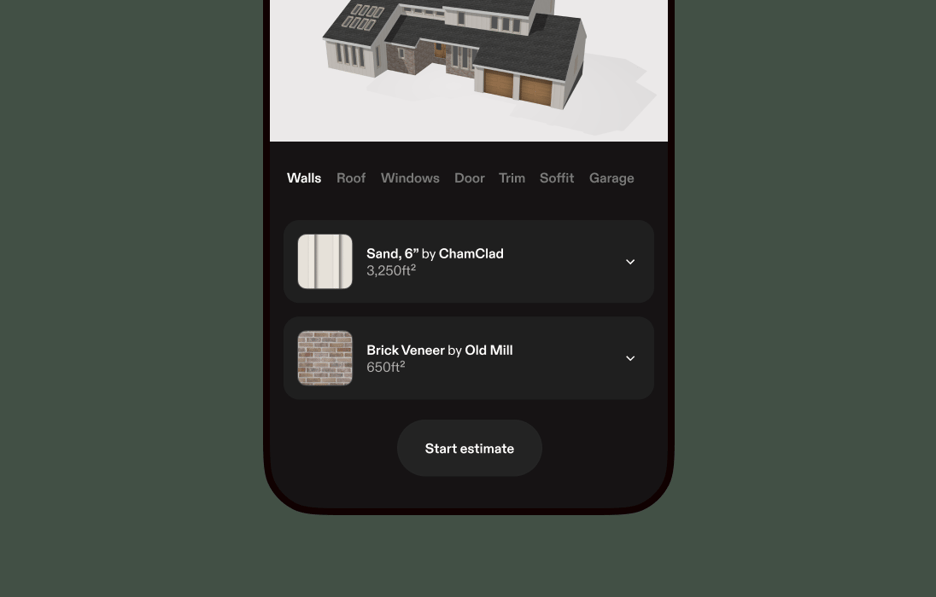
The user experience is deliberately simple. A homeowner or contractor opens the Hover app, walks around a property taking 8-10 photos from specified angles, and submits. Within minutes, Hover's computer vision and deep learning pipeline produces a complete 3D model - dimensionally accurate, textured, and annotated with measurements for every roof plane, wall section, window opening, and door frame.
What comes out isn't just a pretty render. It's an operational document: square footage by surface, material takeoff quantities, and an order-ready list for lumber yards and building supply companies. Contractors save approximately two hours per job on estimation alone. That's time that previously went to measuring tape, spreadsheets, and apologies when the quote came in wrong.
Photo-to-3D Conversion
8-10 smartphone photos generate a complete, dimensionally accurate 3D property model with full material takeoffs.
Roof & Exterior Measurements
Precise measurements for roofing, siding, windows, and doors - from photos. No ladder required.
Interior Solutions
Interior measurements, photo documentation, and 3D walkthroughs for claims and renovation planning.
Instant Design
AI-powered photorealistic visualization. Try new siding, roofing, paint, or windows on your actual house - free for homeowners.
Blueprint Design
Blueprint plans converted to scaled 3D models. Replaces week-long manual scaling. Per-job pricing from $55.
Connected Visual Platform
One platform for measurements, design, estimates, and proposals with e-signature. Replaces up to 5 apps.
"We're on a mission to improve home improvement."
- Hover company missionCustomers, Data, Partnerships
Hover's customer list reads like an industry coalition: 9 of the top 10 U.S. property and casualty insurance carriers use the platform. Three of them - Travelers, State Farm Ventures, and Nationwide - liked the product enough to lead a $60M funding round. It is a rare thing for a startup's biggest clients to also be its investors. It is rarer still for those clients to be insurance companies, which are not historically known for aggressive technology bets.
On the construction side, The Home Depot is both investor and distribution engine. Contractors in the Pro Xtra loyalty program receive a 25% discount on Hover services - and those contractors report 15% higher close rates and roughly two hours saved per job. At 300,000+ professionals on the platform, that arithmetic compounds quickly.
The partnership with James Hardie in 2025 illustrated a different model: a building materials manufacturer embedding Hover's AI directly into their own customer-facing product. Hardie Designer - powered by Hover - lets homeowners visualize James Hardie siding on their actual house before ordering a single panel. That's product placement in a new sense.
$147M Raised, Mostly From People Who Needed the Product
Post-money valuation at Series D: ~$490M. Total funding across all rounds: $146M+.
The Scoreboard
The Single Source of Truth for Your House
Hover's stated ambition is to create a "single source of truth for the physical world" - a permanent, accurate digital record of every home in America. That sounds abstract until you consider what it means in practice: when your roof is damaged in a storm, the insurance adjuster already has your property's dimensions. When you want new siding, the contractor already knows how many square feet to order. When you're selling, the buyer can walk through a 3D model of the home before scheduling a visit.
The 2025 launch of Instant Design brought this vision to homeowners directly, for free. The tool generates photorealistic renders of design changes on your actual house - new siding color, different roofing material, replacement windows - using real products from real manufacturers. It's a try-before-you-buy experience for a $20,000 purchase decision. The design consultation that used to require a contractor visit and a mood board happens on your phone.
The January 2026 Connected Visual Platform took the logic further: one unified system handling measurements, design, estimating, and proposals with e-signature, connected to 1,000+ third-party tools. The pitch to contractors is blunt - stop using five apps and start using one. It's the kind of consolidation play that becomes dominant when the underlying data (Hover's spatial database) is more accurate than anything competitors can source.
"Eight photos. Fifteen minutes. A complete picture of a property that used to take hours to document by hand. That's not incremental. That's a different category."
- YesPress editorial assessmentThe contractors who were standing on roofs with measuring tapes in 2010 are still in business. Some of them now use Hover. The ones who don't are competing against the ones who do - and the math on that comparison gets harder every quarter.
Official Links & Resources
Watch Hover in Action
The Contractor on the Roof in 2010 Had a Tape Measure. In 2026, They Have a Hover.
The gap between those two things is 15 minutes, 8 photos, and a decade of training a neural network to see what professionals see. Hover didn't make measurement easier. It made it different.
Visit hover.to