01The Door, Reconsidered
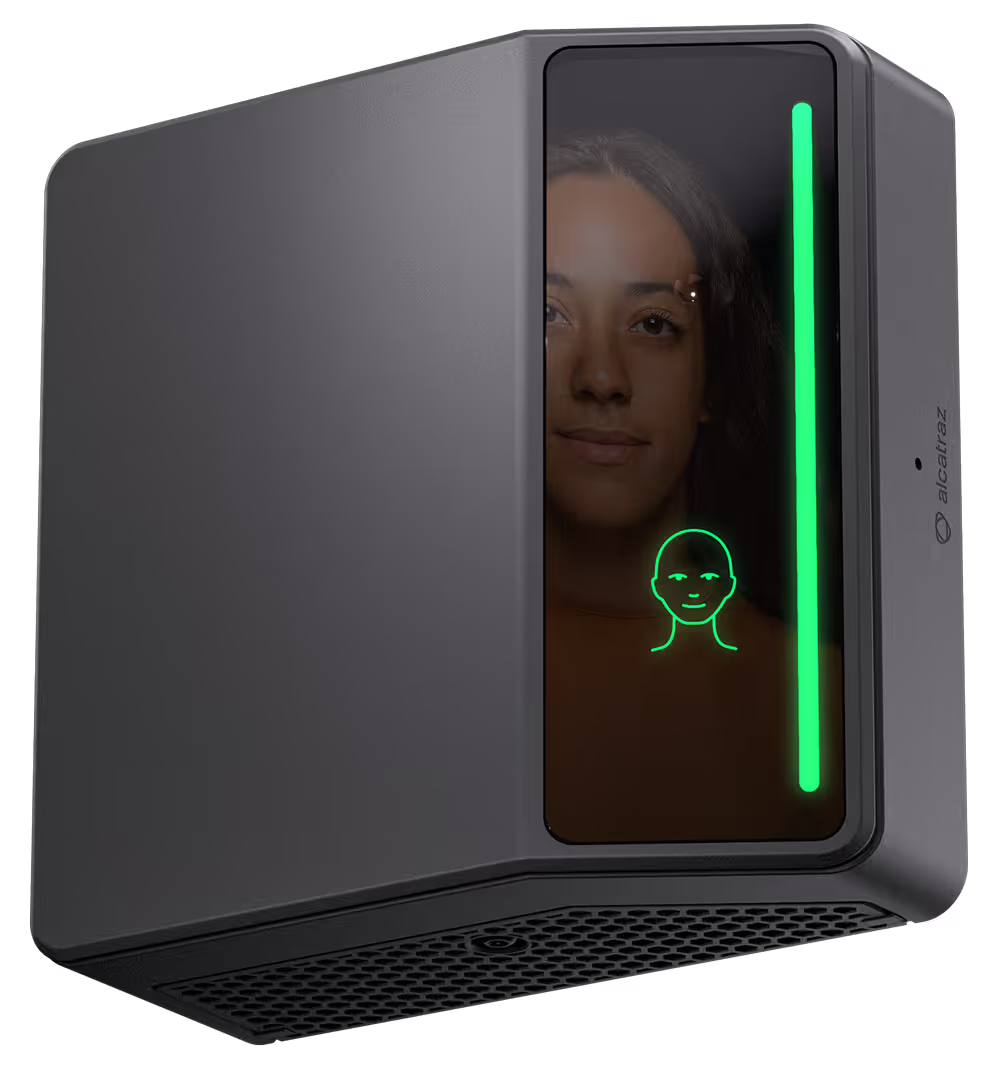
A security guard in a Fortune 100 lobby used to spend his shift squinting at laminated badges and waving people through. Today he watches a screen. People walk up to a small black slab on the wall, the slab thinks for less than a second, a green light blinks, the turnstile opens. He has not been replaced. He has been promoted to the interesting cases - the contractor whose badge was cloned, the visitor a manager forgot to register, the polite man trying to slip in behind a real employee. The slab is called the Rock, and the company that builds it is called Alcatraz AI.
Alcatraz is a Cupertino-based hardware and software company with about 120 people and a single, faintly audacious idea: the face is a better credential than anything you can lose, lend, or photocopy. The company has raised more than $118 million to make that idea boring enough for an enterprise security team to sign off on. As of April 2026 it closed a $50 million Series B, led by BlackPeak Capital with Cogito Capital and Taiwania Capital, that has turned the experiment into something closer to a category.
02The Problem They Saw
Physical access control is an industry stuck in the late nineties. Most office doors are still guarded by plastic cards humming away at 125 kilohertz, a frequency so old it predates the iPod. They are trivially cloned with $20 of equipment off the internet. They are constantly lost, lent, taped to monitors, left at airport security, and quietly resold on Reddit. They do not know who you are. They only know what you are holding.
Worse, they do nothing about the oldest physical security exploit in the book: tailgating. One person scans, two people walk in. Companies have tried to solve this with mantraps, turnstiles, and the polite request that you not be polite. It rarely works. Politeness, it turns out, is the most reliable zero-day in the building.
The badge problem in one chart
The lock you bought in 1998 is still the lock guarding your data center.
Meanwhile the things behind those doors got dramatically more valuable. A modern hyperscale AI data center holds tens of billions of dollars of GPUs, trade secrets the size of small countries, and customer data that comes with criminal penalties attached. The lock on the front door did not get the memo.
03The Founder's Bet
Alcatraz was founded in 2016 by Vince Gaydarzhiev, a hardware engineer who grew up in Ruse, Bulgaria, moved to the United States at sixteen, and eventually wound up at Apple working on the hardware that became Face ID. When he left, he did not go quietly into another phone. He left to put roughly the same idea on the side of a door.
The bet was specific. If facial authentication was good enough to unlock a billion phones, it was good enough to unlock the rooms that contain those phones' designs. The hard part would not be the camera. The hard part would be convincing a chief security officer that the camera was not a privacy disaster waiting to happen.
That is why every architectural choice at Alcatraz starts with a constraint: the face never leaves the device in a form that anyone, including Alcatraz, can do anything with. Templates are encrypted on the edge. The device decides locally. There is no central pile of biometric data quietly accumulating somewhere on AWS, waiting for a breach. The compliance story - GDPR in Europe, CCPA in California, BIPA in Illinois, the patchwork everywhere else - falls out of that constraint almost for free.
In 2021 Gaydarzhiev handed the chief executive title to Tina D'Agostin, a security-industry veteran, and moved to President and Chief Product Officer. Founders who voluntarily promote themselves to product are usually the kind worth listening to.
A short, mostly chronological history
04The Product
Hold a Rock X in your hand for the first time and the surprise is how unflashy it is. It looks like an upscale intercom. The cleverness is on the inside: a 3D sensing stack borrowed conceptually from the world of phone-grade facial authentication, an edge AI inference engine that decides locally whether to open the door, and a software platform that lets a security team run the whole fleet across forty buildings without ever seeing a photo.
The Rock
The original. Facial authentication, 3D liveness, tailgating detection, OSDP and Wiegand integrations. Quietly bolted onto Fortune 100 lobbies since 2019.
Rock X
The redesign. IP66 weatherproof, flat-mount on turnstiles, SIP intercom, video at the door, works in pitch dark and direct sunlight. The one that ships to data centers and airports.
Alcatraz Platform
Cloud or on-prem management. Enrollment, audit logs, real-time alerts, integrations with Genetec, LenelS2, AMAG, and Software House. The boring part. Therefore the important part.
Three features tend to win the bake-off. Enrollment is passive: the device learns a face over a few days of normal use, no awkward studio session. Tailgating detection is real-time and silent - the door opens for the authorized employee and a security operator gets pinged the moment a second body slips through. And the device, contrary to almost every other piece of outdoor security gear ever shipped, genuinely works in the rain.
The Alcatraz growth profile
05The Proof
The list of organizations willing to put a camera at their most expensive door is a useful tell. Alcatraz reports deployments across most of the top ten AI infrastructure providers, multiple major U.S. airports, NFL franchises, big-five banks, energy utilities, hospitals, and a roster of universities. Combined, the company says, roughly five million employees walk through an Alcatraz-protected door on a typical week.
The airport story is its own small case study. Safe Skies, the FAA-funded program that vets technologies for high-security aviation environments, certified the Rock as reliable for airport perimeter use - a credential other facial recognition vendors have spent years failing to earn.
Channel partnerships do the unglamorous work. Integrations with Genetec, LenelS2, AMAG, and Johnson Controls' C-CURE 9000 mean a Rock can slot into existing access-control infrastructure without ripping out a decade of cabling. The biggest enemy of any new physical-security product is not the competitor; it is the inertia of the building it has to retrofit.
06The Mission
Strip the marketing and Alcatraz's mission is unusually concrete: make access control frictionless, secure, and privacy-preserving by replacing badges and PINs with facial authentication that runs on the edge. Each adjective is doing work. Frictionless because no one wants to fumble for a badge with two coffees in hand. Secure because the alternative - the badge - is one of the easiest credentials in modern security to defeat. Privacy-preserving because every state legislature in the country is in some stage of writing a biometric privacy law, and the vendors who do not plan for that will not be around to read it.
The cultural reading is more interesting. Alcatraz is, in a sense, a bet that the lessons Apple learned with Face ID - that consumers will accept biometrics if the tradeoffs are honest - generalize beyond consumer devices into the messier, more regulated, more litigation-prone world of enterprise security. So far the bet looks like it is paying out.
07Why It Matters Tomorrow
Two long arcs are bending toward Alcatraz. The first is the explosion in value of the things behind physical doors - AI training clusters, model weights, the unsexy infrastructure that the entire generative AI boom rests on. A leaked GPU shipment is a fifty-million-dollar problem. A leaked badge is a five-dollar problem that lets someone in to cause the first one.
The second is regulation. Biometric privacy law is no longer a curiosity. BIPA suits regularly produce nine-figure settlements. GDPR has teeth and is using them. A vendor who can credibly claim that no face image ever leaves the device is going to have a markedly easier procurement cycle than one who cannot. Alcatraz has been making that claim, in writing, since before the lawsuits started piling up.
Put differently: the company has spent a decade engineering itself into a position where the rest of the world is now arriving. That is the polite definition of luck. It is also the working definition of strategy.
08Back at the Door
The security guard in the lobby finishes his coffee. An employee walks up. The small black slab on the wall blinks green before she has fully stopped walking. She does not slow down. Behind her, a stranger reaches for the door and the slab notices, and an alert lands quietly on a screen two floors up, and a polite voice asks the stranger if he has been registered for visitor access today.
No badge is fished out of a wallet. No code is typed. No image of anyone's face is sitting in a database in another country, waiting to leak. The door, an object that has been more or less the same since the invention of doors, just got smarter about who it lets through.
That is what Alcatraz AI is selling. Not facial recognition. Recognition with a conscience.