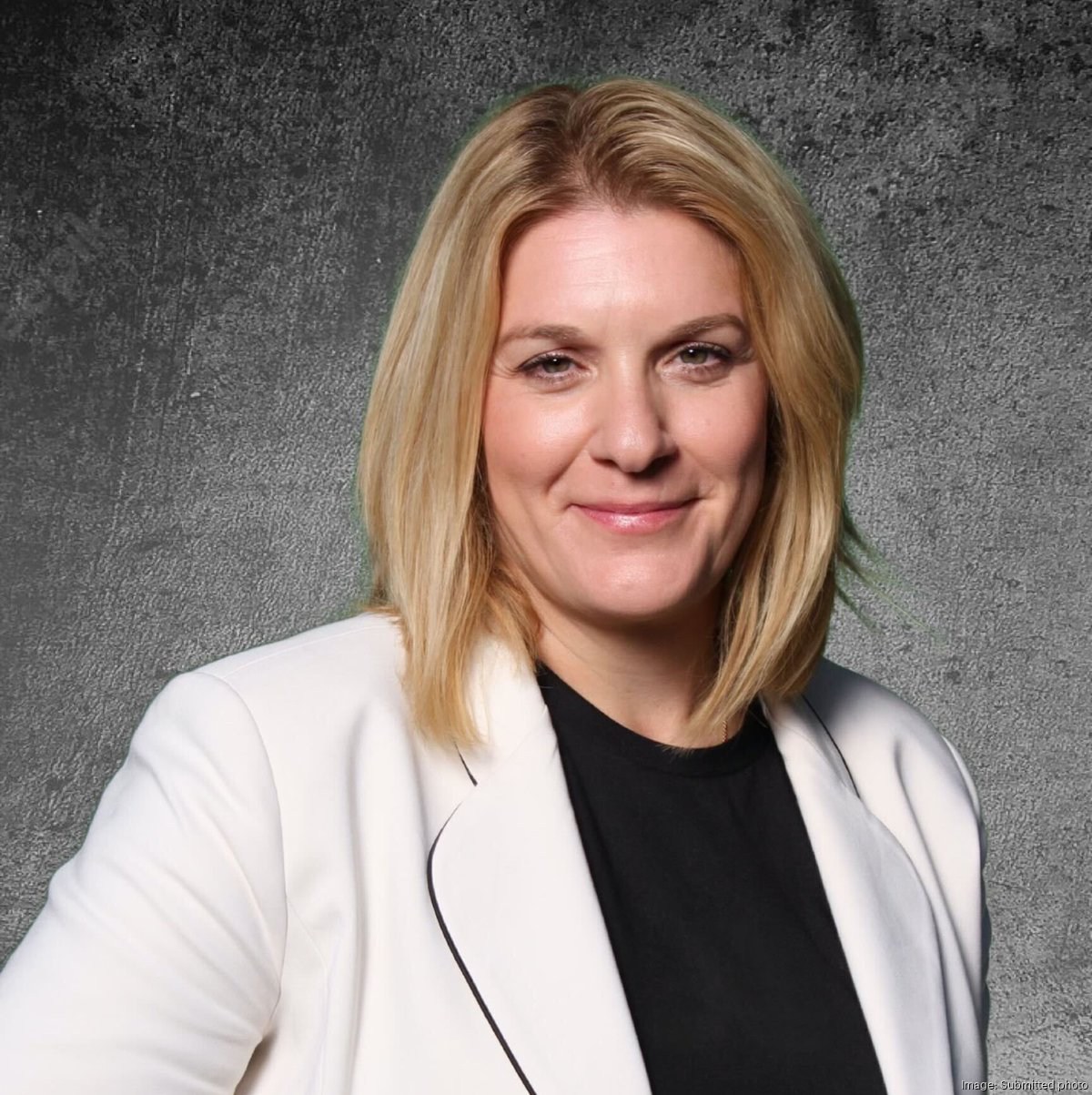
The Badge Killer
The office badge has been the same basic technology for fifty years: a piece of plastic, a magnetic stripe or an RFID chip, the ghost of a photo from your first day on the job. It can be lost. It can be copied. It can be handed to someone who definitely should not have it. Tina D'Agostin has spent the last several years building the thing that replaces it, and in 2026, she's closing in.
D'Agostin is the CEO of Alcatraz AI, a Cupertino-based company whose flagship product - called The Rock - uses depth-sensing cameras and edge AI to authenticate who you are from your face, without taking photographs, without storing your image, and without making you stop walking. You approach a door. The system recognizes you. You walk through. That's it.
The company today protects more than five million employees across Fortune 500 campuses, financial institutions, data centers, stadiums, universities, and airports - including Honolulu's Daniel K. Inouye International Airport. When Alcatraz closed its $50 million Series B in April 2026, bringing total funding past $100 million, D'Agostin wasn't just announcing a round. She was announcing that the market had caught up to her thesis.
"We are the Face ID of securing physical spaces. Our technology is AI-powered and completely anonymized. For the workplace of today, badges and passcodes inherently invite too much risk."
- Tina D'Agostin, CEO, Alcatraz AI
Career
Twenty-Five Years to the Frontier
D'Agostin did not arrive in Silicon Valley as a founder. She arrived as someone who had spent a career becoming indispensable in a slow-moving industry. She came up through Niscayah - now part of Stanley Security - where she was identified as one of five high-potential leaders during the company's management training program. She went on to become General Manager of Building Technology and Solutions for Northern California at Johnson Controls, where she spent years deploying smart building technology inside the companies that would later become her customers.
She holds a bachelor's degree and an MBA from Rockford University, studied abroad at Regent's University London, and has earned professional certificates from Stanford in both Innovation and Entrepreneurship and Energy Innovation and Emerging Technologies. For someone whose name now appears on biometric security press releases, the academic record reads like a very deliberate preparation.
In 2020, she joined Alcatraz as Chief Revenue Officer - the person responsible for turning a technologically compelling product into an actual business. She met founder Vince Gaydarzhiev, a former Apple engineer who worked on Face ID hardware for the iPhone, and recognized what he had built: not a surveillance system, but an authentication system. The distinction matters enormously, and D'Agostin has spent years making sure the world understands the difference.
By 2021, she was CEO. The company that had once been a promising startup was, by 2025, reporting 200% year-over-year growth in enterprise customers and 300% growth in data center adoption. Fortune 500 deployments expanded fivefold. The world's largest airports, the most sensitive energy infrastructure, and the most critical data centers were trusting Alcatraz.
The Thesis
Authentication vs. Surveillance: The Argument She Won't Stop Making
Ask D'Agostin what Alcatraz does, and within three sentences she will make a distinction that most people in her industry elide. Facial authentication - verifying that you are who you say you are - is not facial surveillance - tracking where people go and building profiles about their behavior. The Rock does the first thing. It explicitly does not do the second.
This matters because the regulatory and public relations environment around biometrics is genuinely treacherous. Illinois has BIPA. California has CCPA. Europe has GDPR. These are not hypothetical risks for companies deploying face-based technology at scale - they are existential ones. D'Agostin's answer has been to build the privacy model into the product architecture: encrypted biometric templates, opt-in consent requirements, no centralized image storage, no cloud upload of facial data.
"Like Face ID on your iPhone," she says, "no photographs are being taken." The point is precise. When your phone authenticates your face, it never sends your face to Apple's servers. The same logic applies to The Rock. The biometric template lives on the device, processed at the edge.
"We are the only biometric system protecting physical spaces using facial authentication instead of the legacy facial surveillance use case. Like Face ID on your iPhone, no photographs are being taken."
- Tina D'Agostin
Leadership
Making Rooms Better Than She Found Them
D'Agostin talks about leadership with a practicality that cuts through the usual executive-speak. She is not interested in defining culture abstractly. She is interested in what happens in the daily interactions between people, because that is where culture is actually made. "Make the room a better place than when you joined it," she says. It is a small instruction. It scales.
She moved from Chicago to the Bay Area - that particular bet, taken at a specific moment in a career, is the kind of thing that tends to define what a person becomes. The decision to join Alcatraz as CRO rather than as a founder is another one. She came in as the person who would make the business real, not the person who would be celebrated for starting it. Under her, Alcatraz grew from a compelling technical demo to a company that the most security-conscious organizations in the world choose to trust.
In 2024, she was appointed to the Bay Area Council Board of Directors and named Co-Chair of its Public Safety Committee - a public policy role that takes her concerns about security infrastructure into the arena where the rules get made. She is also a contributing member of the Forbes Technology Council and a member of the Biometric Institute, the global nonprofit that sets standards and accountability frameworks for the biometrics industry.
Recognition
Awards & Milestones
Outlook
The $100M Question
The April 2026 Series B - $50 million, led by BlackPeak Capital from Bulgaria, Cogito Capital from Warsaw, and Taiwania Capital (backed by the Taiwanese government), alongside existing investors including Almaz Capital, the European Bank for Reconstruction and Development, and Analog Devices co-founder Ray Stata - is international capital for an international ambition.
Alcatraz already has offices in Cupertino and Sofia. The Series B signals intent to push into new verticals and new geographies. The company celebrated its 10th anniversary in 2026 - a decade from Vince Gaydarzhiev's prototype to a platform that D'Agostin has turned into a global enterprise security business.
As AI infrastructure becomes more valuable and therefore more targeted, D'Agostin's argument gets stronger with each news cycle. The physical layer of security - who can walk through which door - is the last thing to be modernized, and she believes Alcatraz is the company that modernizes it. "Organizations need a stronger, seamless, and privacy-first approach to access control," she says. She has spent five years making sure that description fits her product.
In Her Words
Direct
"Always approach your next assignment with curiosity, openness, and enthusiasm."
"Consent is a critical element to any modern biometric system, as is optimizing the process in which users can give or deny consent."
"As AI infrastructure becomes more valuable, it also becomes a bigger target. Organizations need a stronger, seamless, and privacy-first approach to access control."
"People all over the world have become more comfortable with the technology, as many use it to unlock their phones via Face ID."
Career Timeline