Tagged Content
Everything on the platform tagged with energy.
Beacon Power Services (BPS) is an energy-technology company building data and grid-management software for Africa's power sector. Its AI-enabled platforms - Adora for real-time grid monitoring, CAIMS for utility asset and customer data, and the Xepp consumer app - help electricity distributors cut losses, prevent outages and digitize networks. Founded by aerospace engineer turned investment banker Bimbola Adisa, BPS now serves utilities reaching more than 50 million people across Nigeria, Ghana, Kenya, Zambia and beyond, processing over a billion grid data points a day.
Rise Science is a Chicago-based health technology company behind RISE, a sleep and energy tracking app built on two ideas sleep researchers agree on: sleep debt and circadian rhythm. Rather than scoring your sleep with a vague number, RISE predicts your daily energy peaks and dips and tells you the best time to do everything - from your last coffee to winding down for bed. Founded in 2015 by Northwestern engineers Jeff Kahn and Leon Sasson, the company has raised $15.5M and grown the app past 5 million users.
Terra AI is a Palo Alto geoscience company building generative AI that turns the messy, expensive guesswork of subsurface exploration into fast, probabilistic 3D models of what lies underground. By fusing geophysics, geochemistry, and drilling data, its platform generates millions of geological scenarios in minutes, helping mining and energy teams decide where to drill, how many wells they need, and whether a project is worth the capital - shrinking exploration timelines and pointing capital at the critical minerals the clean-energy transition depends on.
Texture is a New York-based climate-tech company building the operating system for the energy grid. Its AI-native software platform connects to any meter, device, or data source - solar arrays, batteries, EVs, AMI and SCADA feeds - and gives electric utilities, cooperatives, virtual power plant operators, and grid-services companies a single place to enroll devices, monitor the distribution system in real time, run demand-response and flexibility programs, and measure performance. Founded in 2023 by Sanjiv Sanghavi (co-founder of ClassPass), Texture aims to break the manufacturer 'walled gardens' that keep distributed energy resources from working together.
Cameron Halliday is the co-founder and CEO of Mantel, a Cambridge, Massachusetts climate-tech company spun out of MIT's chemical engineering labs. Mantel uses molten borate salts to capture CO2 from heavy industry at high temperatures, recovering most of the energy as usable steam and slashing the cost and energy penalty of carbon capture. Halliday discovered the core material during his PhD at MIT, then co-founded the company in 2022 and raised a $30 million Series A co-led by Shell Ventures and Eni Next.

Tim Heidel is the co-founder and CEO of VEIR, a Massachusetts startup building overhead superconducting transmission lines that can carry five to ten times the power of conventional lines on roughly the same footprint. An MIT-trained electrical engineer who ran the research behind MIT's Future of the Electric Grid study, then steered a portfolio of grid projects at ARPA-E and vetted climate bets at Bill Gates' Breakthrough Energy Ventures, Heidel concluded that the grid's biggest bottleneck was transmission itself - too slow, too costly, too ugly to permit. VEIR is his answer: black pipes carrying superconducting tape bathed in liquid nitrogen at -321F, aimed squarely at AI data centers, utilities and renewable developers.
Equilibrium Energy is a San Francisco-based clean power company building PowerOS, an agentic AI platform purpose-built for the power industry. Its flagship product, EQ Mission Control, optimizes battery storage and renewables portfolios across US power markets, blending grid physics, market modeling, and AI copilots.
Exodigo is an AI-powered underground mapping company that fuses multiple geophysical sensors with machine learning to produce non-intrusive 3D maps of what lies beneath the surface, helping transit agencies, utilities and engineers de-risk multi-billion-dollar infrastructure projects.
GridX is the enterprise rate engine behind some of the largest utilities in North America, translating tangled tariffs into accurate bills, what-if scenarios, and personalized customer guidance as the grid transitions to clean energy.
Intertrust is a Berkeley-based trusted computing pioneer that builds the cryptographic plumbing for connected devices, media, and energy systems. Founded in 1990 as the inventor of DRM, it now sells PKI, identity, and data-governance tools to clients like Sony, Philips, LG, and a growing roster of utilities and virtual power plant operators.
Mariana Minerals is a software-first, vertically integrated critical minerals company building MarianaOS, an AI platform that turns mineral discovery, extraction and refining into a live, data-driven operation. The company is restarting and building lithium, copper and nickel projects across the U.S., starting with Copper One in Utah - billed as the world's first autonomy-first copper mine.
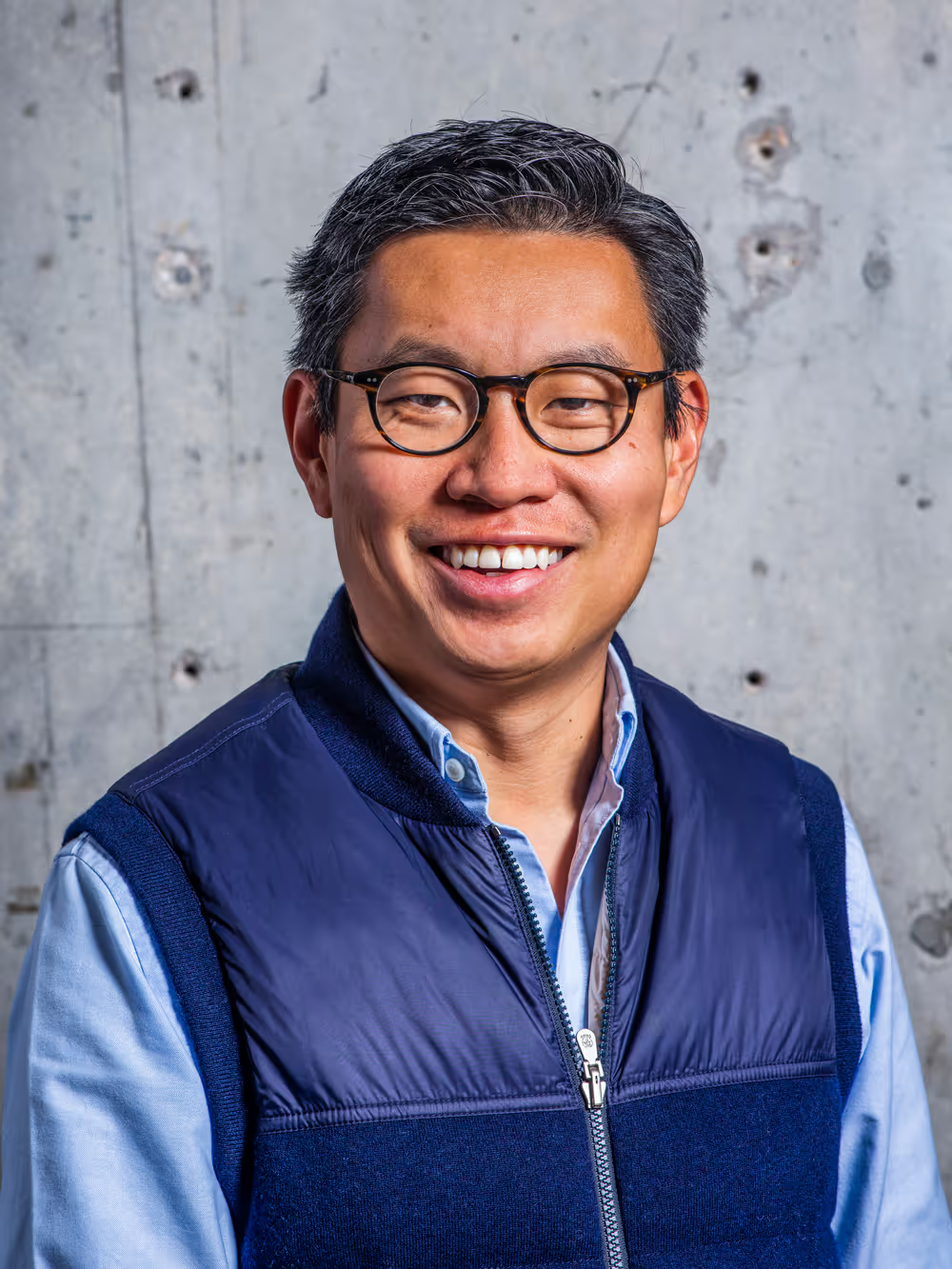
James Wang is the General Partner of Creative Ventures, a San Francisco-based deep tech venture capital firm managing a $50M fund focused on AI, robotics, hardware, industrial automation, healthcare, agriculture, energy, and climate. With a background spanning Bridgewater Associates, Google X (Makani), co-founding the femtech startup Lioness Health, and a career in West African microfinance, Wang brings a rare combination of finance, engineering, and social-impact instincts to early-stage investing. He is also the author of 'What You Need to Know About AI' (2025) and publishes the 'Weighty Thoughts' Substack to over 3,000 subscribers.
Jim Adler is the Founder and General Partner of Toyota Ventures, the corporate venture arm of Toyota with $800M+ in assets under management and 90+ portfolio companies. A rocket-engineer-turned-serial-entrepreneur, Adler built the fund from a $100M seed in 2017 into a powerhouse backing frontier technologies in AI, autonomy, robotics, climate tech, and mobility. Known for his 'geek, suit, wonk' identity, he bridges deep technical expertise with sharp investment philosophy, insisting financial returns must precede strategic ones.
Matt Logan is General Partner at Earthshot Ventures, a $60M San Francisco-based climate tech fund he helped build from the ground up. Formerly with Elemental Excelerator and Advanced Microgrid Solutions, Logan brings a rare blend of project finance, corporate partnerships, and data-driven sourcing to early-stage climate investing. He built Earthshot's proprietary outbound sourcing engine and focuses on companies where powerful technology waves - AI, robotics, materials, and energy - intersect with outsized climate benefit.
Will Robbins is a General Partner at Contrary, the San Francisco-based venture firm that built a national network of 100+ student venture partners across 50+ universities to source and back the most talented early-stage founders in the US and India. Joining in 2017 as an early team member, Robbins helped scale the firm from a $2M experiment into a fund managing hundreds of millions in AUM, with a portfolio spanning unicorns like Ramp, Rippling, Zepto, and Hallow. A University of Illinois CS alumnus who left Stanford to go all-in on venture, he writes prolifically on generalist investing, geopolitical tech themes, and the architecture of the modern startup ecosystem.
Benton Armstrong is CEO of Celerity Consulting, a San Francisco-based risk optimization firm helping electric and gas utilities convert complex data into actionable intelligence. With more than 30 years across PwC and Deloitte — where he led a 1,100-person global discovery team through 8x revenue growth — Armstrong now steers a 180-person consultancy at the intersection of wildfire mitigation, asset risk management, and utility data transformation.
Fernando Llaver is the CEO and Co-Founder of Splight, a San Francisco-based AI company that unlocks hidden transmission capacity on existing electricity grids using machine learning - without building new infrastructure. A veteran of more than two decades in the energy industry, he left a C-level role to co-found Splight in 2021 alongside CTO Thomas Vadora and Chief Data Scientist Carlos Caldart. Splight's Dynamic Congestion Management technology now manages over 6 gigawatts of grid assets across the U.S., Europe, and Latin America, and has raised $28.1M in total funding. Llaver was invited by the International Energy Agency to join global leaders in Paris to discuss energy and AI, and is a member of the Unreasonable Group portfolio of entrepreneurs tackling major global challenges.
Frank Ferrante is the CEO of ForwardEdge ASIC, a Lockheed Martin subsidiary dedicated to advancing U.S. domestic semiconductor chip design. A 30-year veteran of the semiconductor industry, Ferrante has held leadership roles at Intel (Senior Director of Military, Aerospace and Government), Wolfspeed (VP of Worldwide Automotive Sales and Marketing), and Altera. He is a vocal advocate for U.S. advanced manufacturing policy, having advised policymakers on the CHIPS Act, SHIP, and RAMP-C initiatives. Under his leadership, ForwardEdge ASIC achieved U.S. Government Trusted IC Vendor Status in February 2026 and selected the MIPS S8200 for mission-critical autonomous platform ASICs.
Amit Narayan is the Co-Founder and CEO of GridCARE, a Redwood City-based generative AI company that unlocks hidden power grid capacity to slash data center connection timelines from 5-7 years to 6-12 months. A serial entrepreneur with a PhD from UC Berkeley and a B.Tech from IIT Kanpur, he previously founded AutoGrid (acquired by Schneider Electric in 2022) and Berkeley Design Automation (acquired by Mentor Graphics in 2014), and holds 7 U.S. patents across semiconductor design and energy software. GridCARE emerged from stealth in May 2025 with a $13.5M seed round led by Xora and backed by Tom Steyer, Ram Shriram, and Breakthrough Energy, targeting what Narayan calls the defining constraint on AI: immediate access to power.
Mark McClure is the co-founder and CEO of ResFrac Corporation, a Palo Alto-based company building advanced physics-based simulation software for the energy industry. A Stanford PhD in Energy Resources Engineering, he spent time as an assistant professor at UT Austin before founding ResFrac in 2015. His research on hydraulic fracturing, induced seismicity, and enhanced geothermal systems has earned over 5,800 scholarly citations and an h-index of 38. Under his leadership, ResFrac has grown to serve 60+ exploration and production companies and secured a platform investment from Banneker Partners in 2026. He also advises Fervo Energy on geothermal development.
Ryan Buckley is the Co-Founder and CEO of Shovels, a Lafayette, California-based startup that turns fragmented government building permit records into a searchable intelligence layer for the construction and climate tech industries. Armed with degrees from UC Berkeley, MIT Sloan, and Harvard Kennedy School, Buckley spent years building parallel B2B ventures before co-founding Shovels in 2022 with Luka Kacil. The company now processes 180+ million building permits, covers 30 million US addresses, and raised a $5M seed round in June 2025 led by Base10 Partners. A prolific blogger, part-time college professor, and author of 'The Parallel Entrepreneur,' Buckley is building what he calls the 'Pitchbook for the construction industry.'

Turner Caldwell is the Co-Founder and CEO of Mariana Minerals, a San Francisco-based startup rewriting the rulebook on how critical minerals are found, dug up, and refined. After nearly a decade ascending Tesla's battery supply chain from factory design to heading the metals and minerals team, Caldwell left to build Mariana in 2024. The company now operates Copper One in southeastern Utah - the world's first mine running autonomous haul trucks, robotic drills, and AI-driven refining under a single proprietary operating system called MarianaOS. Backed by a16z, Breakthrough Energy Ventures, and Khosla Ventures with $85M in Series A funding, Mariana targets 10 mineral projects in 10 years, compressing a timeline that traditionally stretches 15+ years for a single mine.

Charlie Warren is a startup founder-turned-investor who built Convex, a commercial services software platform, from a garage bootstrapping sprint through $60M in venture funding and a YC Top Companies nod, before selling to ServiceTitan in 2024. Today he serves as a Visiting Partner at Y Combinator, bringing hard-won founder experience to the next wave of vertical SaaS builders. His unusual arc - Goldman Sachs to energy policy to enterprise software - gives him a perspective on markets that most investors simply don't have.
Erin Price-Wright is a General Partner at Andreessen Horowitz (a16z), where she leads the firm's American Dynamism practice alongside Katherine Boyle. Focused on AI for the physical world, she backs early-stage companies in robotics, energy, defense, manufacturing, and critical minerals. A Stanford and Oxford-trained mathematician who grew up on a reservation in Arizona, she spent most of her pre-investing career at Palantir - starting as a Forward Deployed Engineer and rising to Head of Product for its data analytics platform - before becoming a partner at Index Ventures. She joined a16z in April 2024 to focus on the energy and industrial AI side of America's technological renaissance.
Rajesh Swaminathan is a Partner at Khosla Ventures, where he backs bold founders reinventing how the world powers, builds, and heals itself. With two decades of deep-tech investing experience spanning Bell Labs, Deutsche Bank, Applied Materials' venture arm, and now one of Silicon Valley's most storied VC firms, he leads investments across renewables, industrial decarbonization, advanced manufacturing, critical minerals, compute infrastructure, and the intersection of all of these with AI. A chemical engineer by training who was awarded the President of India Medal at IIT Madras and later earned an MBA from Harvard, Rajesh brings rare depth - scientific rigor, financial discipline, and operational empathy - to backing the founders who will, as he puts it, 'save the world.'

Wyatt Horan is a Scout at Andreessen Horowitz (a16z), where he focuses on early-stage investments in AI applications and infrastructure. A Stanford engineer turned venture operator, Horan spent five years as a Deployment Strategist at Palantir Technologies in Europe before earning his MBA at Stanford GSB. He then joined Anthropic's Go-to-Market team, gaining rare front-row exposure to the AI boom before transitioning to the investment side at one of Silicon Valley's most influential VC firms. Outside of tech, Horan has been an engaged civic figure, volunteering with Team Rubicon disaster relief and running for International Secretary of Democrats Abroad.

Meltem Demirors is a Turkish-American crypto investor, venture capitalist, and the founder and general partner of Crucible Capital - a $50M seed fund at the intersection of energy, compute, and crypto. Previously Chief Strategy Officer at CoinShares (where she helped grow AUM to $7B and take the firm public), she's also a prolific angel investor with 250+ bets, an Oxford lecturer, a World Economic Forum council member, and the self-described 'benevolent mischief-maker' who testified before Congress on Facebook's Libra in 2019.

Brian Potter is a structural engineer turned writer who publishes Construction Physics, a Substack newsletter with 72,000+ subscribers covering industrial technology, manufacturing productivity, and why buildings still cost so much to build. A Senior Infrastructure Fellow at the Institute for Progress, he spent 15 years in construction - including a front-row seat to the $2B collapse of Katerra - before channeling his frustration into some of the most rigorously researched long-form writing on industrial systems published anywhere. His first book, The Origins of Efficiency, was published by Stripe Press in October 2025.

Doomberg is the pseudonymous green-chicken persona behind the most-read finance newsletter on Substack, with 373,000+ subscribers. Run by a tight-knit team of former heavy-industry executives and private-equity professionals, Doomberg delivers lateral-thinking analysis on energy, finance, and geopolitics - unapologetically pro-nuclear, data-driven, and fiercely independent. Launched in May 2021, the publication grew from zero to the #1 finance newsletter on Substack without spending a dollar on marketing, making it one of the most remarkable organic media success stories of the independent publishing era.

Zephyr Fusion is building the first in-orbit fusion power source - a compact, megawatt-class reactor designed to run in the vacuum of space. Founded by two physicists who met in grad school operating a spherical tokamak, the San Diego-based startup uses a levitated dipole magnetic confinement approach with high-temperature superconductors. Their bet: space makes fusion easier, not harder. With launch costs down 10x and mass-produced HTS tapes providing 10x more field per kilogram, Zephyr Fusion aims to power the industrial revolution that humanity is about to have off-planet.