The scene, June 2026
A little green bottle, sitting where the coffee used to be
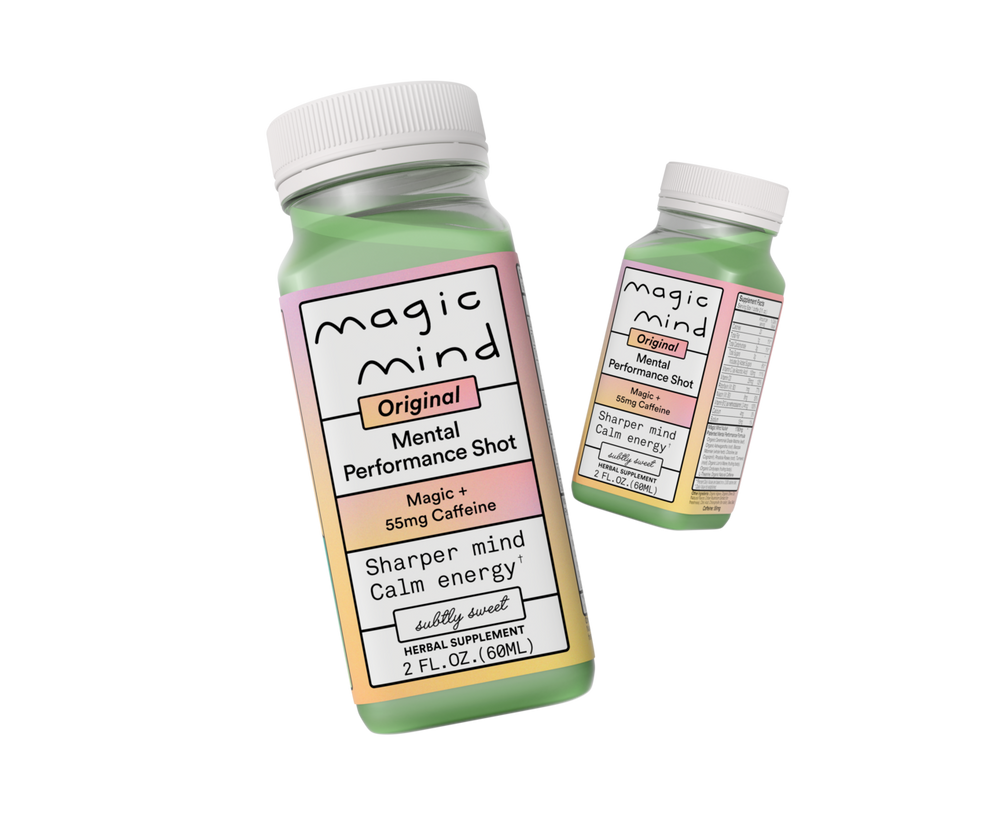
It is 6:50 a.m. in a kitchen in Austin, and a forearm reaches past the espresso machine. It picks up a two-ounce bottle instead. One swallow - tart, herbal, faintly of matcha - and the morning begins. No grinder, no crema, no ceremony. This is the moment Magic Mind has spent six years engineering: not the dramatic quitting of coffee, but the quiet substitution of it.
The bottle now sits on shelves at Whole Foods, Erewhon, Sprouts, Albertsons and Central Market, a few feet from the energy drinks it politely declines to resemble. Inside is a blend of roughly a dozen ingredients - lion's mane, bacopa, ashwagandha, L-theanine, rhodiola, ceremonial matcha, a short row of B vitamins - sold under a phrase the company more or less invented: the mental performance shot. The pitch is calm focus. The enemy is the 2 p.m. crash.
"We're not anti-coffee. We're not a coffee replacement. For most of our consumers, we just think too much caffeine is sub-optimal."
- Magic Mind co-founder, on the brand's actual quarrel
The problem they saw
Coffee is wonderful at 8 a.m. and a liability by 3
Caffeine is the most-used psychoactive substance on the planet, and it is very good at exactly one thing: borrowing energy from later and spending it now. The loan comes due. Jitters, the afternoon trough, the second cup to cover the first, the poor sleep that guarantees you will need a third tomorrow. Most people treat this cycle as weather - unpleasant, unavoidable, not really a product opportunity.
Magic Mind's founders disagreed. They suspected the real category was not "energy" but the thing energy is supposed to buy you: a clear, steady, un-panicked mind. That category had no flagship product. It had pills nobody finished, powders nobody trusted, and a vague sense that "nootropics" were either snake oil or Silicon Valley theatre. The gap was the whole business.
"The category wasn't energy. It was focus - and nobody had bottled it."
- The bet, restated plainly
The founders' bet
Sixty-seven no's, one commercial kitchen
The idea started for a familiar reason: one of the founders, James Beshara, needed to cut his own caffeine for health reasons and went looking for a substitute that didn't exist. Beshara was not a beverage guy. He had co-founded the crowdfunding startup Tilt and spent time at Airbnb - a software person, wandering into the unforgiving world of physical goods, shelf life and FDA labels.
With co-founder William Hicks, he rented a commercial kitchen in San Jose and started mixing by hand. The early formula went through dozens of iterations - enough of a dose to work, little enough caffeine to be the point, and somehow drinkable despite a cast of bitter mushrooms and roots. Investors were unconvinced: the company collected 67 rejections before its first term sheet. For the first two years it was, essentially, two people and a recipe.
"Sixty-seven rejections is a lot of dinners. It is also a fairly precise measure of how new an idea is."
- On the cost of being early
The product
One recipe, three answers to "how much caffeine?"
The formula is the argument. Lion's mane, bacopa and Cognizin for memory and acuity; ashwagandha, L-theanine and turmeric to take the edge off; rhodiola, cordyceps and ceremonial matcha for steady energy; B2, B3, B12, C and D3 for mood and immunity. Matcha and L-theanine are the trick - they smuggle in caffeine alongside a compound that smooths it out, which is why a Magic Mind morning is supposed to feel less like a jolt and more like a dimmer switch turned up.
Magic Mind's other claim is about delivery. It says a liquid format with nano-encapsulation makes its ingredients up to five times more absorbable than the pill versions sitting in your cabinet, half-finished. Whether you buy the multiplier or not, the strategic move is clever: sell caffeine as a dial, not a fixed dose.
OriginalThe daily driver
The full nootropic and adaptogen blend with a modest caffeine floor - the everyday version most subscribers settle on.
~55mg caffeine · about half a coffee
MAXXThe heavy day
Same blend, far more caffeine, for deadlines, early flights and the kind of focus you'd normally chase with espresso.
~165mg caffeine · ~2.5 espressos
FREEThe afternoon
The adaptogens and nootropics without the stimulant - focus support for people who've already had enough caffeine for one day.
0mg caffeine
"Sell caffeine as a dial, not a dose. That is the whole product, hiding inside three flavors of the same idea."
- Why three versions, not one
The proof
Customers, capital and a lot of shelf space
The early proof was a marketing machine. Magic Mind grew up inside the podcast era, reading ads to audiences who were already half-sold on the idea of optimizing their mornings, and converting them into subscribers. The base is broad: knowledge workers, students, athletes and the wellness-curious, plus an Instagram following near 279,000.
The later proof is harder-nosed. A $12.4M Series A in September 2025, led by BFG Partners with Rocana Venture Partners and others, sat on top of a reported ~$37M raised across rounds. Then came the part that actually tests a CPG brand: getting onto shelves where nobody knows your podcast. Whole Foods, Erewhon, Albertsons, Sprouts and Central Market all said yes.
Pick your dose
CAFFEINE PER 2OZ SHOT vs. COMMON REFERENCES (MG)
Approximate values; coffee figure is a typical 8oz reference. The point isn't the biggest bar - it's that you get to choose the bar.
"A podcast ad gets you a customer. A Whole Foods endcap gets you a category."
- On the difference between hype and distribution
- Coined and built the "mental performance shot" category from scratch in 2020.
- Bootstrapped as a two-person team through its first two years before raising.
- Closed a $12.4M Series A in September 2025 (BFG Partners, Rocana Venture Partners).
- Expanded into national retail across Whole Foods, Erewhon, Sprouts, Albertsons and Central Market.
- Grew a direct-to-consumer subscription base with an Instagram following near 279K.
The mission
A healthier relationship with caffeine, sold by the case
Strip away the mushrooms and the marketing and Magic Mind's mission is almost behavioral: change the default. Not to make you quit coffee - the company is oddly insistent that it likes coffee - but to give the over-caffeinated a credible off-ramp and the under-focused a daily ritual that doesn't punish them at 3 p.m. The longer game the brand talks about is cognitive health over years, not just the buzz of a single morning.
It is a tidy thesis with an obvious risk. "Nootropics" is a crowded, lightly regulated aisle full of bold claims and thin evidence, and Magic Mind competes with everyone from MUD\WTR to the humble 5-Hour Energy. Its bet is that taste, dosing control and brand trust beat a longer ingredient list. The skeptic's question - does it actually work, or does it just feel like it does? - is one every wellness brand eventually has to answer.
"The mission isn't a drink. It's a default - the thing your hand reaches for before your brain votes."
- The behavioral bet underneath the bottle
Why it matters tomorrow
Back to that kitchen in Austin
Return to 6:50 a.m. The espresso machine is still there - Magic Mind never asked anyone to throw it out. But the forearm reached past it, and that small, unremarkable choice is the entire company in miniature. Six years ago, that gesture didn't exist, because the product didn't, because the category didn't. Magic Mind made all three.
What happens next is a distribution story and a trust story at the same time. The shelves are won; the harder test is whether the second bottle gets bought, and the twelfth, by people who found it in a grocery aisle instead of a podcast feed. If "calm focus" turns out to be a habit and not a novelty, a two-ounce bottle will have quietly rewritten one of the most stubborn routines we have. If it doesn't, it will have been a very well-marketed shot of matcha. The forearm, every morning, gets to vote.
FILED UNDER: CONSUMER HEALTH · NOOTROPICS · D2C · FUNCTIONAL BEVERAGE