Dateline / Right Now
A laser, a satellite, and a stubborn old idea
Somewhere in a hangar near the San Francisco Bay, a small team is wiring up a satellite that is supposed to do something the textbooks have promised for half a century and never delivered: catch sunlight in space and send the electricity home. Not as data. As power. Real watts, on real ground, lighting a real load.
That is Aetherflux today - a 46-person company with a $50 million Series A, a launch slot, a Pentagon contract, and a deadline. The idea is space-based solar power. The twist is that they are trying to actually ship it, which historically is the part everyone skips.
A problem that matters, with a plan grounded in reality.
- Jan Hammer, Index Ventures, on why he led the round
The Problem They Saw
Energy is everywhere, except where you need it
Power is easy in a city and nearly impossible in a war zone, a mine, a research outpost, or a flooded town. The grid stops where the road stops. Beyond that line, the world runs on diesel hauled in by truck - expensive, flammable, and, on a forward operating base, a target.
Space has always been the obvious answer and the impossible one. Up there the sun shines around the clock with no clouds and no night. The catch was the delivery. For fifty years the standard blueprint was a kilometer-scale platform parked in geostationary orbit, beaming microwaves to a rectenna the size of a small county. Elegant on paper. Unbuildable in practice - and, more to the point, untestable.
That design is not one that you can iterate on.
- Baiju Bhatt, on the old geostationary microwave dream
And there is the whole problem in one sentence. You cannot debug a thing you can only afford to build once. The old vision wasn't wrong about physics. It was wrong about engineering culture.
The Founder's Bet
A fintech billionaire goes looking for a harder problem
Baiju Bhatt co-founded Robinhood and helped turn stock trading into something people did on their phones. In March 2024 he stepped away from the company. Most people in his position buy an island. He went looking for a physics problem instead - which, depending on your view of islands, is either admirable or slightly suspicious.
His bet was not on the idea of space solar, which is old, but on the form factor. Skip geostationary orbit. Go to low earth orbit with small, cheap satellites you can launch on a rideshare and replace when they fail. Swap the microwaves for infrared lasers, which focus to a tight spot you can aim at a receiver roughly ten meters across instead of a field measured in miles. Small enough to build. Small enough to break. Small enough, crucially, to build again next quarter.
The old way
One enormous satellite in geostationary orbit, microwaves, a receiver farm the size of a county. One shot, no iteration.
The Aetherflux way
A constellation of small LEO satellites, infrared lasers, a 10-meter ground spot. Launch cheap, learn fast, fly again.
He put roughly $10 million of his own money in first. The market followed: $50 million more in April 2025, led by Index Ventures and Interlagos, with Breakthrough Energy Ventures, Andreessen Horowitz, and NEA along for the ride. The cap table reads like a dinner party that should not work - Robinhood co-founder Vlad Tenev next to watchmaker Francois-Paul Journe next to the actor Jared Leto. Total raised: about $60 million.
The Product
What Mission 1 actually has to prove
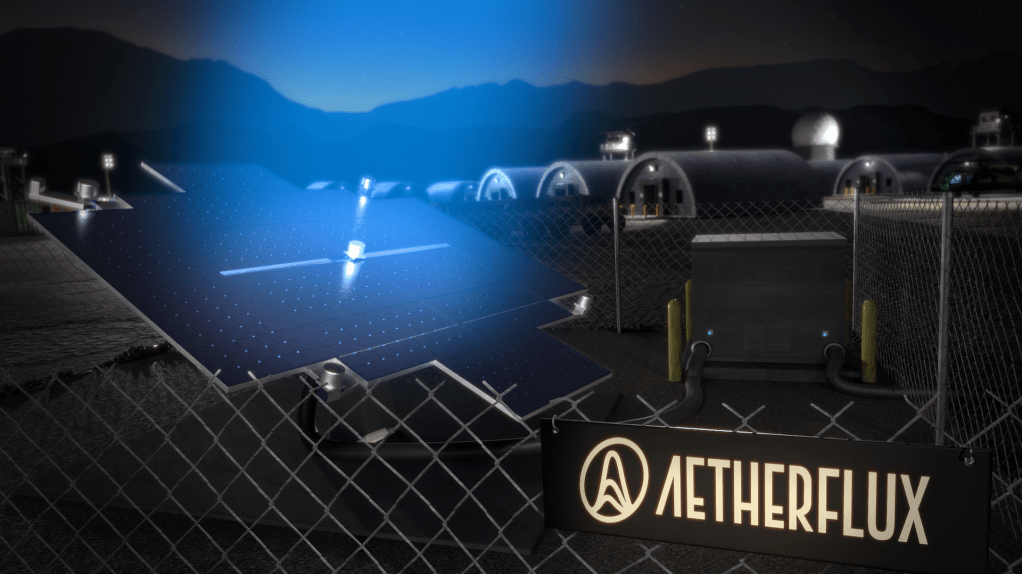
The plan is almost rude in its simplicity. A satellite unfolds its solar panels and soaks up sunlight. Onboard, that power is converted into an infrared laser. The laser points down and tracks a fixed spot on Earth - about ten meters across at first, with the goal of shrinking it. A ground station full of photovoltaic cells catches the beam and turns it back into ordinary electricity.
For Mission 1, the bar is roughly one kilowatt delivered to the ground - enough to, in Bhatt's words, light up an installation or run some electronics. Modest in scale, enormous in meaning: nobody has cleanly closed that loop from orbit to a working load. The first receiver is going up at a military site with controlled airspace, because aiming a kilowatt laser from space is not a thing you test over a public park.
Demonstrate that we actually have electricity on the ground - and use it to light up a light installation or do some electronic stuff.
- Baiju Bhatt, on the goal of Mission 1
The satellite
Built on Apex Space's Aries bus - Bhatt is an investor in Apex - so the team can buy the spacecraft and focus on the hard part: the beam.
The ride
A SpaceX Transporter rideshare slot, the budget-airline of orbit. Cheap access is the whole reason small-satellite space solar is even worth attempting.
The Proof
Defense first, because diesel is a liability
Grand energy missions usually die waiting for a customer. Aetherflux picked the one customer that already pays a brutal premium for power in hard places: the military. A forward operating base runs on fuel convoys, and a fuel convoy is a slow, flammable target. Electricity arriving from the sky, with nothing to ambush on the road, is not a slide in a pitch deck for them - it is an operational problem they would pay to delete.
That logic is why the Department of Defense, through its Operational Energy Capability Improvement Fund, backed Aetherflux's proof of concept for transmitting power from low earth orbit. Non-dilutive money and a credible first market in the same handshake. Beyond the base, the same pitch extends to remote research stations, mining sites, and disaster zones - anywhere the grid quit and the diesel got expensive.
The places that need power most are exactly the places a power line will never reach.
- The Aetherflux thesis, in one line
The Mission
Make energy a thing you can aim
Strip away the satellites and the lasers and the mission is plain: put electricity wherever it is needed, sourced from the one place the sun never clocks out. If it works at scale, power stops being something you wire and starts being something you point - a beam you can redirect to a base, a flood, a field, a frontier.
That is a long way off, and Aetherflux is honest enough to be chasing a kilowatt before a gigawatt. But the difference between this attempt and the last fifty years of space-solar PowerPoints is that this one has a launch date, a payload, and a customer who is not pretending to be interested.
Why It Matters Tomorrow
Back to the ground station
Return to that receiver in the desert, sitting under controlled airspace, waiting. Right now it is a render and a promise - a patch of photovoltaic cells pointed hopefully at nothing. The whole company is a bet on the day a beam fired from low orbit lands on it and the lights come on.
If that day arrives, the field of dishes the size of a county becomes a relic, and the question shifts from "can we beam power from space" to "where do we point it next." That is a smaller, more buildable, far more dangerous-to-incumbents idea than the one the textbooks drew. Aetherflux is not promising the gigawatt future. It is promising to close the loop once, cleanly, and let the iteration begin. For a problem fifty years deep, once would be a lot.