chatbots
(32)
Botika Built a Business on the Questions That Wouldn’t Go Away
An Indonesian travel business made booking easier, but customers kept asking for a human. Botika turned those persistent conversations into software for shipping companies, public services and railway stations.

Jelou Wants to Run a Bank Inside Your WhatsApp Chat
In Latin America, hundreds of millions of people run their lives inside a chat window. A Guayaquil-born startup just raised $10 million to make that window verify identity, sign contracts, and approve loans - without anyone leaving the conversation.

The Quiet Company Teaching Retailers to Answer 50% of Their Customers With a Bot
Leon Chaddock spent 15 years watching contact centers drown in tweets, DMs and chat windows. Sentiment is his answer - one inbox, a low-code bot builder, and a bet that AI can handle half the queue without anyone noticing.

The Chatbot Company That Bet Against the Chatbot Hype
Inbenta spent nearly two decades teaching machines to actually understand a sentence. When the generative-AI gold rush arrived, that patience turned out to be the moat.

Quiq
The Bozeman company that started with text messages now runs AI agents in production for 150-plus global brands - on a platform built so the enterprise, not the algorithm, stays in charge.

Quality Unit
Developing B2B Cloud Applications since 2004.

Voice AI Agents Are Eating the Chatbot Business Alive
In 2026 the tidy world of customer-service chatbots split in two. On one side, legacy vendors like LivePerson and Verloop.io are being sold for parts; on the other, voice-native upstarts like Retell AI and deep-pocketed enterprise players like Kore.ai race to answer your next call in under a second.

AI Customer Service Agents Are Closing Tickets Without You
Intercom's Fin, Ada, Forethought, Gupshup, Five9 and Amazon are racing to build support agents that resolve tickets on their own. As the platforms buy up the startups, here is who does what - and where the real money is going.

How boost.ai Turned Norwegian Banking Chat Into a Global AI Play
A conversational AI company from Stavanger now runs 600+ live virtual agents across 450+ organizations - and it is competing for enterprise deals against Uniphore, Intercom and Five9.

Jio Haptik Bet That Cheap AI Beats Clever AI
The Mumbai-born conversational AI platform Reliance bought for $100 million now sells enterprise-grade AI agents to corner shops for 10,000 rupees. Here is how a decade-old chatbot company reinvented itself for the agentic era.

Verloop Spent a Decade on the Chat Window. Nurix Just Bought It
The Bengaluru company built its business on automating customer support one message at a time, handling more than 20 million conversations a month. In July 2026, Mukesh Bansal's Nurix AI bought it - just as the category it helped pioneer turned into a multi-billion-dollar race.

How boost.ai Taught Norwegian Banks to Answer Their Own Phones
A team of coders in Stavanger built conversational AI for the industries that fire you for getting it wrong. Ten years on, 600-plus AI agents handle 150 million conversations a year for banks, insurers and governments.
Verloop.io Turned 100 Chat Agents Into a Bot, Then Sold the Bot
The Bengaluru company spent ten years automating the parts of customer support nobody wanted to do by hand. In July 2026, Mukesh Bansal's Nurix AI bought the whole thing.
Gupshup and Yellow.ai Race to Turn India's Chatbots Into Agents
Two of India's best-known conversational AI companies are chasing the same prize from different corners - one built on high-volume messaging, the other on enterprise voice. The gap between a bot that answers and an agent that acts is where the fight is now.

Retell AI and boost.ai Are Rewiring the Customer Call
Two companies - one a Norwegian chatbot pioneer, the other a Y Combinator voice startup - are pulling conversational AI in opposite directions. Whoever wins gets to decide how you talk to every business you deal with.

Live Chat Software Grew Up and Learned to Sell
Eight companies - from a free widget called tawk.to to Salesforce's new AI seller Piper - are fighting over the little box in the corner of your screen. The chat bubble stopped answering questions and started closing deals.

LivePerson
Three decades after it put a live human behind the website chat window, LivePerson is betting the whole company on AI agents that talk back.
Infobip
How a self-funded SMS gateway from a Croatian fishing town became the plumbing behind hundreds of billions of texts, WhatsApp messages and login codes.
Gupshup
It spent nearly two decades sending text messages nobody thought about. Now Gupshup wants those same pipes to carry AI agents that sell, support and close - one conversation at a time.

Gist
A better customer experience across support, marketing, and sales.
DRUID AI
The Bucharest company teaching enterprise software to hold a conversation - and now to run the workflow behind it.
boost.ai
It's not about what AI can do. It's about what you can rely on AI to do.

100% of Agents Use AI Every Day. Zero Think It's Essential.
UJET's Agent Survey Report, 'The Agent and AI Disconnect,' surveyed 250 U.S. frontline contact center agents at mid-market and enterprise companies to compare AI hype with the daily reality on the call center floor. The findings reveal a striking paradox: while 100% of agents use AI every single day, 78% say those tools are not transformative, 93% are confident they could do their jobs without them, and not a single agent considers AI critical to their success. The report argues that immature, bolt-on AI — especially chatbots layered onto legacy systems — is deflecting customers rather than helping them, leaving agents to clean up failed bot interactions. It closes with a seven-pillar blueprint for turning AI from a liability into a genuine agent co-pilot.
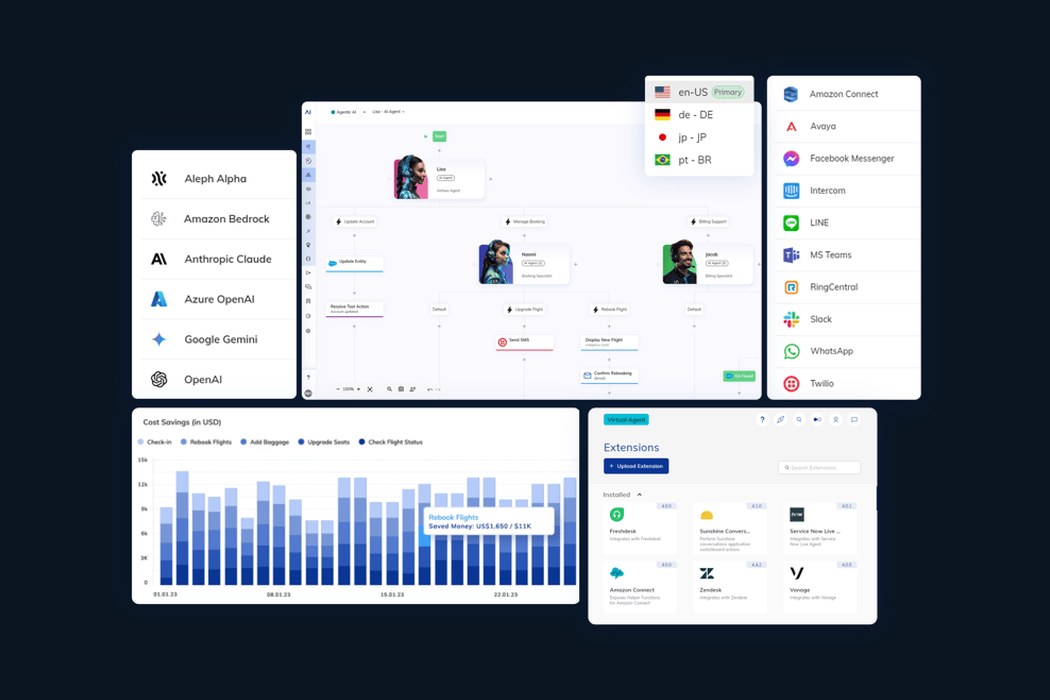
Cognigy
Cognigy is a German enterprise software company that builds conversational and agentic AI agents for customer service. Its Cognigy.AI platform lets large brands automate voice and chat interactions across contact centers, deploying AI agents that resolve customer requests and assist human agents. Founded in Dusseldorf in 2016, it grew into a Gartner-recognized leader before NICE acquired it for roughly $955 million in 2025.

Prosa.ai
Prosa.ai is an Indonesian deep-tech company that builds natural language processing and speech technology for Bahasa Indonesia. Founded in 2018 by ITB academics and an industry veteran, it develops NLP APIs, speech-to-text and text-to-speech engines, voice biometrics, chatbots and analytics that let banks, insurers, government agencies and enterprises understand and act on Indonesian-language text and voice data - a market largely underserved by global AI providers.
UneeQ
UneeQ builds AI-powered digital humans - lifelike, real-time animated avatars that give chatbots and enterprise AI a human face, voice and body language. Founded in New Zealand in 2009 as FaceMe and now headquartered in Austin, Texas, the company pairs its Synanim synthetic-animation engine and Synapse AI-orchestration brain to deploy digital humans for customer experience, brand engagement and immersive employee training across banking, airlines, telecom, retail, healthcare and government.
Genesys
Genesys is a global customer experience and contact center software company that helps more than 8,000 organizations across 100+ countries orchestrate personalized, AI-powered interactions across voice and digital channels. Its flagship Genesys Cloud CX platform combines omnichannel routing, self-service, conversational and agentic AI, and workforce engagement management into a single cloud service. Founded in 1990 as a computer-telephony integration startup, Genesys today operates an 'Experience Orchestration' model with roughly $2.4 billion in annual revenue and Genesys Cloud ARR approaching $2.2 billion.

Telerivet
Telerivet is a cloud communications platform that lets organizations send, automate, and orchestrate messages across SMS, WhatsApp, Voice, USSD, Viber and more - in any market, including the places bigger providers ignore. Born from a Peace Corps insight in Tanzania that most people have a phone but not the internet, it now powers enterprises, governments, NGOs and universities across 150+ countries with a drag-and-drop rules engine, APIs, and a phone-as-gateway model that reaches customers where the network is thin.

Kaon (prev. FlowGPT)
Kaon (formerly FlowGPT) is a San Francisco AI-native content lab building consumer AI experiences. After scaling FlowGPT into a 4M+ monthly user prompt marketplace, the team shifted gravity to Emochi - an AI character roleplay app that has climbed into the top tier of consumer AI with millions of monthly users. Founded in 2023 by UC Berkeley dropout Jay Dang and co-founder Lifan Wang, the company raised $10M led by Goodwater Capital and DCM in early 2024 and added a strategic round backed by B Capital and Redpoint in 2025.

Raghu Ravinutala
Raghu Ravinutala is the co-founder and CEO of Yellow.ai, an enterprise-grade conversational AI platform that automates customer and employee experiences at scale. A former IC design engineer turned AI entrepreneur, he built Yellow.ai into a $500M-valued company serving 1,300+ enterprises across 85+ countries, with $79.5M in annual revenue and over $102M raised. Under his leadership, Yellow.ai developed proprietary LLM technology and a multi-LLM architecture trained on 16 billion conversations annually, processing support in 135+ languages across 35+ channels.