Ask most enterprise software a question and, at best, you get a link to the answer. Ask a DRUID agent, and it books the vacation, files the ticket, or processes the claim - then tells you it is done. That gap, between answering and finishing, is the whole business. DRUID AI, founded in Bucharest in 2018, spent seven years building software that treats a conversation not as the destination but as the front door to a completed task.
The company sits in a crowded, noisy corner of technology - conversational AI, now rebranded across the industry as "agentic AI" - and has grown by ignoring most of the noise. It does not sell a chatbot. It sells an enterprise platform for building, deploying and coordinating AI agents that plug into the systems a company already runs: HR, IT, finance, insurance claims, retail support. The agents talk in plain language, pull from a company's own knowledge, and act.
01 / What it doesFrom FAQ to co-worker
The core product is an AI agent builder that does not require a data-science team to operate. Business users design agents through a visual, largely no-code environment, connect them to back-end systems, and ground them in the organization's documents and rules. Customer-facing agents handle support 24/7 across web, messaging and voice. Internal agents take on the errands that clog a service desk - a vacation request here, a password reset there, an expense query, an onboarding checklist.
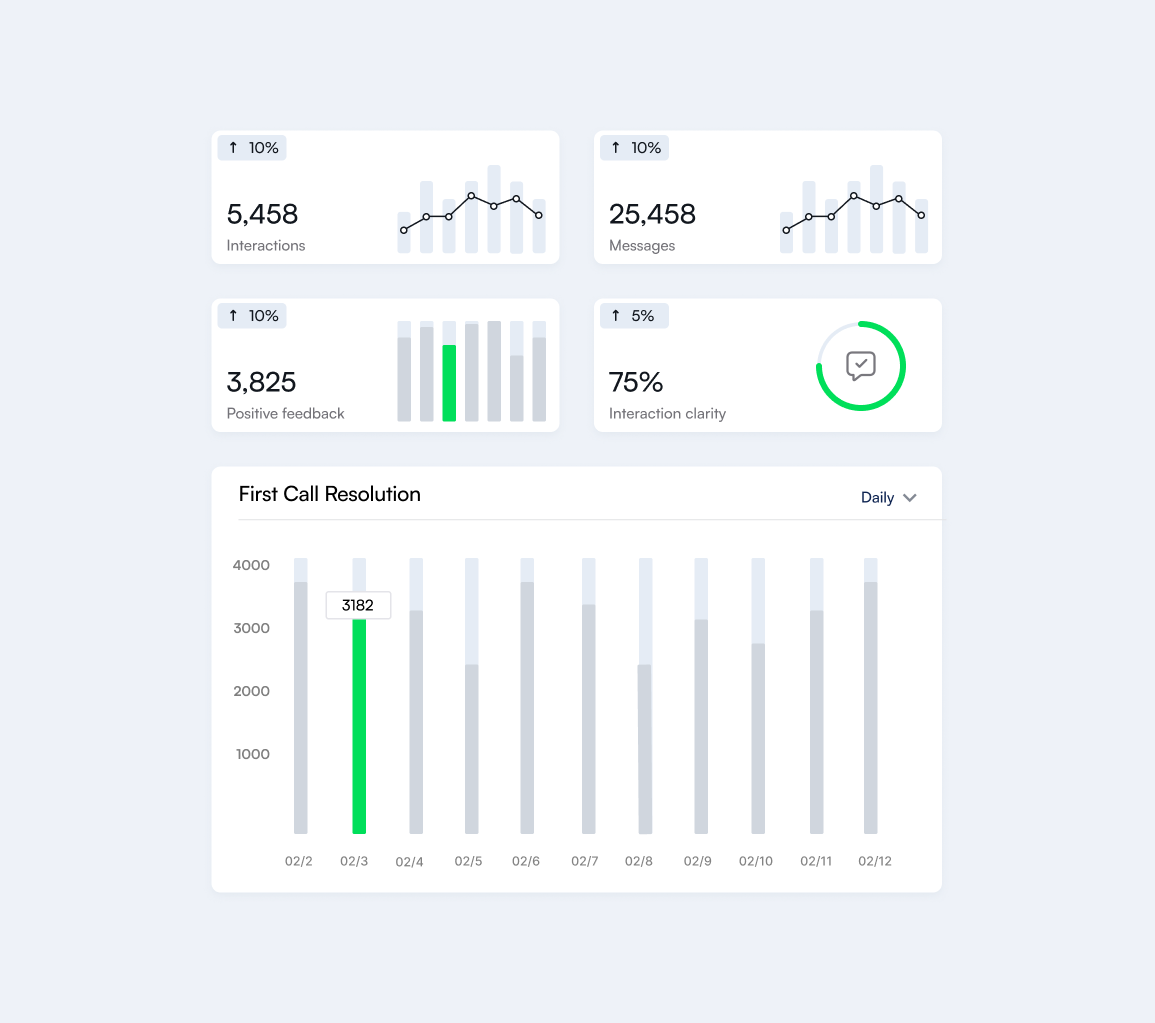
The pitch is unglamorous on purpose. DRUID's customers report automating up to 80% of specific business functions and lifting customer satisfaction by roughly 30%. The number the company repeats most is 98% first-response accuracy, because in an enterprise that figure is the line between trusting an agent with a real customer and keeping a human in the loop for everything.
02 / The wedgeAn AI to manage the other AIs
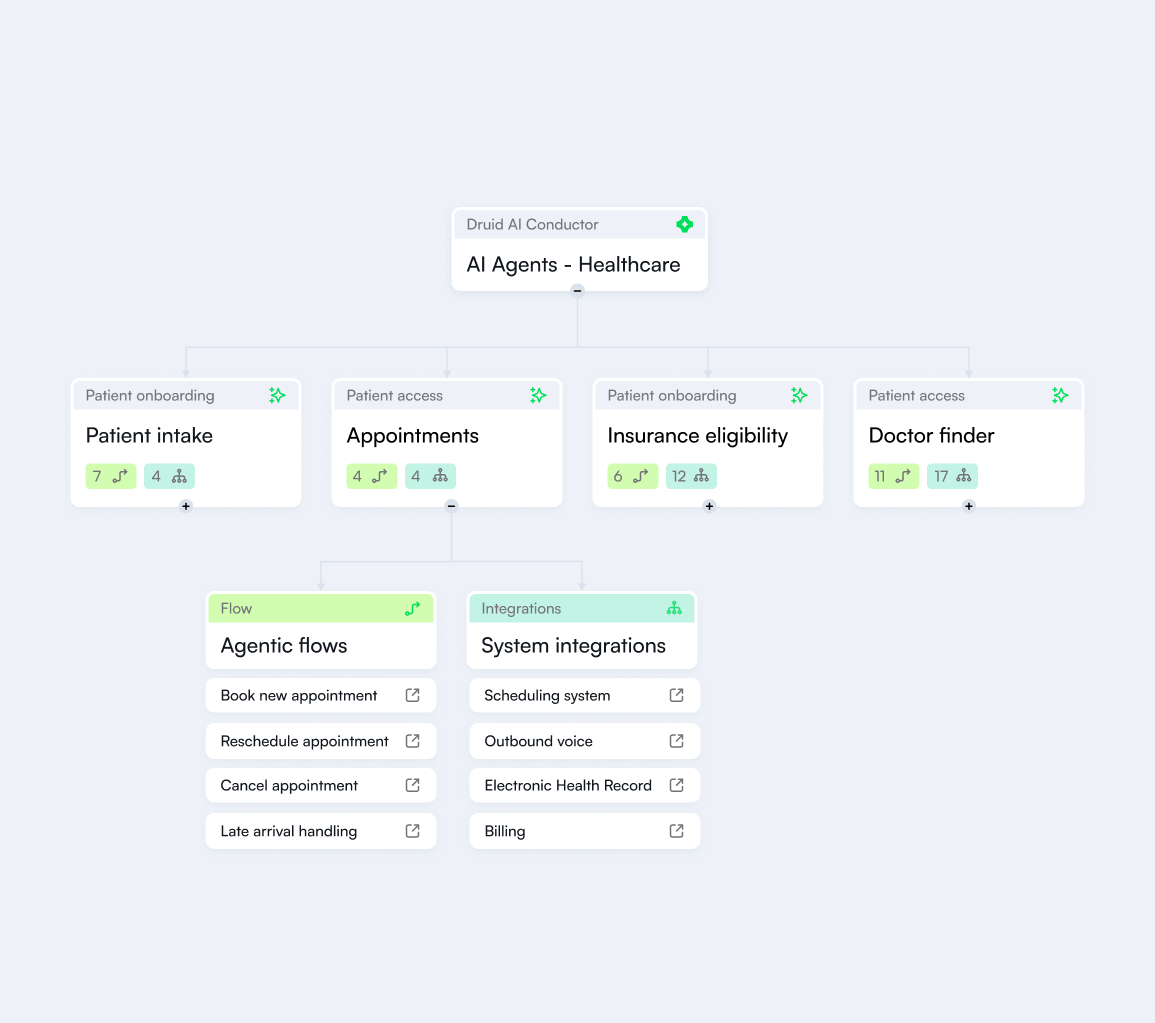
The bet that separates DRUID from the pack arrived in late 2024 with a product called DRUID Conductor. As enterprises pile up agents - one from a helpdesk vendor, one from a CRM, one built in-house - somebody has to keep them from tripping over each other. Conductor is DRUID's answer: an orchestration engine that unifies and coordinates every agent an employee touches, regardless of which system created it. It ships pre-loaded with best-practice processes, specialized skills and enterprise-specific knowledge, so a team can stand up a new autonomous agent quickly instead of starting from a blank page.
"Conductor unifies and orchestrates all the different agents an employee interacts with, regardless of which system creates or operates the agent." DRUID AI, on the Conductor launch
It is a subtle repositioning. The market spent two years selling individual agents; DRUID started selling the layer that conducts them, like a section leader keeping an orchestra in time. For a large company drowning in half-finished AI pilots, "the thing that makes your agents work together" is an easier purchase to justify than the tenth standalone bot.
03 / Who buys itAXA to the FDA
DRUID's client roster reads like a cross-section of the regulated economy. More than 300 enterprises run its agents across banking and financial services, insurance, healthcare, government, higher education, manufacturing, retail and telecom. Named customers include AXA, Carrefour, the U.S. Food and Drug Administration, the NHS, Orange, Liberty Global, Auchan, Kmart Australia, Georgia Southern University and MatrixCare.
The spread matters. Insurance and healthcare are exactly the industries where a wrong answer is expensive and a human hand-off is mandatory, which is why the accuracy numbers and the governance and analytics tooling are not marketing garnish - they are the reason a compliance officer signs off.
04 / The mapWhere it sits in the market
DRUID competes with Kore.ai, Cognigy, Amelia, Ada, Boost.ai and Yellow.ai, and increasingly against the platform giants - Microsoft's Copilot Studio and Google's Dialogflow - that would like conversational AI to be a feature of their clouds rather than a separate purchase. In 2025, Gartner named DRUID a Challenger in its Magic Quadrant for conversational AI platforms, a useful piece of third-party validation for a company selling to buyers who read those charts closely.
Its differentiation is less about a single feature and more about posture: agents grounded in enterprise knowledge, an orchestration layer on top, a heavy partner channel to handle implementation, and a stubborn focus on completing tasks rather than staging demos. It is also, quietly, a geography play. Romania produced UiPath, one of Europe's largest software exits, and the same deep bench of enterprise engineers now feeds DRUID. The two even integrate, letting a DRUID conversation trigger a UiPath robot in the back office.
The market spent two years selling bots. DRUID started selling the conductor.
05 / The moneyThree rounds and a $300M mark
DRUID has raised north of $100 million since 2018. A roughly €14M Series A in 2022 funded the international push; a €27.55M Series B in 2023, led by TQ Ventures, poured fuel on it. In September 2025 the company closed a $31M Series C led by Cipio Partners, with TQ Ventures, Karma Ventures, Smedvig and Hoxton Ventures returning - reportedly valuing DRUID at around $300 million. In 2024, its annual recurring revenue grew 2.7 times year over year.
Funding rounds — approximate, USD
The Series C came bundled with a leadership change. DRUID hired Joseph Kim, formerly chief executive of Sumo Logic - which he scaled past $300M in revenue before its take-private by Francisco Partners - to run the company and lead its push into the United States. Co-founder Andreea Plesea, who had served as interim CEO, moved to chief operating officer.
06 / The foundersA transition, handled in public
DRUID was started by Liviu Dragan alongside co-founders Andreea Plesea, Daniel Balaceanu, Bogdan Pietroiu and Bogdan Grigorescu. Dragan, a veteran of Romania's enterprise-software industry, was the company's public face and its CEO. He died in 2025, and the company said so plainly, then kept building - a co-founder stepping in as interim chief, an outside CEO recruited, a funding round closed. Growing a company through a founder's loss is rarely part of the pitch deck; DRUID's 2025 was defined by it.
"Customer success is what it's all about - introducing innovations that help customers address complex challenges." Joseph Kim, CEO
07 / Under the hoodWhere the expertise actually lives
DRUID's edge is less a single algorithm than an accumulation of enterprise plumbing. The platform leans on large language models for the conversation and reasoning, but the parts customers pay for are the unsexy ones: connectors into core systems, a knowledge layer that keeps agents anchored to trusted sources instead of improvising, role-based governance, and analytics detailed enough to audit. The company built its stack in the years before "agentic AI" was a category, which means the retrieval, security and integration scaffolding predates the current hype cycle rather than being bolted onto it.
That heritage shows up in the voice product too. In 2024 DRUID rolled out voice agents that handle spoken interactions in natural language, aimed squarely at the call-heavy operations - banks, insurers, utilities - where a two-minute phone tree is the customer's least favorite part of the day. The design principle is consistent across text and voice: understand the request, ground the answer, then complete the action inside the systems of record.
08 / The modelLand, expand, and let partners carry it
The business is straightforward B2B SaaS: subscription licensing that typically starts in one department - a contact center, an HR team - and spreads across the enterprise as the agents prove out. What makes it scale beyond a Bucharest headcount is the 200-plus partner ecosystem of system integrators and technology vendors who implement and resell DRUID, letting a mid-sized company punch into markets far larger than its own sales team could reach. That channel is doing double duty now: it is both a distribution engine and a training ground, because every deployment feeds back templates and industry-specific processes that make the next one faster to stand up. With an American CEO now in the chair, the next chapter is obvious: turn a European enterprise darling into a global one.
For all the industry's talk of autonomous everything, DRUID's story is grounded in something older and duller than the hype - the enterprise's endless appetite for getting routine work off human desks. It just happens to be one of the more credible companies betting that the interface for that work is a conversation, and the payoff is a task that finishes itself.