data-enrichment
(63)
Liran Kotzer and the people hiding in plain sight
After running a recruitment agency, Liran Kotzer came away with an expensive lesson: knowing people and keeping track of them are different jobs. At Woo, he has spent years trying to close that gap.
LakeB2B and the trouble with a name
A contact list can tell you who someone was. LakeB2B is building a business around the harder question: who should you talk to now?

aMarketForce and the art of finding the right person
Before a sales pitch can work, someone has to find the person worth pitching. aMarketForce has built a business around that deceptively difficult assignment.

Wiland follows the money. Then finds the audience.
A purchase tells a story that a demographic cannot. Wiland turns those stories into marketing audiences, donor prospects, and a sharper view of who might buy next.

SalesIntel.io puts humans behind the signal.
AI can find a buying signal. Someone still has to check the phone number. SalesIntel’s bet is that reliable data and faster follow-through belong in the same product.

Selling Simplified learned to read the room
A contact list tells you who someone is. Selling Simplified built its business around a harder question: when might they actually want to buy?

Span Global Services sells the missing context
A name gets you an inbox. Knowing what a company runs, buys, and needs gets you a reason to be there. Span Global Services sells the difference.
Manlitics and the art of the qualified yes
A name in a database is easy. A buyer ready to talk is harder. Manlitics puts people, data and persistent follow-up into the gap.

Introhive knows who you know
Your next client may already know someone at your firm. Introhive turns scattered emails, meetings, and contact records into a map of those relationships - and now puts that map within reach of AI.
Mad Street Den found the mess behind the dress
An AI company learned to read clothes, then discovered a larger business in reading the disorder behind them. Its journey from retail catalogues to enterprise automation now runs through M2P Fintech.

Sourcescrub finds the companies that haven’t made the headlines
A trade-show list can reveal what a funding announcement cannot. Sourcescrub built a business around that small observation - and brought human research into the machinery of deal sourcing.

The Intelligence Behind the Intelligent Agent
Explorium spent its first act helping predictive models see beyond a company’s own database. Now it supplies the outside facts that sales agents need before they can decide whom to contact - and why.

The Sales Stack Ate Itself. Sprouts.ai Wants the Crumbs.
B2B teams bought a tool for every leak in the funnel. Sprouts.ai is betting that the real fix is one clean data layer - and a set of agents willing to do the plumbing.

InFynd Wants to Fix the List Before You Make the Pitch
The British data company is stretching beyond contact lists into healthcare intelligence, managed outreach and AI agents. Its most persuasive pitch starts with a less glamorous job: cleaning up the CRM.

Cognism Puts Europe on Speed Dial
Cognism sells something every outbound team wants and nobody can fully guarantee: a clean route to the right buyer. Its sharpest argument is not database size, but Europe-ready phone data with compliance checks baked into the workflow.
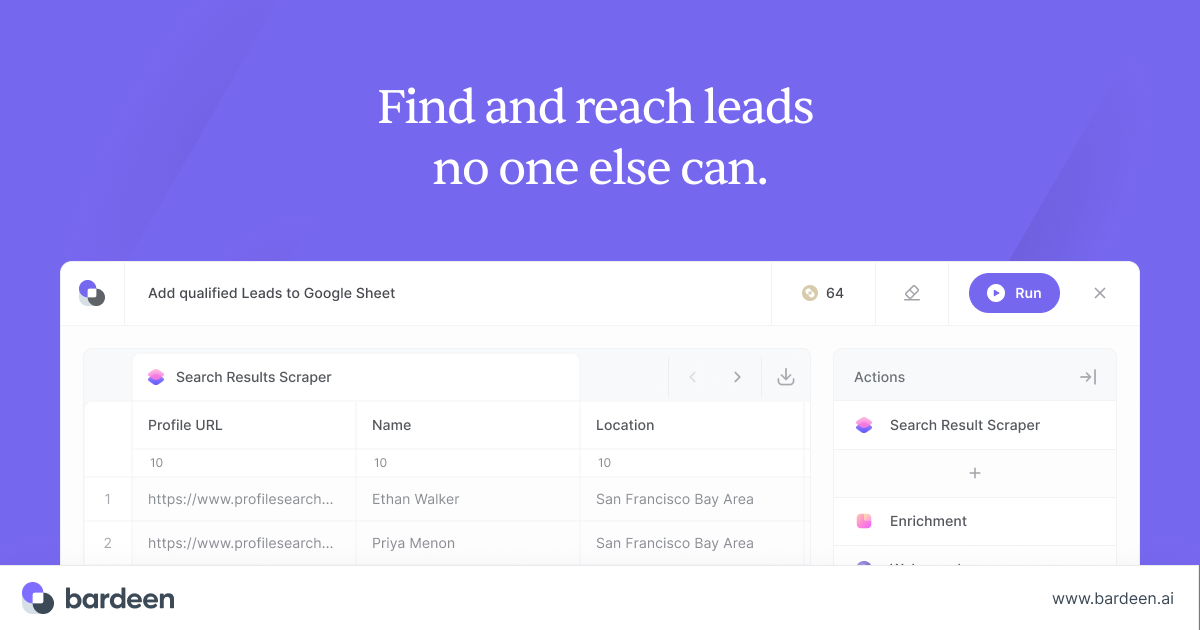
Bardeen Put a Sales Robot in Your Browser
Bardeen can turn a messy hunt across tabs into a tidy lead list. The clever bit is where it works - inside the browser - and that is also where buyers should look closely before handing over the keys.

Kaspr Puts the Phone Book Inside LinkedIn
Kaspr turns a LinkedIn profile into a phone number, an email and a next step. For small sales and recruiting teams, the trick is wonderfully direct - until the credit maths joins the call.

Melissa Spent 40 Years Fixing the Customer Data Everyone Else Ignores
The California company started by mailing ZIP-code databases on floppy disks. Four decades later, its pitch is still disarmingly practical: stop a bad address, dead email or duplicate customer before the mistake gets expensive.

Golden Tried to Map Everything. Its $59.5 Million Lesson for AI Builders Was Knowing What Mattered.
Golden wanted to organize the facts Wikipedia missed. Seven years and $59.5 million later, its broad knowledge graph found a pointed job inside financial-crime intelligence - a useful lesson in turning ambitious AI infrastructure into something customers will buy.

The Company That Turned "Prove It" Into a Business
For 20 years, ActiveProspect has sold one unglamorous promise to marketers: keep the receipt. In a regulatory minefield where a single unwanted robocall can cost $500 to $1,500, that receipt is the whole business.

Clay Versus Lusha Is the Wrong Question
Clay can call Lusha for contact data, then route, score and act on the result. The useful choice is not which brand wins, but which layer your team actually needs.

Clay Is Becoming ZoomInfo’s New Front Door
Clay has not made ZoomInfo irrelevant. It has changed where revenue teams decide how, when and whether ZoomInfo data gets used.

The Company Mapping the Invisible Software Inside 40 Million Businesses
HG Insights built its business by reading the digital exhaust of corporate technology. Now it wants to turn that sprawling evidence - from software installs to buyer research - into an operating system for B2B growth.

DemandScience
The Boston company turns 247 million professional profiles and a web of intent signals into something B2B marketers pay for by the qualified lead - and largely pay only when the lead fits the spec.
Precisely
The 1968 mainframe sorting company you have never heard of quietly became the plumbing behind 95 of the Fortune 100's data - and it is now betting the house on making that data safe for AI agents to act on.

Abhilash Chowdhary
Abhilash Chowdhary is the co-founder and CEO of Crustdata (YC F24), a San Francisco company building real-time B2B data and a search layer for AI agents. A computer science graduate of IIIT Hyderabad, he spent over a decade as a robotics and data engineer at Yahoo, Adobe, Postmates X, and Serve Robotics before turning a bootstrapped side project into a company that raised a $6M seed round led by Y Combinator and A Capital.
Crustdata
Crustdata is a San Francisco company that supplies real-time company and people data through clean APIs and webhooks built for AI agents. Founded in 2024 and part of Y Combinator's Fall 2024 batch, it pulls live data from many primary sources so AI SDRs, recruiting tools, and investment platforms can find the right person, watch for job changes and funding rounds, and act on fresh signals instead of stale databases.

FuseAI (YC W25)
FuseAI (operating as Fuse, tryfuse.ai) is a San Francisco-based, Y Combinator W25 startup building an AI-native sales platform for outbound revenue teams. It consolidates the fragmented GTM stack - contact data, waterfall enrichment, email and LinkedIn automation, deliverability infrastructure, a parallel dialer, and real-time buying signals - into one system where AI agents execute sales workflows from natural-language prompts. Founded in 2024 by CEO Saurav Bubber (former Deel GTM operator) and CTO Imogen Low (ex-SAP, co-founder of NWO.ai), Fuse aims to let one rep do the work of five.

Leadbay
Leadbay is a Y Combinator (F25) B2B sales startup building a domain-specific AI model that discovers and qualifies small-to-mid-sized business leads that traditional platforms like LinkedIn, ZoomInfo, Apollo, and Clay can't find. Trained on market data, a company's own CRM/ERP history, and reps' instincts, Leadbay learns a team's Ideal Customer Profile and predicts who will buy next - delivering qualified leads directly inside agentic workflows and AI apps like Claude, ChatGPT, and Copilot. Customers in data-scarce industries such as construction, hospitality, manufacturing, and B2B services report roughly 3-5x more qualified prospects. The company raised a $4.3M seed round led by Y Combinator in May 2026 and is based in San Francisco.

Reprompt
Reprompt builds AI agents for location data. Mapping companies like Foursquare, TomTom, and Radar use its agents to keep points-of-interest and business records current - verifying hours, status, ownership, and dozens of other attributes by cross-referencing web, social, government, and news sources. Founded in 2024 by ex-Mapbox and ex-Robinhood operators, the company turns work that once took weeks of manual research into runs that finish in under an hour.