He built a platform that predicts your business future - 60 to 90 days out. Now the Golden State Warriors, UTA, and the PGA trust that prediction engine before making their next move.
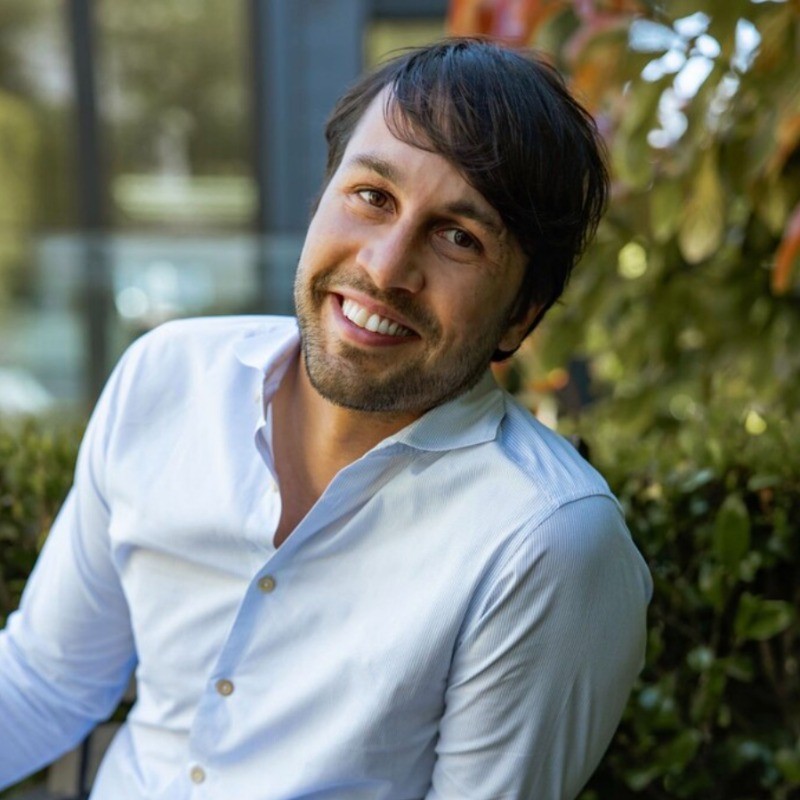
Jon Carr-Harris finished high school a year early. Spent twelve months volunteering internationally. Enrolled at McGill, started a company during his second year, and then - while most founders are still figuring out their first product - went on to build a consulting empire that would eventually stretch across 30 countries. Somewhere in there, he also worked on the Obama campaign, tried to bring Khan Academy to Canada, and joined the founding team of a DeFi protocol that became a pillar of decentralized finance.
All of that before CRED. The company he started in 2023, operated in total stealth for two years, and quietly signed 25 enterprise clients - including the Golden State Warriors, United Talent Agency, and the PGA - before the world knew it existed.
CRED launched publicly on June 30, 2025, the same day it announced a $15M seed round led by defy.vc. The pitch is both audacious and specific: CRED is the intelligence layer that tells you what is going to happen to your business before it happens. Not a dashboard. Not a report. An answer, with a prediction horizon of 60 to 90 days and a claimed accuracy rate of 92%.
"We're in the age of AI where contextual data can now lead to profound business outcomes. Just like in science fiction, we can finally start to predict the future." - Jon Carr-Harris, Founder & CEO, CRED
The technical architecture is built on data unification - pulling from 200+ native integrations (CRM, HRIS, marketing, finance, email) and layering on an external signal layer drawn from 10,000+ sources: funding activity, hiring patterns, digital ad spend, executive movement. Synthetic data modeling fills the gaps that real data can't cover. The result, per Carr-Harris, is organizational memory that doesn't evaporate when employees leave.
Before CRED, there was Swish Labs - the distributed tech consulting and venture ecosystem he founded in 2013, scaled globally, and exited circa 2019. There was Lovely Inc., the ML-powered real estate app where he served as Senior Product Manager and watched the company get acquired. There was CFPF, the talent investment fund he ran until it was acquired by Arcadia. And there was his angel investing work - quiet, consistent, attached to names like Airbnb and Kik back when those bets still required conviction rather than hindsight.
The pattern that runs through all of it: Jon Carr-Harris doesn't optimize for speed. He optimizes for signal. Two years of stealth at CRED wasn't secrecy for its own sake - it was proof-gathering. Twenty-five enterprise clients, $100M+ in documented revenue impact, $20M+ in cost savings, and 10,000+ hours of monthly manual data entry eliminated. He showed up to the public launch not with a pitch but with evidence.
CRED doesn't just analyze what happened. It tells you what will happen - and when to act.
200+ native integrations spanning CRM, HRIS, marketing, finance, and email - combined with a proprietary external database of 200M+ companies and 900M+ contacts across 10,000+ sources.
AI models deliver scoring on customer fit, churn propensity, upsell likelihood, and intent signals - with a 60-90 day prediction horizon and 92% claimed accuracy. Synthetic modeling fills data gaps.
Real-time alerts and AI agents that take action inside existing enterprise tools. No new dashboards to check. The intelligence surfaces where work already happens.
Funding activity, hiring trends, digital ad spend, executive movement - external signals decoded and cross-referenced against internal data to surface revenue opportunities before they're obvious.
When employees leave, they take knowledge with them. CRED creates persistent intelligence structures so that institutional know-how doesn't walk out the door.
Synthetic data modeling identifies lookalike accounts - finding your next best customer by mapping the pattern of your best current ones against 200M+ companies in the external database.
Two years is a long time to keep a secret. Most startups announce seed funding before product-market fit. CRED did the opposite: it went quiet in 2023, signed enterprise contracts, measured impact, and only surfaced when the numbers were ready to do the talking. By launch day - June 30, 2025 - CRED wasn't pitching potential. It was presenting receipts.
The choice wasn't timidity. Carr-Harris had been through enough product cycles - at Lovely, at Swish, at CFPF - to know that early noise often substitutes for real signal. The clients he wanted (C-suite buyers at technology companies, financial services firms, sports organizations) make decisions on evidence, not momentum. So he built the evidence first.
Swish Labs was the proving ground. Founded in 2013, it grew into a global distributed tech consulting and venture ecosystem operating across 30+ countries - an unusual structure for an early-2010s startup, built on remote collaboration before remote work was a mainstream idea. Clients included Fortune 500 names: Prudential, Nasdaq, Gatorade, HSBC. Carr-Harris ran it for six years before exiting, the kind of long, unglamorous build that doesn't fit neatly into a tweet but teaches you things that no accelerator program covers.
The Swish years gave him something that most technical founders lack: a granular understanding of how large organizations make decisions, where data gets lost, and why good information so rarely reaches the people who need it in time to act on it. CRED, in many ways, is the enterprise software that Swish Labs clients needed but couldn't find.
Before Swish was even fully off the ground, Carr-Harris was advising Kik Interactive - the messaging app that would accumulate 300 million registered users. Before that, he was working to establish Canada's first Khan Academy chapter. His advisory relationship with Airbnb predates most people's awareness of what Airbnb was trying to do. These weren't celebrity advisory roles taken for logo value. They were early-stage bets on specific founders with specific problems, made when the outcomes were genuinely uncertain.
The pattern holds with THORChain. Joining the founding team of a decentralized cross-chain liquidity protocol in 2018 - when DeFi was still a concept rather than an industry - was a bet on infrastructure at a moment when the thesis required real conviction. Carr-Harris held that position through 2021, long enough to see the thesis play out.
The central premise of CRED - "to give every business the predictive advantage once reserved for hedge funds" - is either a remarkable claim or a very clear description of what high-frequency financial modeling actually does, applied to enterprise operations. Hedge funds have always had the best data, the fastest feeds, and the most rigorous signal-processing infrastructure. The difference between a successful trade and a failed one is often a matter of being 30 minutes ahead of the market.
Carr-Harris is making the argument that enterprise decisions - who to hire, which customer to prioritize, when to expand, whether a key account is about to churn - should be made with the same quality of forward-looking intelligence. The gap between what financial institutions know and what most businesses know is, in his framing, the market CRED is closing.
The investors who backed the $15M seed round - defy.vc leading, with HOF Capital, Alumni Ventures, LDV Partners, Streamlined Ventures, SilverCircle Ventures, Octopus Ventures, BAM Ventures, and Gaingels participating - evidently find the thesis compelling. So do the Golden State Warriors, who presumably know something about the value of predicting outcomes before they happen.
To give every business the predictive advantage once reserved for hedge funds.
He studied economics in Montreal, entrepreneurship at Stanford, Spanish literature in Salamanca, and software engineering at a coding bootcamp in Toronto. The curriculum was designed by curiosity, not a career counselor.
CRED's June 2025 seed round drew a consortium of enterprise-focused and global investors who collectively bet $15M on the predictive intelligence thesis.