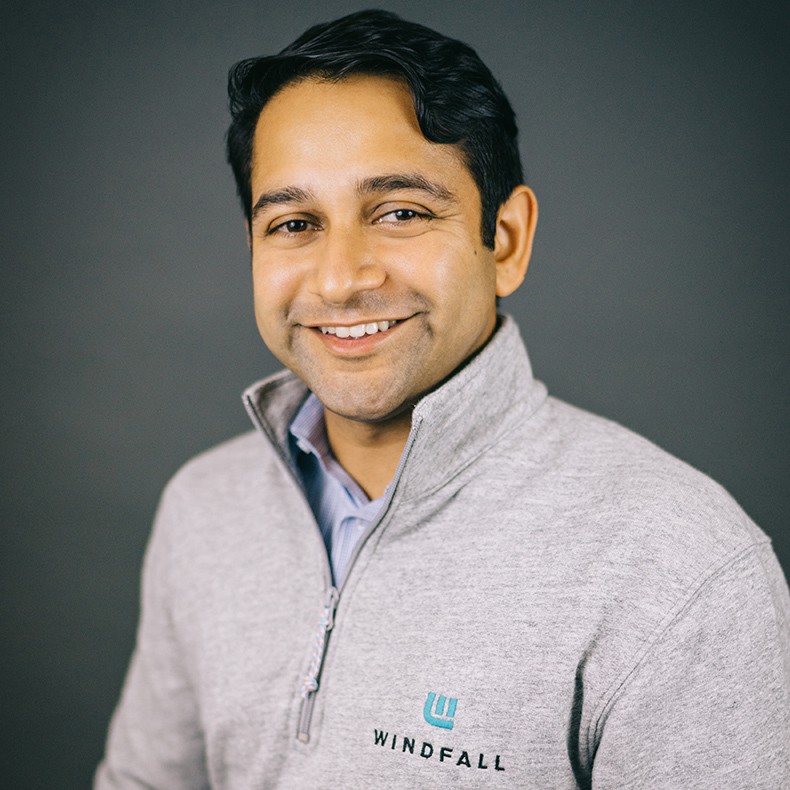
A data problem hiding in plain sight
Before there was Windfall, there was a gap. Not a subtle one - a 50% accuracy rate across the consumer data that nonprofits, financial firms, and enterprises were paying good money to trust. Deloitte had the numbers. The industry had the problem. And Arup Banerjee had just the right career to see what everyone else was ignoring.
He came out of Duke with a double degree in Computer Science and Economics - two disciplines that, when combined, keep asking the same question: how do you make a decision when the input data is wrong? After two years at Citi in investment banking, then three years as a venture associate at Updata Partners, then an MBA at Berkeley Haas, he arrived at GoodData as a Senior Product Manager in 2013. Cloud-based business intelligence. Analytics at scale. The gears were turning.
Radius Intelligence was where things crystallized. As SVP of Product at this B2B predictive marketing company, he scaled the product team to 10 PMs, oversaw data, application, and analytics end-to-end, and drove 400% year-over-year revenue growth. Radius had raised over $125 million. It was a masterclass in what happens when you put institutional-grade data infrastructure behind sales and marketing. Banerjee absorbed every lesson.
"Even with like one of our investors, this is the extreme example, told me that they did five different ways of calculating their wealth. And the disparate like the range was like $50 million."- Arup Banerjee, World of DaaS Podcast, November 2024
What happens when wealth data actually works
In 2016, Banerjee co-founded Windfall alongside Cory Tucker (CTO) and Dan Stevens (COO). The premise was straightforward: build a people intelligence platform that could estimate the net worth of every American - not with stale approximations, but with deterministic data algorithms refreshed weekly.
The nonprofit sector became an early proving ground. Organizations trying to identify high-value donors were working with wealth screens that were years out of date and half wrong. Windfall showed them something different: net worth modeling that updated continuously, household-level insights that went beyond income estimates, and predictive AI that told fundraisers not just who was wealthy but who was likely to give.
The company grew 500% in its first three years. That trajectory wasn't built on novelty - it was built on accuracy. When your product's core value proposition is "the data you're currently using is wrong, and here's proof," early traction depends entirely on the proof holding up. It did.
Net worth as a data product
Windfall operates in a category it helped define: people intelligence. The platform delivers three things that most data vendors can't combine: accurate net worth estimates at the household level, predictive AI that scores likelihood to engage or donate, and generative AI tools that activate those insights across CRM systems, marketing channels, and sales workflows.
The customer base spans two distinct worlds. On the nonprofit side, Windfall helps organizations find philanthropic donors, understand giving capacity, and prioritize outreach at scale. On the commercial side, enterprises use the platform for high-net-worth individual identification, customer segmentation, and personalized outreach campaigns. The common thread is wealth data that behaves like a living document rather than a static report.
What makes this hard isn't the AI layer - it's the data foundation. Windfall builds on deterministic data algorithms rather than probabilistic guesses. The difference shows up in that 50% accuracy stat: when Banerjee talks about existing consumer wealth data being unreliable, he's not talking about edge cases. He's describing the baseline everyone else calls acceptable.
The path that made this possible
Morgan Stanley writes the check
In April 2025, Windfall closed a $65 million Series B led by Morgan Stanley Expansion Capital - bringing total funding to over $95 million. That's not venture capital looking for an exit. That's an institutional expansion bet. Morgan Stanley Expansion Capital backs companies with demonstrated revenue growth and clear paths to category leadership.
The round signals something beyond the capital: Windfall's people intelligence category has institutional-grade validation. When a firm with Morgan Stanley's brand writes a $65 million check into a data platform serving nonprofits and enterprises alike, the market is saying the data problem Banerjee identified in 2016 is real, large, and worth solving at scale.
Real data on the ultra-wealthy
In November 2024, Banerjee joined Auren Hoffman's World of DaaS podcast for a 46-minute conversation on wealth data accuracy, data co-ops, predictive AI, and why net worth estimation is harder than it looks - even for the ultra-wealthy themselves.
Standing at the intersection of wealth and AI
Banerjee keynoted the 2021 AHP International Conference and spoke at the APRA Prospect Development Conference on "State of Consumer Wealth & How to Engage with High-Net-Worth Individuals" - audiences that work in institutional philanthropy and prospect research, where bad wealth data costs real money in missed donations and wasted outreach.
His speaking portfolio spans AI, business leadership, data, and entrepreneurship. The through-line in every appearance is the same argument he made when he founded Windfall: the data you're relying on is probably wrong, and that matters more than you think.
The RAISE podcast episode with EverTrue gets at something more personal - how he came to this problem not just through product work, but through recognizing that nonprofits were flying blind with tools that hadn't fundamentally changed in decades. That conversation traces the arc from investment banking to people intelligence platform, and it's a sharper version of the founder story than any press release.
What doesn't make the press release
His Duke double-major in CS and Economics is almost too perfect a setup for a company that uses computer science to answer economic questions about every American.
Windfall refreshes its net worth data every week. Most wealth data vendors update annually. That cadence gap is what makes fundraising and sales intelligence feel like two different industries.
The company name itself is a tell: a "windfall" is unexpected financial gain. That's exactly what Windfall's clients are supposed to find in their customer and donor lists.
On the World of DaaS podcast, he shared that an investor calculated their own net worth five different ways and got answers that ranged by $50 million - the problem Windfall exists to solve, illustrated by someone with the resources to know better.